
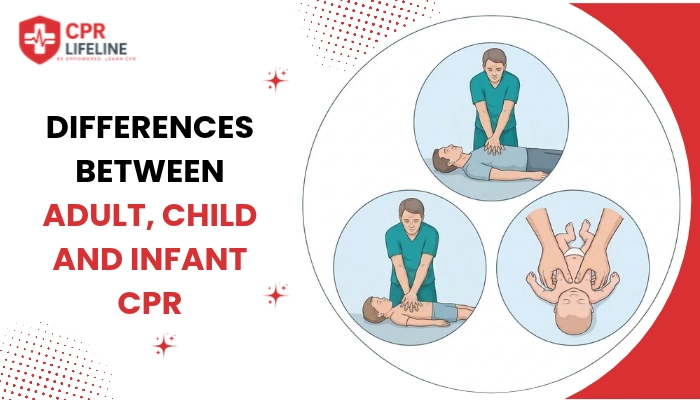


CPR techniques must be adapted to the patient’s age, as infants, children, and adults require different approaches. Although the main goal of CPR is to maintain blood circulation and deliver oxygen to vital organs, the techniques used for infants, children, and adults differ because of differences in body size, physical development, and the causes of cardiac arrest.
Infant, child, and adult CPR differ in compression depth, hand placement, compression-to-breath ratios, and rescue breathing techniques. Infants require compressions about 1.5 inches (4 cm) deep using the two-thumb encircling-hands technique or the heel of one hand, while children need compressions about 2 inches (5 cm) deep using one or two hands, depending on their size. Adults require two-handed compressions at least 2 inches (5 cm) deep. The compression-to-breath ratio also changes for infants and children when two rescuers are present, from 30:2 to 15:2. Rescue breaths are particularly important for infants and children because cardiac arrest often follows breathing problems.
This blog compares infant, child, and adult CPR, covering differences in chest compression depth and hand placement, rescue breathing techniques, compression-to-breath ratios, AED use, and age-specific resuscitation guidelines.
Why Is Infant and Child CPR Different from Adult CPR?
Although infant, child, and adult CPR follow the same basic principles, the techniques differ to accommodate variations in physical development, breathing needs, and the causes of cardiac arrest. These differences affect how rescuers deliver chest compressions, provide rescue breaths, and respond to cardiac emergencies.
The following factors explain why CPR techniques vary across age groups.
1. Body Size and Chest Structure
Adults have larger chests, more developed bones and surrounding tissues, while infants have smaller, more flexible chest walls and developing ribs, making their bodies more vulnerable to injury from excessive pressure. Applying too much force on infants and children during CPR can damage the ribs and underlying organs, including the lungs and liver. This is why chest compressions must be adjusted to the patient’s age and size to provide effective circulation while reducing the risk of injury.
2. Airway Anatomy and Breathing Needs
Infants have narrower airways and softer airway structures than adults, making airflow more easily restricted by swelling, secretions, or incorrect head positioning. Their smaller lungs also require less air during rescue breathing. Tilting an infant’s head too far backward can narrow the airway, while delivering excessive air can cause lung injury or force air into the stomach.
3. Causes of Cardiac Arrest
In adults, cardiac arrest most often results from a sudden heart problem, such as an abnormal heart rhythm. In infants and children, breathing-related causes play a much larger role. A 2026 US registry study of more than 10,000 pediatric out-of-hospital cardiac arrests found that 37.3% had a respiratory cause and 10.0% were due to drowning, while 43.3% were presumed to be cardiac. Since many of these arrests follow a breathing emergency, a child or an infant may already be short of oxygen by the time the heart stops, which is why recognizing breathing problems early matters. It is also why CPR that includes rescue breaths is particularly important for infants and children.
4. Differences in Oxygen Requirements and Reserves
Infants consume more oxygen relative to their body weight than adults and have lower oxygen reserves in their lungs. When breathing stops or becomes inadequate, their oxygen levels can fall rapidly, leaving less time before vital organs are affected. This makes breathing emergencies particularly dangerous for infants and increases the need for quick recognition and treatment before the condition progresses to cardiac arrest.
Key Differences Between Infant, Child and Adult CPR
The following table summarizes the main differences between infant CPR, child CPR and adult CPR, based on current basic life support recommendations.
CPR Feature | Infant CPR | Child CPR | Adult CPR |
Age group | Under 1 year, excluding newborn resuscitation at birth | Approximately 1 year until puberty | Puberty and older |
Compression depth | About 1.5 inches (4 cm) | About 2 inches (5 cm) | At least 2 inches (5 cm), not exceeding 2.4 inchrate es (6 cm). |
Hand placement | Heel of one hand or two-thumb encircling-hands technique | One or two hands, depending on size | Two hands, one over the other |
Compression rate | 100 to 120 per minute | 100 to 120 per minute | 100 to 120 per minute |
Single-rescuer ratio | 30 compressions to 2 breaths | 30 compressions to 2 breaths | 30 compressions to 2 breaths |
Two-rescuer ratio | 15 compressions to 2 breaths | 15 compressions to 2 breaths | 30 compressions to 2 breaths |
Rescue breaths | Particularly important | Particularly important | Included in conventional CPR; compression-only CPR is an option in certain circumstances |
AED use | Use pediatric pads or an attenuator if available | Use pediatric pads or an attenuator if available | Use adult pads as directed |
The main differences between infant, child and adult CPR involve compression depth, hand placement and rescue breaths. While the recommended compression rate remains 100 to 120 per minute across all age groups, the compression-to-breath ratio varies for pediatric CPR depending on the number of rescuers. These recommendations apply to conventional CPR without an advanced airway. When an advanced airway is in place, such as an endotracheal tube or supraglottic airway, rescuers continue chest compressions without pausing to give breaths.
Step-by-Step Guide to Performing CPR on Different Age Groups
Performing CPR involves a series of steps to support breathing and circulation when a person experiences cardiac arrest. But the approach varies for infants, children and adults, particularly when checking responsiveness, delivering chest compressions and providing rescue breaths.
The following steps explain how to perform CPR step by step for each age group:
Step 1: Check the Scene and Responsiveness
Before approaching the person, you should make sure the surroundings are safe. For an adult or child, tap the shoulder gently and shout to check for a response. For an infant, gently tap the bottom of the foot. If the person is unresponsive and is not breathing normally or is only gasping, suspect cardiac arrest. A lay rescuer should not delay CPR to check for a pulse.
Step 2: Call Emergency Services
Call 911 immediately or ask someone nearby to call and bring an automated external defibrillator (AED). If you are alone, use your phone’s speaker mode so you can follow the emergency dispatcher’s instructions while preparing to begin CPR.
Step 3: Begin Chest Compressions
You should place the person on their back on a firm, flat surface whenever possible. Start compressions using the appropriate technique for their age.
For infants:
- Use the heel of one hand or the two-thumb encircling-hands technique to compress the breastbone.
- Compress the chest at least 1.5 inches (4 cm), or about one-third of the chest’s depth.
- Maintain a rate of 100 to 120 compressions per minute
The 2025 AHA and AAP Pediatric Basic Life Support Guidelines recommend the two-thumb encircling-hands technique for infant chest compressions when the rescuer can encircle the infant’s chest. If this is not possible, use the heel of one hand. The guidelines no longer recommend the two-finger technique because it may not achieve adequate compression depth.
For children:
- Place the heel of one or both hands on the lower half of the breastbone.
- Compress the chest about 2 inches (5 cm), or one-third of the chest’s depth.
- Compress at a rate of 100 to 120 compressions per minute, allowing the chest to recoil fully after each compression.
For adults:
- Place the heel of one hand on the center of the chest, over the lower half of the breastbone.
- Place your other hand on top and interlock your fingers.
- Keep your arms straight and position your shoulders directly above your hands.
- Compress 2 inches (5 cm) deep, avoiding depths greater than 2.4 inches (6 cm), at 100 to 120 compressions per minute.
For all age groups, you should maintain proper hand placement, avoid unnecessary interruptions and allow the chest to return to its normal position after each compression.
Step 4: Provide Rescue Breaths
Rescue breaths deliver oxygen to the lungs during CPR. For conventional CPR without an advanced airway, you should give each breath over approximately one second, using enough air to make the chest visibly rise. Avoid excessive ventilation, as it can interfere with circulation.
The airway-opening process, rescue breathing technique, and compression-to-breath ratio vary depending on the person’s age and the number of rescuers.
- For infants: Keep the head in a neutral position to maintain an open airway. If possible, cover both the infant’s mouth and nose with your mouth to form a gentle seal. Use a ratio of 30 compressions to 2 breaths with one rescuer or 15 compressions to 2 breaths with two rescuers.
- For children: Use a head-tilt/chin-lift to open the airway without overextending the neck. Pinch the nose closed and seal your mouth over the child’s mouth. Use a ratio of 30 compressions to 2 breaths with one rescuer or 15 compressions to 2 breaths with two rescuers.
- For adults: Use a head-tilt/chin-lift to open the airway, pinch the nose closed and seal your mouth over the person’s mouth. Use a ratio of 30 compressions to 2 breaths, regardless of the number of rescuers.
If you cannot or are unwilling to provide rescue breaths, hands-only CPR is still better than doing nothing. For infants and children, CPR that includes rescue breaths is recommended whenever feasible.
Step 5: Use an AED as Soon as Possible
An automated external defibrillator (AED) checks the heart’s rhythm and determines whether an electric shock is needed. You should follow the device’s voice prompts, ensure nobody touches the person during rhythm analysis or shock delivery, and resume CPR immediately when instructed.
- For infants and children: Use pediatric pads or a pediatric dose attenuator, if available. If neither is available, use an AED with adult pads rather than delaying defibrillation. Follow the pad placement diagrams and ensure the pads do not touch each other.
- For adults: Use standard adult AED pads on the bare chest, following the placement diagrams provided with the device. Ensure the pads do not touch each other.
Continue following the AED instructions until emergency medical services arrive or the person shows signs of recovery.
Step 6: Continue CPR Until Help Arrives
You should continue CPR and follow the AED’s instructions until emergency responders take over, the person shows clear signs of life and is breathing normally, the scene becomes unsafe, or you are physically unable to continue.
If other trained rescuers are available, switch the person performing compressions approximately every two minutes when possible. Switching rescuers helps to reduce fatigue and maintain compression quality.
Why Proper CPR Training Matters for All Ages
Understanding CPR is important, but reading about the techniques alone does not provide the practical experience needed to respond effectively during an emergency. Hands-on training helps rescuers develop the skills and confidence required to provide appropriate care.
Here are some of the key benefits of proper CPR training for people who may need to respond to emergencies:
1. Develops Correct CPR Skills
Practical training allows participants to practise hand placement, compression depth, compression rate, chest recoil and rescue breaths on age-appropriate training manikins. This is particularly valuable for infant and child CPR, where the compression technique must be adapted to the patient’s size.
2. Builds Confidence During Emergencies
Emergencies can be stressful, and uncertainty may delay action. CPR training helps participants recognize cardiac arrest, contact emergency services and begin appropriate resuscitation promptly.
3. Prepares Parents and Caregivers
Parents, babysitters, teachers and childcare providers may be the first people present when an infant or child experiences a breathing emergency. Pediatric CPR training helps caregivers understand the correct response, including the importance of rescue breaths and the differences between infant and child CPR.
4. Supports Workplace and Community Safety
Schools, childcare centers, healthcare facilities, gyms and workplaces can benefit from having trained first responders and access to AEDs. CPR training also helps organizations establish emergency response plans and ensure that people understand their responsibilities during a medical emergency.
5. Keeps Knowledge Up to Date
CPR recommendations can change as new evidence becomes available. Refresher training helps people maintain their skills and learn updated techniques. CPR certification typically remains valid for two years, after which renewal is required to maintain current certification. Choose a recognized CPR training provider and follow the certification and renewal requirements applicable to your course and location.
CPR Techniques Vary Across Different Age Groups
CPR for infants, children, and adults differs in compression depth, hand placement and rescue breathing techniques. Infant CPR requires compressions of about 1.5 inches (4 cm), while child and adult CPR require deeper compressions based on chest size. Rescue breaths are particularly important for infants and children because cardiac arrest often follows a breathing problem. The compression-to-breath ratio also changes during pediatric CPR when two rescuers are present. Applying these age-specific techniques helps deliver appropriate chest compressions and support oxygen delivery during a cardiac emergency.
Using the correct CPR techniques is essential during a cardiac emergency, and practical training helps turn these skills into action. CPR Lifeline offers AHA certification courses, including CPR, BLS, ACLS and PALS. Participants can develop the practical skills needed to respond to emergencies with flexible learning options that combine online coursework and in-person skills practice.
Faqs

Chris Peters
Chris Peters is a certified American Heart Association instructor and firefighter since 1996 with over 30 years of emergency response experience. After answering thousands of 911 calls, he founded CPR Lifeline to provide AHA-certified training that transforms bystanders into confident lifesavers who act decisively when seconds count