

Sudden cardiac arrest kills nearly 350,000 people outside of hospitals in the United States each year, and survival depends almost entirely on what happens in the first few minutes. Most bystanders become unsure whether to act without training, afraid of doing something wrong, or convinced rescue breaths are required. That hesitation costs someone’s lives.
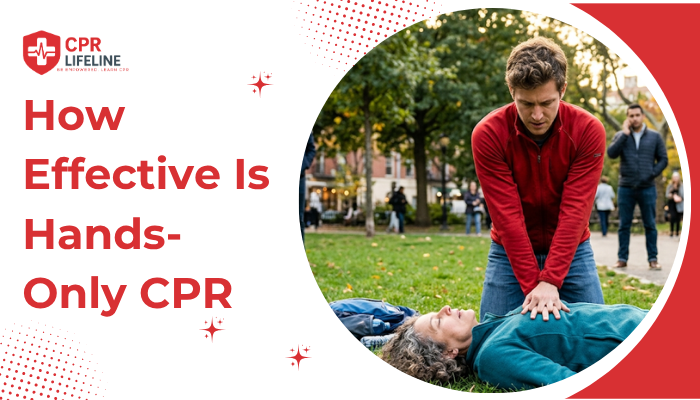
Hands-only CPR is effective for adults who collapse from sudden cardiac arrest. Continuous chest compressions without rescue breaths can be just as effective as conventional CPR in the critical minutes before emergency responders arrive. The American Heart Association endorses hands-only CPR as a valid first response for untrained bystanders witnessing adult cardiac arrest.
This blog explains what hands-only CPR is, how it compares to traditional CPR, when to use it, and how to perform it correctly. It also covers its limitations and what you can do now to prepare before a cardiac emergency happens.
What Is Hands-Only CPR and How Does It Work?
Hands-only CPR is compression-only cardiopulmonary resuscitation. In this CPR technique, continuous chest compression without rescue breath is performed to keep blood moving through the body during cardiac arrest. When the heart stops beating, it can no longer deliver oxygenated blood to the brain and vital organs. Chest compressions recreate this pumping motion so blood circulates to vital organs and the rest of the body. At the moment of cardiac arrest, the lungs still hold a reserve of oxygen, which means rescue breaths are not immediately necessary. The AHA emphasizes chest compressions over rescue breaths because minimizing interruptions to compressions is a key part of delivering high-quality CPR, and the circulation of oxygen to vital organs is more important than delivering more oxygen to the victim.
This CPR technique is specifically designed for sudden cardiac arrest, a condition that people frequently confuse with a heart attack, though the two are quite different. While a heart attack is a circulation problem caused by a blocked artery, sudden cardiac arrest is an electrical problem where the heart abruptly stops beating altogether. Because cardiac arrest immediately halts all blood flow, hands-only CPR serves as the vital temporary pump needed to keep the victim alive. This manual circulation is the ideal immediate response for adults who suddenly collapse and become unresponsive. However, the AHA notes that standard CPR with both compressions and breaths is still recommended for infants, children, or victims of drowning, drug overdose, and respiratory failure, where oxygen reserves are already depleted.
How Effective Is Hands-Only CPR Compared With Traditional CPR?
For adult sudden cardiac arrest occurring outside a hospital, hands-only CPR can be as effective as conventional CPR during the first few minutes before emergency responders arrive. In the initial minutes of cardiac arrest, oxygen levels in the blood remain high enough that continuous chest compressions alone can sustain circulation to the brain and vital organs without the immediate addition of rescue breaths. This window is where hands-only CPR delivers its greatest value, and acting within it is what determines whether the victim survives with neurological function intact.
Multiple studies published in peer-reviewed journals including the New England Journal of Medicine have found no statistically significant difference in survival outcomes between hands-only CPR and conventional CPR for witnessed adult sudden cardiac arrest. The American Heart Association endorses hands-only CPR as an effective option for untrained bystanders specifically because the evidence shows that immediate action with compressions alone outperforms delayed action caused by hesitation around rescue breaths. What matters most in those first minutes is not perfect technique. It is the decision to start compressions without delay and maintain them consistently until emergency medical services arrive.
When Should You Use Hands-Only CPR in an Emergency?
Hands-only CPR is appropriate in specific emergency situations. Knowing exactly when to apply it helps you respond with confidence and avoid using the wrong technique for the wrong emergency.
- Witnessed Adult Collapse: Hands-only CPR is the correct immediate response when an adult suddenly collapses, becomes unresponsive, and stops breathing normally in front of you. Start compressions immediately and call 911 or direct someone nearby to call without delay.
- Public Space Emergencies: Cardiac arrest in airports, shopping centers, gyms, offices, and other public spaces are situations where bystander hands-only CPR has the greatest impact. AEDs are more likely to be accessible in these settings, making the combination of immediate compressions and early defibrillation highly achievable.
- Workplace Emergencies: Many workplaces require emergency action plans that include CPR response. Hands-only CPR is an appropriate first response for any adult employee or visitor who collapses and shows signs of cardiac arrest while waiting for emergency medical services to arrive.
- Untrained Rescuers: Hands-only CPR removes the barrier of rescue breaths, making it the most practical option for bystanders without formal CPR training. Emergency dispatchers can also provide real-time guidance over the phone to help untrained rescuers perform compressions correctly.
- When Rescue Breaths Feel Unsafe or Uncomfortable: Hands-only CPR is a recognized and evidence-backed alternative when a rescuer is unwilling or unable to perform mouth-to-mouth breathing. Continuous compressions alone are always better than no intervention at all.
What Are the Survival Benefits of Immediate Hands-Only CPR?
The significant survival benefit of hands-only CPR is time. Brain damage begins within four to six minutes of cardiac arrest, and the probability of survival decreases by seven to ten percent for every minute that passes without intervention. Immediate chest compressions preserve oxygenated blood flow to the brain and vital organs, delaying the irreversible damage that makes survival impossible. According to the American Heart Association, bystander CPR can double or triple a cardiac arrest victim’s chance of survival compared to receiving no intervention before emergency medical services arrive.
Bystander intervention rates have a measurable impact on community-wide cardiac arrest survival outcomes. Communities with higher rates of bystander CPR consistently report better survival statistics than those where bystanders wait for professional help without acting. Research published in the journal Circulation found that survival rates for out-of-hospital cardiac arrest are significantly higher when CPR begins before EMS arrival, regardless of whether the bystander is formally trained. Every person who learns hands-only CPR represents a potential first responder in their workplace, neighborhood, or home. Understanding why bystander CPR matters in the broader context of cardiac arrest survival reinforces why acting immediately, even imperfectly, is always better than not acting at all.
How to Perform Hands-Only CPR Step by Step
The steps of CPR may be simple to learn, but performing them in the correct order is essential for hands-only CPR to be effective. Preparation and speed matter more than perfection. Follow these steps exactly as listed the moment you recognize a cardiac arrest emergency.
- Confirm the scene is safe before approaching. Do not put yourself at risk by entering an unsafe environment.
- Check for responsiveness by tapping the person’s shoulders firmly and shouting. Look for normal breathing for no more than 10 seconds. Treat gasping as a sign of cardiac arrest.
- Call 911 immediately or point to a specific person nearby and instruct them to call. Request an AED at the same time if one is available.
- Kneel beside the person and place the heel of your dominant hand on the center of the chest, directly on the lower half of the sternum.
- Place your other hand on top and interlace your fingers. Keep your arms straight and position your shoulders directly above your hands.
- Push hard and fast, compressing at least 2 inches deep at a rate of 100 to 120 compressions per minute. The beat of “Stayin’ Alive” by the Bee Gees matches this rate closely and can help you maintain the correct pace.
- Allow full chest recoil between each compression without lifting your hands off the chest.
- Use an AED as soon as one becomes available and follow the device prompts without pausing compressions any longer than necessary.
- Continue without stopping until emergency services arrive, the AED instructs you to pause, or the person shows clear signs of recovery.
What Are the Limitations of Hands-Only CPR?
Hands-only CPR is a powerful technique, but it has clear boundaries. Understanding where those boundaries lie helps rescuers make better decisions in emergencies where compression-only CPR may not be enough. Applying the wrong approach in the wrong situation can reduce the victim’s chances of survival just as much as not acting at all.
Not Appropriate for Pediatric Emergencies
Cardiac arrest in infants and children most commonly results from breathing failure rather than a sudden electrical problem in the heart. By the time the heart stops in a pediatric patient, the body is already oxygen-depleted, making rescue breaths a required component of high-quality CPR rather than an optional one. Hands-only CPR does not address that oxygen deficit and should not be used as the primary response for cardiac arrest in patients under 18.
Less Effective in Oxygen-Deprivation Emergencies
Drowning, drug overdose, choking, and respiratory arrest all involve oxygen depletion as the primary cause of collapse. In these emergencies, the bloodstream is already critically low in oxygen before cardiac arrest occurs, and continuous compressions alone cannot restore adequate oxygen levels. Conventional CPR combining compressions and rescue breaths is the appropriate response in each of these situations.
Compression Quality Declines With Fatigue
Hands-only CPR places the full physical demand of resuscitation on the rescuer without the natural break that rescue breaths provide in conventional CPR. Compression depth and rate begin to decline within the first few minutes as rescuer fatigue sets in. Rotating to a second rescuer every two minutes wherever possible maintains compression quality and keeps hands-only CPR effective throughout the response.
AED Availability Remains Critical
Hands-only CPR sustains circulation but cannot correct the underlying electrical malfunction causing cardiac arrest in most cases. An AED is still required to deliver the shock that restores a normal heart rhythm. Without access to a defibrillator, even high-quality hands-only CPR has significant limitations in achieving return of spontaneous circulation. Knowing where the nearest AED is located in your workplace or community is just as important as knowing how to perform compressions. Learning how to use an AED alongside CPR ensures you are prepared to deliver a complete emergency response, not just one part of it.
The Best CPR Is the One You Actually Do
Hands-only CPR is not a compromise. It is an evidence-based, AHA-endorsed response that has saved countless lives in the hands of bystanders who had no formal training but chose to act anyway. Research shows that immediate chest compressions, even when not perfect, are far better than hesitation every time. Recognizing cardiac arrest, calling 911, and starting compressions without delay are three actions anyone can take, and together they form the difference between a victim who survives and one who does not.
Knowing how to respond confidently starts with proper training. CPR Lifeline offers flexible, AHA-certified CPR, BLS, ACLS, and PALS courses designed for both healthcare professionals and everyday individuals. The skills you build in a hands-on training environment are the ones that carry over when an emergency removes every second of thinking time. Visit CPR Lifeline to find a course near you and make sure you are prepared before the moment demands it.
Faqs
Hands-only CPR is a life-saving technique that uses continuous chest compressions without rescue breaths to maintain blood circulation during sudden cardiac arrest. It is recommended by the American Heart Association as an effective option for untrained bystanders responding to adult cardiac arrest.
Yes, for witnessed adult sudden cardiac arrest occurring outside a hospital. Research shows that hands-only CPR produces survival outcomes comparable to conventional CPR during the first few minutes before emergency medical services arrive. For oxygen-deprivation emergencies like drowning or drug overdose, conventional CPR with rescue breaths remains the appropriate response.
Hands-only CPR should be used when an adult suddenly collapses, becomes unresponsive, and stops breathing normally. It is appropriate in public spaces, workplaces, and home settings, particularly when the rescuer is untrained or uncomfortable performing rescue breaths.
Hands-only CPR is not appropriate for infants, children, drowning victims, drug overdose cases, or anyone experiencing a breathing-related emergency. These situations require conventional CPR that includes rescue breaths because oxygen depletion is the primary cause of collapse.
Compressions should be delivered at a rate of 100 to 120 per minute, at least 2 inches deep, in the center of the chest. The beat of "Stayin' Alive" by the Bee Gees closely matches this rate and can help maintain the correct pace during a real emergency.
Continue hands-only CPR without stopping until emergency medical services arrive and take over, an AED becomes available and delivers a shock, or the person shows clear signs of recovery. Stopping too early is one of the most common and consequential mistakes in bystander CPR.
No. Hands-only CPR maintains blood circulation but cannot correct the electrical malfunction causing cardiac arrest. An AED is required to deliver the shock that restores a normal heart rhythm. CPR and AED work together as part of the same emergency response.
No formal training is required to perform hands-only CPR, and emergency dispatchers can guide untrained bystanders through the process in real time. However, formal CPR training significantly improves compression quality, builds confidence, and prepares you to respond effectively without hesitation in a real emergency.

Chris Peters
Chris Peters is a certified American Heart Association instructor and firefighter since 1996 with over 30 years of emergency response experience. After answering thousands of 911 calls, he founded CPR Lifeline to provide AHA-certified training that transforms bystanders into confident lifesavers who act decisively when seconds count