


Rescuers should switch positions approximately every 2 minutes, or after five cycles of CPR, to reduce fatigue and maintain high-quality chest compressions. Most people assume they can perform CPR at full strength for as long as it takes for help to arrive. That assumption is wrong, and it can cost a life. Compression quality starts to decline within the first one to two minutes, often before the rescuer even feels tired.
Following the timing guidelines set by the American Heart Association is what keeps compressions effective throughout a prolonged resuscitation effort. Switching rescuers at the right interval, with the right technique, prevents the drop in compression depth and rate that fatigue causes.
Learn exactly when to switch positions, why the 2-minute interval matters, how to execute a smooth transition, and the common mistakes that compromise CPR quality during rescuer rotation.
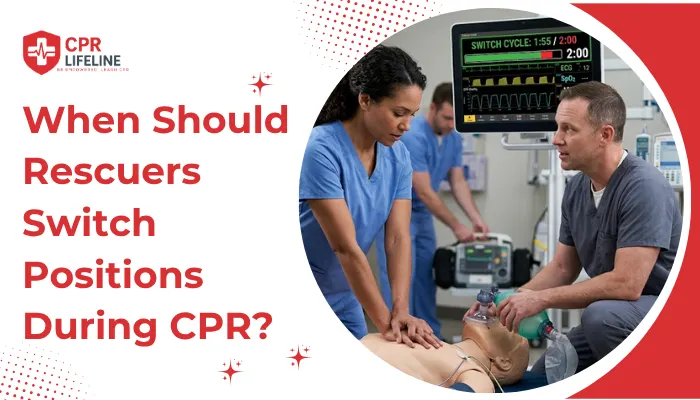
When Should Rescuers Switch Positions During CPR?
Rescuers should switch positions every 2 minutes, or after about five cycles of CPR, during rhythm analysis or another brief interruption. Frequent switching reduces fatigue and helps maintain compression depth, rate, and effectiveness throughout the resuscitation effort. The American Heart Association builds this interval directly into its CPR guidelines because it aligns with the natural point at which compression quality begins to decline. A standard CPR cycle consists of 30 compressions followed by 2 rescue breaths, and five completed cycles take approximately 2 minutes to perform at the recommended rate.
Timing and technique shift depending on how many rescuers are present and who they are treating. In two-rescuer CPR, the second rescuer prepares to take over compressions while the first approaches the 2-minute mark, allowing the switch to happen with minimal delay. In single-rescuer CPR, no switch is possible, which makes maintaining consistent technique even more important since fatigue cannot be offset by rotation. Pediatric CPR follows the same 2-minute interval, though rescuers must also coordinate ventilation timing more closely due to the different compression-to-breath ratios used in children and infants. Regardless of the situation, the switch itself should happen quickly. Learning how to perform CPR correctly from the start makes rescuer rotation feel like a natural extension of the technique rather than a disruption to it.
Why Do Rescuers Switch Every 2 Minutes?
Compression quality deteriorates faster than most rescuers expect. Studies referenced by the American Heart Association show that compression depth begins to decline within the first one to two minutes of CPR, even when the rescuer feels physically capable of continuing. The muscles used during chest compressions, primarily the shoulders, arms, and core, fatigue rapidly under the sustained effort required to deliver compressions at the correct depth of at least two inches for adults. That fatigue produces shallower compressions, an inconsistent rate, and incomplete chest recoil, all of which reduce the amount of oxygenated blood reaching the brain and vital organs.
Smooth, fast transitions between rescuers are just as important as the timing of the switch itself. A transition that takes longer than five seconds creates an unnecessary pause in blood flow that compounds the damage already caused by the cardiac arrest. The International Liaison Committee on Resuscitation reinforces that minimizing interruptions to chest compressions is one of the highest priorities in resuscitation quality. Understanding the components of high-quality CPR makes it clear that compression depth, rate, recoil, and minimal interruptions are all interdependent. Losing any one of them through fatigue or a slow transition reduces the overall effectiveness of the entire resuscitation effort.
How to Switch Positions During CPR Without Interrupting Compressions
A rescuer switch that takes longer than five seconds is a switch that reduces survival odds. The goal is a seamless handoff that the patient’s heart never notices. Preparation is what makes that possible. The incoming rescuer must be in position and ready to take over before the current rescuer stops, not after. Clear verbal communication between rescuers during the final compression cycle is what closes the gap between a smooth transition and a disruptive one.
Follow these steps to execute a clean rescuer switch without interrupting compressions:
- Step 1. Anticipate the switch early: The incoming rescuer moves into position beside the patient before the 2-minute mark arrives. Do not wait for the current rescuer to stop before moving into place.
- Step 2. Signal the transition verbally: The current rescuer counts down the final five compressions aloud so the incoming rescuer knows exactly when to take over. Clear communication removes hesitation from the handoff.
- Step 3. Time the switch to a natural pause: Execute the switch during AED rhythm analysis, a ventilation pause, or the transition between compression cycles. Never interrupt an active compression cycle to switch.
- Step 4. Place hands immediately: The incoming rescuer places hands on the correct position at the center of the chest, the moment the current rescuer lifts away. There should be no gap between the last compression of one rescuer and the first of the next.
- Step 5. Resume at the correct rate immediately: Begin compressions at 100 to 120 per minute without pausing to recheck hand placement or adjust position. Correct positioning should be confirmed during the preparation step, not after the switch.
- Step 6. Confirm compression quality: The rescuer who just stepped back monitors the incoming rescuer’s depth and rate and provides immediate feedback if either drops below standard.
Practicing rescuer rotation during a certified course is the only way to make this sequence feel automatic under pressure.
CPR Compression Quality Standards Every Rescuer Should Know
High-quality CPR is defined by five measurable standards that apply regardless of the rescuer’s experience level or the setting in which the emergency occurs. Meeting all five consistently throughout a resuscitation effort is what separates effective CPR from compressions that simply look correct. Knowing these standards before an emergency means you can self-monitor during compressions and recognize when fatigue is beginning to affect your performance, which is the clearest signal that a rescuer switch is due.
The five core compression quality standards are:
- Compression rate: Deliver compressions at a rate of 100 to 120 per minute for both adults and children. Rates below 100 reduce blood flow, and rates above 120 reduce compression depth by shortening the time available for full chest recoil between compressions.
- Compression depth: Compress the chest at least two inches for adults and at least one-third of the chest diameter for children and infants. Shallow compressions fail to generate adequate pressure to move blood through the circulatory system effectively.
- Full chest recoil: Allow the chest to fully rise between every compression. Leaning on the chest between compressions prevents the heart from refilling with blood and reduces the volume pumped with each cycle.
- Minimal interruptions: Keep pauses in chest compressions to under ten seconds except during AED rhythm analysis or airway management. Maintaining a chest compression fraction above 80 percent is a direct indicator of resuscitation quality, and understanding when rescuers should pause compressions helps every rescuer protect that number.
- Correct hand placement: Place the heel of one hand on the center of the chest, directly on the lower half of the sternum, with the second hand on top. Incorrect placement reduces compression effectiveness and increases risk of injury.
A rescuer who can track these five standards and recognize when fatigue is affecting performance knows exactly when to call for a switch. Effective self-monitoring combined with supportive communication from team members keeps compression quality high throughout the resuscitation effort.
Rescuer Switching in Different CPR Scenarios
Two-Rescuer CPR
Two-rescuer CPR is the most common scenario for team-based resuscitation. One rescuer performs compressions while the second delivers rescue breaths, monitors compression quality, and prepares to switch when the 2-minute interval approaches. The switch is coordinated verbally, with the compressor counting down the final five compressions aloud. Both rescuers move into their new positions during a planned pause, such as rhythm analysis, completing the transition without creating an additional interruption.
Multi-Rescuer Teams
In healthcare or EMS settings with four or more rescuers, rotation can happen faster than every 2 minutes, and multiple rescuers can prepare to cycle into the compressor role in advance. A designated team leader coordinates rotation timing and ensures fresh rescuers are ready to take over without any pause in blood flow. Practiced teams with clear role assignments perform these transitions seamlessly while also managing ventilation, AED operation, medication administration, and documentation without creating a harmful interruption. This coordinated approach is a core component of Basic Life Support training and requires practice to execute smoothly under pressure.
Healthcare Provider Teams
Healthcare teams use compression feedback devices and CPR quality monitors to track rate, depth, recoil, and chest compression fraction in real time. A designated team leader coordinates rotation timing and calls switches based on both the 2-minute interval and live feedback data. Team-based rotation allows compressions to continue almost without interruption throughout an extended resuscitation effort.
Pediatric CPR
Pediatric CPR follows the same 2-minute rotation interval, but rescuers must also coordinate ventilation differences specific to children and infants. Compression technique varies by age group, and the incoming rescuer must be prepared to apply the correct method for the patient’s size immediately after the switch.
CPR During AED Use
AED rhythm analysis creates a natural pause that serves as the ideal moment for a rescuer switch. Both events should be coordinated so that the transition happens during the analysis window rather than creating a second interruption. After the AED delivers a shock or advises no shock, the incoming rescuer begins compressions immediately without waiting for further instruction.
How Proper CPR Rotation Improves Survival and Compression Quality
Proper rescuer rotation directly protects the consistency of every compression quality standard. When compressions remain deep, fast, and uninterrupted, the brain and heart receive a continuous supply of oxygenated blood that buys critical time until defibrillation or advanced care restores a normal rhythm. Without rotation, fatigue degrades that consistency faster than most rescuers anticipate, and the patient pays the price for every compression that falls short of the required depth or rate.
The difference between rotating and not rotating is measurable across every metric that matters:
| Without Rotation | With Rotation |
|---|---|
| Faster fatigue | Reduced fatigue |
| Shallower compressions | Consistent depth |
| Longer pauses | Minimal interruptions |
| Lower CPR quality | Higher-quality CPR |
| Less effective circulation | Improved blood flow |
Teams that practice rotation during training develop the communication habits and muscle memory that make real-world switches fast and automatic.
Maintain High-Quality CPR by Switching at the Right Time
Rescuers should switch positions every 2 minutes, or after approximately five CPR cycles, to maintain effective chest compressions and reduce the impact of fatigue on compression quality. Smooth transitions lasting less than five seconds preserve blood flow and protect the chest compression fraction that determines how effective the overall resuscitation effort is. Every standard covered in this article, from compression depth and rate to full chest recoil and minimal interruptions, depends on rescuers rotating before fatigue has the chance to compromise any one of them.
Knowing the rules is only half of the preparation. Practicing rescuer rotation in a structured training environment is what makes the technique automatic when a real emergency demands it. CPR Lifeline offers AHA-certified CPR and BLS courses across Tennessee and Georgia, where rescuer rotation, team coordination, and compression quality standards are all practiced hands-on. Browse available CPR and BLS certification courses and register for a session that builds the skills your team needs before they are needed.
Faqs

Chris Peters
Chris Peters is a certified American Heart Association instructor and firefighter since 1996 with over 30 years of emergency response experience. After answering thousands of 911 calls, he founded CPR Lifeline to provide AHA-certified training that transforms bystanders into confident lifesavers who act decisively when seconds count