
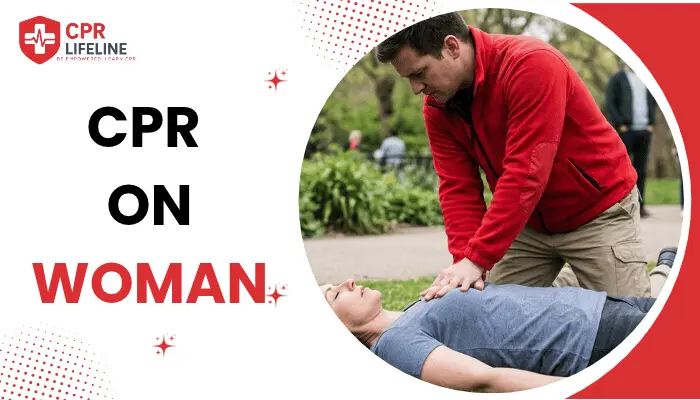

CPR for women follows the same technique as CPR for men. If an adult woman becomes unresponsive and is not breathing normally, you should call 911 and begin chest compressions. Place the heel of one hand on the lower half of her breastbone, put your other hand on top, and push hard and fast at a rate of 100 to 120 compressions per minute. Compress at least 2 inches (5 cm) deep, allowing the chest to return to its normal position after each compression. These steps apply regardless of breast size or body type.
Despite these established guidelines, women are less likely than men to receive bystander CPR in public settings. Some rescuers may feel uncertain about performing chest compressions on a woman’s chest, particularly when they are unfamiliar with how breast anatomy affects hand placement. Others may hesitate because of concerns about exposing the chest or using an AED. Knowing the correct approach can help bystanders respond quickly rather than lose valuable time.
In this blog, you’ll learn how to perform CPR on a woman, where to place your hands, whether a bra needs to be removed, how to position AED pads, and special considerations while performing CPR on a woman.
Why Are Women Less Likely to Receive Bystander CPR?
Although CPR techniques are the same for adult women and men, research shows that women are less likely to receive bystander CPR in public settings. A U.S. study published in the Journal of the American Heart Association analyzed 309,662 out-of-hospital cardiac arrests across 47 states and found that women had 14% lower odds of receiving bystander CPR than men when cardiac arrest occurred in public. Several factors may contribute to this disparity, including concerns about physical contact, exposing the chest, breast anatomy, and causing injury.
Some of the common reasons why bystanders may hesitate to perform CPR on women include:
Fear of Inappropriate Touching
Some bystanders may worry that placing their hands on a woman’s chest could be misunderstood or lead to accusations of inappropriate touching, sexual harassment, or assault, particularly when helping someone they do not know. A 2024 U.S. study published in Circulation: Cardiovascular Quality and Outcomes supports this concern. When respondents considered a male rescuer, 36.2% identified fear of sexual assault or harassment accusations, while 34% identified concerns about inappropriate touching as potential reasons for hesitation.
Concern About Exposing the Breasts
Rescuers may hesitate to move clothing or adjust a bra because they feel uncomfortable exposing a woman’s chest in a public setting. They may also be unsure whether the bra must be removed before using an AED.
The 2025 AHA Guidelines state that adjusting the position of a bra instead of removing it may be reasonable when placing AED pads. The pads must still make proper contact with bare skin. The guidelines also explain that discomfort with exposing a woman’s chest may contribute to lower rates of public-access defibrillation among women.
Uncertainty About Hand Placement
Breast tissue may make some rescuers unsure where to position their hands, particularly if their CPR training used manikins without realistic female anatomy. However, breast size does not change the recommended hand placement. For adult CPR, compressions should be delivered over the lower half of the breastbone, at the center of the chest.
Fear of Causing Injury
Some bystanders worry that chest compressions could damage breast tissue, cause bruising, or break ribs. Although CPR can cause injuries, withholding or delaying CPR during cardiac arrest puts the person’s life at much greater risk. Immediate chest compressions are essential to maintain blood circulation until emergency medical services take over.
Limited Representation in CPR Training Materials
A study published in JAMA Cardiology reviewed 638 online instructional CPR videos and found that only 10 showed a woman receiving CPR. Just four of those videos met the study’s quality criteria, and none specifically addressed barriers to performing CPR on women. This lack of representation may leave important questions about female anatomy, hand placement, and AED use unanswered in common training materials.
How to Perform CPR on a Woman: Step-by-Step Instructions
Recognizing cardiac arrest and starting CPR promptly are the most important actions a bystander can take. The CPR procedure follows the AHA’s adult Basic Life Support (BLS) recommendations, with particular attention to correct hand placement and AED use on a woman.
You should follow these steps to do CPR on a woman:
Step 1: Check Responsiveness and Breathing
Before starting CPR, you should determine whether the woman is responsive and breathing normally. Do not assume that a sudden collapse is simply fainting or exhaustion.
- Check that the surrounding area is safe.
- Tap her shoulders and shout, “Are you okay?”
- Look for normal chest movement and breathing.
- Watch for occasional gasps, irregular snorting, or slow, abnormal breaths.
If she does not respond and is not breathing normally or is only gasping, presume cardiac arrest.
Step 2: Call 911 and Get an AED
Once you suspect cardiac arrest, activate the emergency response system. In the United States, call 911 immediately.
If other people are present, you should assign specific responsibilities:
- Ask one person to call 911 and follow the emergency dispatcher’s instructions.
- Ask another person to locate and bring the nearest AED.
- If you are alone, use your cell phone on speaker mode so you can communicate with the dispatcher while preparing to provide CPR.
Do not delay CPR to search for an AED if you are the only person available to help. Follow the 911 dispatcher’s directions.
Step 3: Position the Woman on Her Back
Position the woman on her back on a firm, flat surface so you can deliver effective chest compressions. Kneel beside her chest, keeping your body close enough to maintain proper hand positioning. Whenever possible, position her torso approximately at the level of your knees. This helps you apply compressions using your upper body weight rather than relying only on your arms.
Step 4: Locate the Correct Hand Placement
Correct hand placement is important when performing CPR on a woman because breast tissue can make the sternum less visible or harder to identify. You should place the heel of one hand in the center of the chest, on the lower half to lower third of the sternum. Place your other hand on top of the first hand and interlock your fingers. Position your shoulders directly above your hands and keep your elbows straight.
Your hands must rest on the breastbone, not on the breasts. If breast tissue obscures the sternum, gently move it aside to locate the correct compression area. Do not place your hands between the breasts simply because that area appears to be the center of the chest. The anatomical landmark is the lower half of the sternum, not the space between the breasts. Breast size does not change the recommended compression location or depth.
Step 5: Perform Chest Compressions at the Correct Rate and Depth
Once your hands are correctly positioned, begin chest compressions. The AHA recommends performing compressions at a rate of 100–120 per minute, with a depth of at least 2 inches (5 cm) while avoiding depths greater than 2.4 inches (6 cm).
For effective chest compressions:
- Push straight down using your upper body weight.
- Keep your elbows straight and shoulders above your hands.
- Compress firmly and consistently.
- Allow the chest to return completely to its normal position between compressions.
- Avoid leaning on the chest between pushes.
- Keep interruptions as short as possible.
Do not reduce compression depth because the woman has larger breasts or because you are concerned about hurting her. The recommended depth is based on adult chest anatomy, not breast size.
Step 6: Provide Rescue Breaths if You Are Trained
If you have CPR training and are willing to provide rescue breathing, use the standard adult 30:2 compression-to-ventilation ratio.
Follow these instructions:
- Perform 30 chest compressions.
- Open the airway using the head-tilt, chin-lift technique.
- Pinch the woman’s nose closed.
- Create a complete seal over her mouth with your mouth.
- Give one breath lasting approximately 1 second, watching for visible chest rise.
- Give a second breath lasting approximately 1 second.
- Immediately resume chest compressions.
Each breath should be sufficient to produce visible chest rise. Avoid giving breaths too quickly or forcefully, as excessive ventilation can interfere with effective resuscitation.
If you are not trained in rescue breathing, you can still help by performing hands-only CPR. The AHA recommends hands-only CPR for members of the general public who witness a teen or adult suddenly collapse outside a hospital.
Step 7: Apply an AED Correctly on a Woman
An AED should be used as soon as it becomes available. It analyzes the heart’s electrical rhythm and determines whether a shock is needed to help restore an effective heartbeat.
The electrode pad positions are the same for women and men. However, breast tissue, bras, and clothing can affect how easily the pads are positioned.
For standard adult anterior-lateral pad placement:
- Turn on the AED and follow its voice instructions.
- Expose the chest sufficiently to position both pads.
- Dry the chest if it is wet.
- Place one pad on the upper right side of the chest, below the collarbone.
- Place the second pad on the left side of the chest, below the armpit, along the mid-axillary line.
- Ensure both pads adhere directly to bare skin.
- Connect the pads if required by the device and allow the AED to analyze the rhythm.
- Make sure nobody is touching the woman during analysis or shock delivery.
- If the AED advises a shock, deliver it as instructed.
- Resume CPR immediately after the shock or when prompted by the device.
The 2025 AHA guidelines introduced an important recommendation stating that it may be reasonable to adjust a woman’s bra instead of removing it when positioning AED pads.
Step 8: Continue CPR Until EMS Arrives
After an AED delivers a shock, immediately resume CPR. If the device does not advise a shock, continue CPR as instructed.
Keep providing care until one of the following happens:
- EMS personnel arrive and take over.
- The woman begins showing signs of life and resumes normal breathing.
- You become physically unable to continue.
- The scene becomes unsafe.
If another trained rescuer is available, switch rescuers approximately every 2 minutes. This helps prevent fatigue and maintain compression quality.
Do not stop CPR simply because the woman has not responded after several minutes. Continue following the AED and emergency dispatcher’s instructions.
Special Considerations When Performing CPR on a Woman
The standard adult CPR technique remains unchanged, but some situations require additional attention. Understanding these circumstances can help rescuers avoid common mistakes and provide appropriate care without delaying compressions.
Below are some important considerations for performing CPR on women with different anatomical or medical circumstances.
Performing CPR on a Woman With Large Breasts
Larger breasts may make it more difficult to identify the sternum, but they do not require a different compression technique. The correct hand placement remains over the lower half of the breastbone. If breast tissue obscures this area, gently move it aside to identify the sternum before positioning your hands.
Place the heel of your hand directly over the breastbone and maintain the recommended adult compression depth and rate. Avoid placing your hands over breast tissue or moving them toward the sides of the chest to avoid contact, as this can result in ineffective compressions.
Performing CPR on a Woman Wearing a Bra
A bra does not prevent you from starting chest compressions. You can begin CPR without removing it, provided you can position your hands directly over the sternum. AED use requires additional attention because the electrode pads must make direct contact with bare skin. Depending on the bra’s design and position, you may need to adjust the straps, move the fabric, or remove the garment if it obstructs pad placement.
You should remember these distinctions:
- During chest compressions: Removing the bra is usually not necessary. Begin compressions right away, and only move or remove the bra if it prevents you from placing your hands correctly on the breastbone.
- During AED placement: The electrode pads must touch bare skin. The 2025 AHA guidelines say it may be reasonable to adjust the position of a bra instead of removing it, as long as the pads end up directly on skin in the correct position.
- When the bra still obstructs pad placement: If adjusting it does not work, remove it. Do not delay the shock to preserve clothing.
- To preserve modesty: Once the pads are attached, you can drape clothing or a cover over her chest, as long as it does not touch the pads or interrupt compressions or AED use.
Performing CPR on a Pregnant Woman
Cardiac arrest during pregnancy requires additional considerations because the growing uterus can compress major blood vessels, reducing blood return to the heart. However, pregnancy is not a reason to withhold CPR or use a different compression technique.
When performing CPR on a pregnant woman, the 2025 AHA guidelines recommend manual left lateral uterine displacement if the uterine fundus is at or above the level of the belly button. This intervention is performed by trained healthcare professionals while another rescuer provides chest compressions. It helps relieve pressure on major blood vessels without compromising CPR. Advanced medical teams may also need to prepare for resuscitative delivery if standard resuscitation does not restore circulation.
Performing CPR on a Woman With a Pacemaker or Implanted Defibrillator
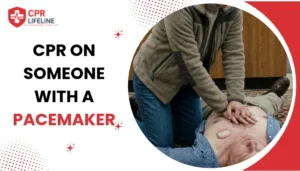
Some women have an implanted pacemaker or implantable cardioverter-defibrillator (ICD) to manage abnormal heart rhythms. These devices are usually located beneath the skin in the upper chest and may appear as a small raised area.
You should perform CPR on someone with a pacemaker. Continue standard chest compressions, but avoid placing AED pads directly over a visible implanted device. Position the pads according to the AED manufacturer’s instructions, allowing adequate space between the pad and the device when possible.
Be Prepared to Respond to Cardiac Arrest in Women
Providing CPR to a woman means applying the same adult resuscitation techniques used for any other adult while accounting for practical considerations such as breast anatomy and AED placement. Effective chest compressions should be delivered at 100 to 120 per minute, reaching a depth of at least 2 inches (5 cm) without exceeding 2.4 inches (6 cm). Place the heel of your hand on the lower half of the breastbone, move breast tissue aside if needed to locate the correct position, and compress straight down while allowing the chest to recoil fully. When using an AED, expose the chest and place both electrode pads directly on bare skin in the positions shown on the device.
Reading about CPR provides a foundation, but hands-on practice helps turn these instructions into skills you can use under pressure. Practicing on a CPR manikin helps you develop proper hand positioning, maintain consistent compressions, and become comfortable with the skills needed during an emergency. CPR Lifeline offers AHA-certified CPR, BLS, ACLS, and PALS courses through flexible blended learning, combining online HeartCode coursework with an in-person skills check.
Faqs

Chris Peters
Chris Peters is a certified American Heart Association instructor and firefighter since 1996 with over 30 years of emergency response experience. After answering thousands of 911 calls, he founded CPR Lifeline to provide AHA-certified training that transforms bystanders into confident lifesavers who act decisively when seconds count