
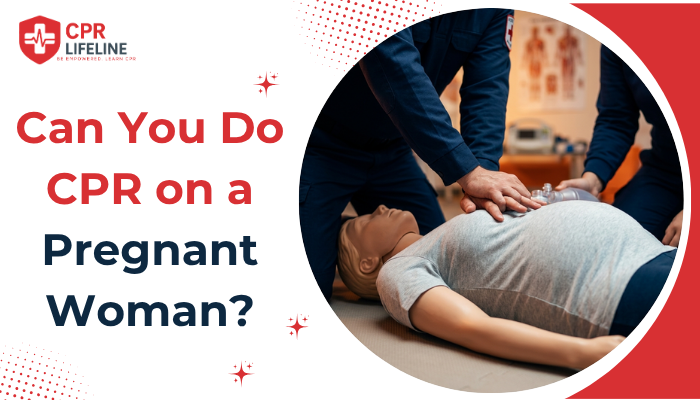


Cardiac arrest during pregnancy is rare, but when it happens, quick action gives both the mother and the baby the best chance of survival. You can and should perform CPR on a pregnant woman if she is unresponsive and not breathing normally.
CPR on a pregnant woman follows the same basic steps as CPR on any adult. You check for responsiveness and breathing, call for emergency help right away, and perform chest compressions at the same depth and rate used for any adult, 2 to 2.4 inches deep at 100 to 120 compressions per minute. But a few adjustments are needed too, such as tilting the body slightly to the left to relieve pressure on a major blood vessel, giving rescue breaths a bit more gently, and paying closer attention to the airway.
This blog walks you through everything you need to know about CPR for a pregnant woman, including positioning, compressions, rescue breaths, and AED use.
Why Pregnant Women Need Special CPR Techniques
CPR for a pregnant woman follows the same core principles as CPR for any adult, but pregnancy causes physical changes that require a few important adjustments. As the uterus grows, it can affect blood flow, breathing and body positioning, making proper technique even more important.
Here are the key physical changes during pregnancy that influence CPR technique:
Reduced blood flow when lying flat: In later pregnancy, the enlarged uterus can press on the inferior vena cava, reducing blood flow back to the heart. This is why a slight left tilt or manual left uterine displacement is recommended.
Higher oxygen demand: Both the mother and the baby rely on a continuous oxygen supply, so starting CPR quickly is especially important.
Changes in the lungs and diaphragm: As the uterus grows, it reduces lung capacity, which makes effective airway management and rescue breaths more important.
Higher aspiration risk: Pregnancy increases the chance of stomach contents entering the airway, so rescue breaths should be given gently.
Although these changes require a few additional considerations, the overall goal of CPR remains the same: to restore blood flow and oxygen as quickly as possible until emergency medical help arrives.
Is It Safe to Perform CPR on a Pregnant Woman?
Yes, performing CPR during pregnancy is safe. If a pregnant woman goes into cardiac arrest, CPR should be started immediately. Although many people worry about hurting the baby, delaying CPR puts both the mother and the baby at greater risk. Restoring the mother’s heartbeat and circulation gives both of them the best chance of survival. In fact, a study on Survival outcomes in maternal in-hospital cardiac arrest found that among women who suffered an in-hospital cardiac arrest and received resuscitation, pregnant women survived to discharge at a rate of 45.1 percent, compared to 26.5 percent among non-pregnant women of similar age.
Pregnancy is not a reason to delay chest compressions, rescue breaths, or the use of an AED. If you are not trained to give rescue breaths, perform hands-only CPR until emergency medical services arrive.
What to Do Before Starting CPR on a Pregnant Woman
Before you begin CPR, quickly assess the situation to make sure it is safe to help. These initial steps only take a few seconds and help ensure you can respond as quickly and effectively as possible.
Follow these steps before starting CPR:
- Make sure the scene is safe: Before you approach, look for hazards such as traffic, fire, electrical dangers, or anything else that could put you at risk. Do not put yourself in danger while trying to help.
- Check responsiveness: Tap her shoulder and ask loudly if she is okay. If there is no response, move on to checking her breathing.
- Check breathing: Look for normal breathing for no more than 10 seconds. Gasping is not normal breathing and should be treated as a sign of cardiac arrest.
- Call 911 immediately: If she is unresponsive and not breathing normally, call 911 or your local emergency number right away. If someone else is nearby, ask them to make the call while you begin CPR. Be sure to tell the dispatcher that the woman is pregnant so emergency responders can prepare appropriately.
- Get an AED quickly: Ask someone nearby to bring an automated external defibrillator (AED) as quickly as possible. Use it as soon as it arrives by following the device’s voice prompts. Do not delay CPR while waiting for the AED.
- Estimate how far along the pregnancy is: If the pregnancy appears visibly advanced, this helps you know when to make the positioning adjustment. Do not delay CPR if you aren’t sure how far along the pregnancy is.
How to Perform CPR on a Pregnant Woman
If a pregnant woman goes into cardiac arrest, begin CPR immediately. The basic steps are the same as for any adult, with one important difference in late pregnancy: reducing pressure from the uterus helps improve blood flow during resuscitation.
Here is a clear, step-by-step breakdown on how to perform CPR on a pregnant woman, based on AHA’s scientific statement on cardiac arrest in pregnancy:
Step 1: Position Her Properly
Lay her on a firm, flat surface. If the pregnancy is visibly advanced, usually during the third trimester, try to reduce pressure on the large blood vessels by gently moving the uterus to the left if another person is available to help. If you are alone, place a rolled towel, blanket, or firm pillow under her right hip and lower back to create a slight left tilt of about 15 to 30 degrees while keeping her back as flat as possible.
Make sure you don’t roll her completely onto her side, as this makes it much harder to perform high-quality CPR.
Step 2: Start Chest Compressions
Perform chest compressions the same way you would for any adult. Place the heel of one hand in the center of her chest, place your other hand on top, and interlock your fingers. Keep your arms straight with your shoulders directly over your hands. Then, push hard and fast at a depth of at least 2 inches (5 cm) but no more than 2.4 inches (6 cm), at a rate of 100 to 120 compressions per minute.
Allow complete chest recoil after each compression and minimize interruptions. If you are trained in CPR, perform cycles of 30 chest compressions followed by 2 rescue breaths. If you are not trained to give rescue breaths, continue with hands-only CPR until help arrives.
Step 3: Give Rescue Breaths
Open the airway using the head tilt-chin lift maneuver, pinch the nose closed, and create a complete seal over the mouth. Give 2 breaths, each lasting about 1 second, and watch for the chest to rise with each breath.
Because pregnancy increases the risk of aspiration, give each breath gently and avoid blowing too hard or too quickly.
Step 4: Continue Until Help Arrives
Continue CPR until she begins breathing normally or shows other signs of life, emergency medical responders arrive and take over, or you are physically unable to continue and another rescuer can take your place.
If another person is available, switch the person performing chest compressions about every 2 minutes to help maintain effective compression depth and rate.
Can You Use an AED on a Pregnant Woman?
Yes, using an Automated External Defibrillator (AED) on a pregnant woman is safe at every stage of pregnancy. The electrical shock delivered by an AED does not pose a meaningful risk to the baby, and restoring the mother’s heartbeat is the best thing you can do to protect the baby too.
Here is how to use an AED during CPR on a pregnant woman:
- Turn on the AED as soon as it is available and follow its voice prompts.
- Expose her chest and make sure the skin is dry.
- Place one pad on the upper right side of the chest and the other pad on the lower left side, below the armpit, just like you would for any adult. If the pads would overlap with a very large abdomen, you can adjust placement slightly, but do not delay the shock trying to get perfect placement.
- Stand clear while the AED analyzes the heart rhythm.
- If a shock is advised, make sure no one is touching her, then let the AED deliver it.
- Resume chest compressions immediately after the shock, following the AED’s instructions.
Do not delay defibrillation while waiting for other things, like fetal monitoring or extra help. Getting her heart back into a normal rhythm as quickly as possible is the priority, and it directly supports the baby’s survival too.
Considerations During and After CPR on a Pregnant Woman
Pregnancy affects circulation, breathing, and recovery in ways that make high-quality CPR even more important. Although the basic CPR steps remain the same, a few additional considerations can help you provide the best possible care while waiting for emergency responders.
Keep these important considerations in mind while performing CPR on a pregnant woman:
Switch Rescuers When Possible
Chest compressions are physically demanding, and their quality often decreases after about 2 minutes. If another trained person is available, switch the person performing compressions every 2 minutes to help maintain the correct depth and rate while minimizing interruptions.
Focus on the Mother First
During CPR, your priority is restoring the mother’s circulation. Do not interrupt CPR to check on the baby or look for a fetal heartbeat. The best way to improve the baby’s chances of survival is to restore the mother’s heartbeat and breathing as quickly as possible.
If She Starts Breathing Again
If she begins breathing normally and shows other signs of life, place her on her left side if it is safe to do so while waiting for emergency responders. Continue monitoring her breathing and be prepared to restart CPR if she becomes unresponsive again.
Be Ready to Share Information
When emergency responders arrive, tell them what happened, approximately how long she was unresponsive, whether an AED was used and how many shocks were delivered, and, if known, how far along the pregnancy is. This information helps them provide the most appropriate care as quickly as possible.
Get CPR Certified and Be Ready to Save Two Lives
Cardiac arrest during pregnancy is rare, but knowing how to respond can save two lives at once. The most important things to remember are simple: call for help right away, start chest compressions without delay, adjust her position to relieve pressure on major blood vessels, and use an AED as soon as one is available. You do not need to be a medical professional to make a real difference. Staying calm, acting quickly, and following these steps gives both mother and baby the best possible chance.
If you want to build real confidence for situations like these, taking a CPR and AED course is one of the best ways to prepare. CPR Lifeline offers AHA-certified CPR courses through a fast, flexible blended learning format, combining a short online course with a quick in-person skills check. This hands-on practice helps you build the muscle memory and confidence to respond effectively in emergencies.
Faqs

Chris Peters
Chris Peters is a certified American Heart Association instructor and firefighter since 1996 with over 30 years of emergency response experience. After answering thousands of 911 calls, he founded CPR Lifeline to provide AHA-certified training that transforms bystanders into confident lifesavers who act decisively when seconds count