
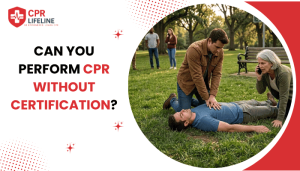
If someone suddenly collapses and stops responding, you may wonder whether you can perform CPR if you have never taken a CPR course. You may also worry about making a mistake, causing an injury, or facing legal consequences. These concerns are common, especially when you have never been trained to respond to a cardiac emergency.
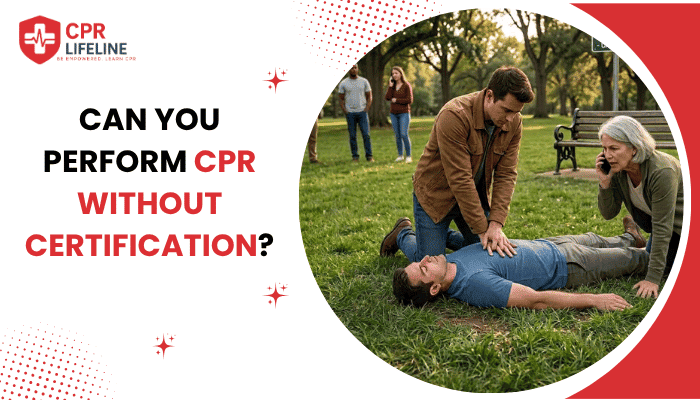
Yes, you can perform CPR safely and legally even though you are not certified. You do not need a CPR certificate, medical license, or professional healthcare background to help someone during a cardiac emergency. The American Heart Association recommends that lay rescuers provide chest compressions when they suspect an adult is experiencing cardiac arrest. When someone goes into cardiac arrest, every minute matters, so waiting for a certified person to arrive can delay potentially life-saving care.
This blog explains whether you can perform CPR without certification, what to do as an untrained bystander, the potential risks, Good Samaritan protections, and the benefits of proper CPR training.
Why You Should Start CPR Even Without Formal Training
Cardiac arrest happens when the heart suddenly stops pumping blood effectively. Without circulation, the brain and other vital organs quickly lose oxygen. Brain damage can begin within 4 to 6 minutes and often becomes irreversible after 8 to 10 minutes. CPR helps maintain blood flow until emergency medical services arrive. Although CPR may not restart the heart on its own, it can keep blood moving through the body while the person waits for advanced medical care. The American Heart Association states that immediate CPR can double or triple a cardiac arrest victim’s chance of survival, making early action especially important when professional help may take several minutes to arrive.
A lack of formal training should not make you hesitate when someone’s life may be at risk. You may not know every CPR technique or feel confident about your skills, but taking immediate action can still make a meaningful difference. Calling 911, listening to the dispatcher’s instructions, and staying with the person until help arrives can all support the emergency response. Formal training can improve your skills, but you do not need a cpr certification card to begin helping.
How to Perform CPR If You Are Not Trained
If you have never received CPR training, you can still perform Hands-Only CPR on a teen or adult who suddenly collapses and appears to be in cardiac arrest. This method relies on chest compressions alone, so there is no need to worry about rescue breaths or memorizing complex steps.
You should follow these basic CPR steps and listen to the 911 dispatcher’s instructions while waiting for emergency help.
1. Make Sure the Scene Is Safe
Before approaching the person, quickly check the area for immediate dangers such as traffic, fire, electricity, or dangerous equipment. Do not put yourself at risk. If the area is safe, approach the person and check for a response.
2. Check for a Response
Tap the person’s shoulder and speak loudly to see if they respond. If they do not respond, check whether they are breathing normally. Gasping or irregular breathing is not considered normal breathing and can be a sign of cardiac arrest. If the person is unresponsive and not breathing normally, they may be experiencing cardiac arrest and need immediate CPR.
3. Call 911
If you are alone, call 911 and follow the dispatcher’s instructions. If someone else is present, have them call emergency services while you stay with the person. Keep the dispatcher on the line if possible. They can guide you through the next steps while emergency responders are on their way.
4. Start Chest Compressions
Place the heel of one hand on the lower half of the breastbone, roughly between the nipples, and place your other hand on top, interlocking your fingers. Position your shoulders directly over your hands and keep your arms straight. Push hard and fast at a rate of 100 to 120 compressions per minute. For an average adult, compress the chest at least 2 inches (5 cm) deep while avoiding depths greater than 2.4 inches (6 cm). Allow the chest to fully recoil between compressions.
5. Use an AED If One Is Available
An automated external defibrillator (AED) checks the person’s heart rhythm and determines whether a shock is needed. You do not need CPR certification to use an AED. Turn the device on and follow its voice or visual instructions. Expose the person’s bare chest and attach the pads as shown by the device. Make sure nobody is touching the person while the AED analyzes the heart rhythm or delivers a shock, then follow its instructions about when to resume CPR.
6. Continue Until Help Arrives
Keep following the instructions from the 911 dispatcher and AED until emergency medical personnel take over. If another rescuer is available, switch when you become tired and keep the changeover as brief as possible. Only pause compressions if the person begins breathing normally, moves, or shows other clear signs of life. Continue monitoring them until emergency help arrives.
Potential Risks of Performing CPR Without Certification
CPR requires firm chest compressions, so injuries can occur even when CPR is performed correctly. Someone without formal training may also be less familiar with proper technique, which can make them uncertain about how to respond.
Below are some of the most common risks an untrained person should be aware of while giving CPR.
Broken or Bruised Ribs
Chest compressions require enough force to push the chest down and allow blood to circulate. Because of this, bruised or broken ribs can occur during CPR, particularly in older adults. The possibility of a rib injury should not be a reason to stop CPR when someone is experiencing cardiac arrest.
Incorrect Hand Placement
An untrained rescuer may be unsure where to place their hands or how to position their body for chest compressions. Incorrect hand placement can make compressions less effective and may increase the risk of unnecessary injury.
Incorrect Compression Depth or Rate
It can be difficult to judge whether compressions are deep and fast enough without formal training. Compressing too shallowly may not provide adequate blood flow, while excessive depth can increase the risk of injury.
Incomplete Chest Recoil
The chest needs to return fully to its normal position between compressions. Failing to allow complete chest recoil can reduce the amount of blood that returns to the heart, which can make CPR less effective. Maintaining a steady rhythm while allowing the chest to fully rise after each compression helps support effective blood flow.
Stopping CPR Too Soon
An untrained rescuer may stop CPR because they become tired, think the person is not responding, or worry that they are doing something incorrectly. You should only stop CPR if the person shows clear signs of life, emergency personnel take over, or the scene becomes unsafe.
Interrupting Compressions Too Often
Frequent interruptions reduce the amount of time the chest is being compressed and can make CPR less effective. An untrained rescuer may pause repeatedly to check the person, adjust their position, or hesitate about what to do next. Keeping pauses as short as possible helps maintain continuous chest compressions.
How Good Samaritan Laws Protect People Who Provide CPR
You may worry about facing legal consequences if you accidentally hurt someone while providing CPR. Good Samaritan laws in the United States are generally intended to protect people who voluntarily provide emergency assistance in good faith. These laws can help reduce concerns about liability when a bystander steps in to help during a medical emergency. However, the specific protections vary by state.
These laws are designed to encourage people to assist during emergencies rather than avoid helping because they are concerned about being held responsible for an unintended outcome. Protection generally does not extend to intentional misconduct or gross negligence, and some states have additional requirements or limitations. If you are concerned about the legal protections in your area, check the Good Samaritan law that applies in your state.
How Proper CPR Certification Helps
Although you can perform CPR without certification, formal CPR training can help you feel more prepared and confident during an emergency. A certification course gives you the opportunity to practice important skills in a hands-on setting rather than only learning them in theory.
- Builds hands-on CPR skills: Practice helps you become comfortable with chest compressions, proper hand placement, body positioning, and maintaining an effective rhythm. Repeated practice can make these skills easier to recall during a stressful situation.
- Improves confidence in emergencies: Knowing what to do can reduce hesitation when someone suddenly needs help. Training gives you the chance to practice responding to an emergency so you can approach the situation with greater confidence.
- Teaches AED use: CPR courses show you how to operate an automated external defibrillator (AED) and follow its voice or visual instructions. Hands-on practice can make you more familiar with using an AED when one is available.
- Helps you recognize cardiac arrest: Training teaches you how to identify when a person may be experiencing cardiac arrest and when CPR should be started. This can help you make a quicker decision instead of being unsure about whether the situation requires immediate action.
- Provides practice in realistic situations: Many certification courses use hands-on scenarios that simulate real emergencies. This allows you to practice responding under pressure and become more comfortable applying CPR and AED skills in different situations.
- Keeps your skills current: CPR certification and renewal courses provide an opportunity to review important techniques and stay familiar with current CPR recommendations. Regular training can also help prevent skills from becoming less familiar over time. Most CPR certifications are valid for 2 years.
Formal training cannot predict exactly how an emergency will unfold, but hands-on practice can make it easier to respond effectively when help is needed. You can even complete online CPR training through blended learning courses that combine online coursework with in-person skills practice.
Quick Action Without Hesitation Can Save a Life
Even without certification, performing CPR can save lives and significantly improve a victim’s chances of surviving a cardiac emergency. Hands-Only CPR allows untrained bystanders to act quickly and confidently, while Good Samaritan laws generally provide legal protection for those who help in good faith. Although improper technique may pose minor risks, the benefits of immediate action far outweigh them. Getting CPR certified further enhances your skills, ensures you follow the latest guidelines, and prepares you for a variety of situations, from cardiac arrest to pediatric emergencies and choking.
If you want to build your skills and feel more prepared to respond, proper CPR training can give you the hands-on practice and knowledge needed to act with confidence. CPR Lifeline offers American Heart Association (AHA) CPR, BLS, ACLS, and PALS training at multiple locations across Georgia and Tennessee. Courses include blended learning options along with hands-on skills training to help participants prepare for real-life emergencies.
Faqs

Chris Peters
Chris Peters is a certified American Heart Association instructor and firefighter since 1996 with over 30 years of emergency response experience. After answering thousands of 911 calls, he founded CPR Lifeline to provide AHA-certified training that transforms bystanders into confident lifesavers who act decisively when seconds count