
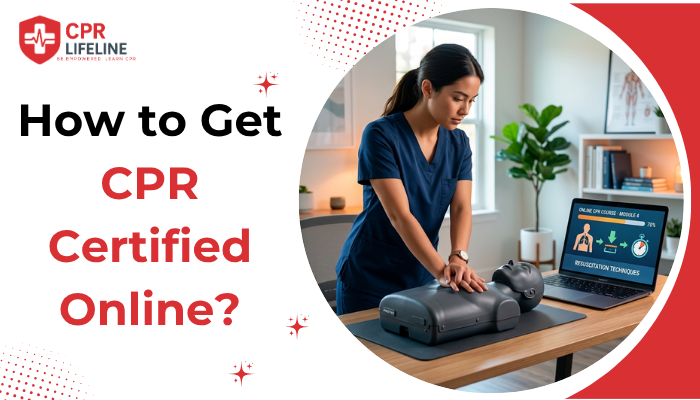

Cardiac arrest can happen anywhere, and the person most likely to help in those first critical minutes is a bystander, not a paramedic. That reality is why so many employers, schools, and licensing boards now require current CPR certification, whether you work in healthcare, childcare, education, fitness, or an entirely unrelated field. Knowing how to get CPR certified online has become one of the most common questions among people trying to meet that requirement without disrupting a packed schedule.
Online CPR certification allows you to complete the educational portion of your training through web-based coursework, though many certifications still require an in-person skills assessment to verify hands-on competency. The exact format that fits you depends on your employer’s requirements, your state’s regulations, and whether your role demands healthcare-level certification or general public training.
This blog breaks down what online CPR certification actually involves, how to complete the process step by step, what it typically costs, whether employers accept it, and the mistakes to avoid when choosing a provider.
What Is Online CPR Certification?
Online CPR certification allows learners to complete CPR education through web-based training. Some certifications require an in-person skills assessment, while others are entirely online depending on employer or state requirements.
Online certification confirms that a person has learned and demonstrated the core skills needed to respond to a cardiac or breathing emergency, including chest compressions, rescue breathing, and AED use. Most certifications remain valid for two years before renewal is required. A complete online certification covers the content through video lessons and a written exam with no hands-on component. Blended learning certification pairs that same coursework with a shorter in-person skills session where an instructor evaluates technique directly.
Certification is issued as a digital certificate, a physical card, or both, depending on the provider. Digital certificates can be shared electronically with an employer, which speeds up verification. Renewal follows the same format requirements as initial certification, and most providers expect the same combination of online coursework and hands-on skills verification each time your credential comes up for renewal.
Can You Get CPR Certified Completely Online?
No, not for most professional or employer-required certifications. Complete online CPR certification is legally obtainable and can be useful for general personal knowledge, but it is not accepted by most healthcare employers, licensing boards, or organizations that require verified hands-on competency. The American Heart Association and the American Red Cross both require an in-person skills evaluation as part of their standard CPR certification pathway.
Blended learning satisfies both the convenience of online coursework and the verification employers expect. It combines online video instruction with a shorter in-person session where a certified instructor evaluates hands-on skills such as compression depth, rate, and AED use. Requirements vary by state and employer, and roles in healthcare, childcare, and education typically require certification with a documented skills assessment. Before enrolling in any online-only course, it is better to confirm with your employer or licensing body whether it will actually meet their requirement.
Steps to Getting CPR Certified Online
Getting CPR certified online follows a clear, structured process regardless of which provider or certification level you choose. Completing each step in order ensures you end up with a credential that is actually recognized by your employer or licensing body. Follow these six steps to get certified:
- Step 1. Choose a recognized provider: Select a provider accredited by the American Heart Association, the American Red Cross, or another organization your employer accepts. Verify accreditation before enrolling to avoid wasting time on an unrecognized certificate.
- Step 2. Select the appropriate certification level: Choose the course that matches your role and requirements. Common options include Adult CPR, Child CPR, Infant CPR, CPR plus AED, and Basic Life Support for healthcare providers.
- Step 3. Complete the online coursework: Work through the video lessons and instructional content at your own pace. Most platforms allow you to pause and resume as your schedule allows.
- Step 4. Pass the written assessment: Complete the multiple choice exam covering CPR protocols, AED use, and emergency recognition. Most accredited courses set the passing threshold between 70 and 80 percent.
- Step 5. Complete skills testing if required: Attend the in-person skills session where an instructor evaluates your hands-on technique on a training manikin. This step is required for any certification your employer or licensing body will recognize.
- Step 6. Download or receive your certification: Once you pass both components, your certificate is issued digitally, physically, or both. Be sure to keep a copy on file and mark your renewal date on your calendar, since a refresher course is required to stay current.
How Much Does Online CPR Certification Cost?
Online CPR certification typically costs between $20 and $100, depending on the certification level, provider, and format. Basic hands-only CPR courses for the general public sit at the lower end of that range, while CPR plus AED certification and Basic Life Support for healthcare providers cost more due to the added skills content and required in-person evaluation. Courses through the American Heart Association and the American Red Cross tend to price higher than lesser-known providers because of their instructor networks, training infrastructure, and broader employer recognition.
Several factors influence the final cost beyond the certification level itself. Group and workplace training typically comes with a discounted per-person rate, which makes sense for employers certifying an entire team at once. Many schools and nursing programs offer student pricing for BLS certification, since it is often a mandatory requirement before clinical rotations begin. Renewal courses are usually priced lower than initial certification since they cover less material and take less time to complete. When comparing providers, price alone should not be the deciding factor. A certification priced far below the typical range is often a red flag for a missing in-person skills component, which can make the credential unusable for employer or licensing purposes.
Is Online CPR Certification Accepted by Employers?
Employer acceptance of online CPR certification depends heavily on the industry, the specific role, and whether the course included a verified in-person skills assessment. Healthcare employers are the strictest, typically requiring Basic Life Support certification from the AHA specifically, since it aligns with clinical protocols used across hospitals and medical facilities. Education, childcare, and fitness employers are generally more flexible and often accept certification from either the American Heart Association or the American Red Cross, provided the course includes hands-on skills verification.
Acceptance standards vary meaningfully across common industries:
- Healthcare: Requires AHA BLS certification in most hospital and clinical settings. Some facilities accept Red Cross BLS if it meets equivalent skills standards.
- Education: Requires CPR and first aid certification from an accredited provider, often with state-specific renewal requirements for school staff.
- Childcare: Requires CPR and first aid certification as a condition of state licensing, almost always with an in-person skills component.
- Fitness: Requires CPR and AED certification, frequently tied to personal training or group fitness certifications from bodies like NASM.
- Construction: Requires CPR and first aid training under OSHA workplace safety standards, particularly for designated first responders on site.
- Security: Requires CPR and AED certification in many states as part of licensing for armed and unarmed security personnel.
- Hospitality: Requires CPR and AED certification for staff in roles with public-facing safety responsibilities, such as pool attendants and event security.
Fully online certification without any in-person component is rarely accepted across these industries. Confirming your employer’s specific accreditation requirement before enrolling saves you from purchasing a certificate that fails to meet the standard your role demands.
How Long Does CPR Certification Last?
Most CPR certifications are valid for two years from the date of completion. This applies consistently across the American Heart Association and the American Red Cross, regardless of whether the course was completed online, in person, or through a blended format. After two years, a renewal course is required to maintain active certification.
Renewal courses are shorter than initial certification but still require a hands-on skills demonstration and a written assessment. A lapsed certification is not usable for employer compliance or licensing, even by a single day, and some providers require the full initial course rather than the shorter refresher once the lapse extends too long. For a complete breakdown of renewal timelines and what happens if your card expires, see how long CPR certification lasts before you need to recertify.
Common Mistakes to Avoid When Choosing an Online CPR Course
Choosing the wrong online CPR course can leave you with a certificate that costs money but does not meet the requirement you needed it for. Most of these mistakes are avoidable once you know what to check before enrolling. Reviewing the checklist below before you commit to a provider saves both time and money.
Choosing an Unrecognized Provider
Not every online CPR course is backed by an accredited organization. Verify that the provider is recognized by the American Heart Association, the American Red Cross, or another body your employer explicitly accepts before enrolling.
Ignoring Employer Requirements
Some employers require certification from a specific organization, such as AHA BLS for healthcare roles. Confirm the exact requirement with your employer or HR department before purchasing a course, rather than assuming any accredited certificate will work.
Skipping the Skills Assessment
A certification without an in-person skills evaluation is often unusable for professional or licensing purposes. If your role requires verified competency, choose a blended learning course that includes hands-on practice with an instructor.
Assuming All Certificates Are Equal
A completion card and a formal certification are not the same thing. Some low-cost providers issue a certificate of completion rather than an accredited certification, which will not satisfy most workplace or licensing requirements.
Buying Extremely Cheap Certifications
A price far below the typical range for CPR certification is often a sign that the course lacks accreditation, skips the skills assessment, or issues a credential that employers will not recognize. Treat unusually low pricing as a reason to investigate the provider more closely, not as a reason to enroll faster.
Quick checklist before enrolling:
- Confirm the provider is accredited by AHA, Red Cross, or your employer’s required organization
- Confirm your employer’s exact certification requirement
- Confirm whether an in-person skills assessment is included
- Confirm you are receiving a full certification, not a completion card
- Confirm the price aligns with the typical range for that certification level
Ready to Get CPR Certified Online? Here’s Your Next Step
Getting CPR certified online is straightforward once you know what to look for. Choose a provider recognized by the American Heart Association or American Red Cross, verify whether your role requires an in-person skills assessment, and compare course costs, renewal periods, and certification formats before enrolling. Skipping any of these steps risks ending up with a credential that your employer or licensing board will not accept.
CPR Lifeline offers AHA-certified blended learning courses across Tennessee and Georgia, combining flexible online coursework with the hands-on skills verification employers require. Review the available CPR certification courses and choose the option that matches your profession or personal preparedness goals.
Faqs
Choose an accredited provider, complete the online coursework and written assessment, and finish an in-person skills evaluation if your certification requires one. Most employer-recognized certifications use this blended format rather than a fully online-only course. Once you pass both components, you receive a digital or physical certification card.
No, not for most employer or licensing requirements. Fully online certification without a hands-on skills assessment is legally available but is not accepted by most healthcare employers, licensing boards, or organizations requiring verified competency. Blended learning, which pairs online coursework with a short in-person session, satisfies both convenience and verification needs.
Online CPR certification typically costs between $20 and $100, depending on the certification level and provider. Basic hands-only courses sit at the lower end, while CPR plus AED and Basic Life Support certification cost more due to added content and required in-person evaluation. Group and student pricing is often available.
Acceptance depends on the industry and whether the course included a verified in-person skills assessment. Healthcare employers typically require AHA BLS certification specifically, while education, childcare, and fitness employers are generally more flexible if the course meets accreditation and skills verification standards.
Most CPR certifications are valid for two years from the date of completion, regardless of whether the course was online, in person, or blended. A renewal course is required after that period to maintain active certification and avoid gaps in employer or licensing compliance.
Verify the provider is accredited by the American Heart Association or American Red Cross, confirm your employer's specific certification requirement, and check whether an in-person skills assessment is included. Avoid providers offering certification prices far below the typical range, as this often signals a missing accreditation or skills component.
A completion card confirms you finished a course but does not always meet formal certification standards required by employers or licensing boards. A full CPR certification requires passing both a written assessment and, in most cases, a hands-on skills evaluation. Confirm which one a provider is issuing before enrolling.
Yes, renewal courses are available online and typically follow the same blended format as initial certification, combining online coursework with a shorter in-person skills refresher. Renewal is required every two years, and completing it before your certification expires keeps you continuously compliant.

Chris Peters
Chris Peters is a certified American Heart Association instructor and firefighter since 1996 with over 30 years of emergency response experience. After answering thousands of 911 calls, he founded CPR Lifeline to provide AHA-certified training that transforms bystanders into confident lifesavers who act decisively when seconds count