
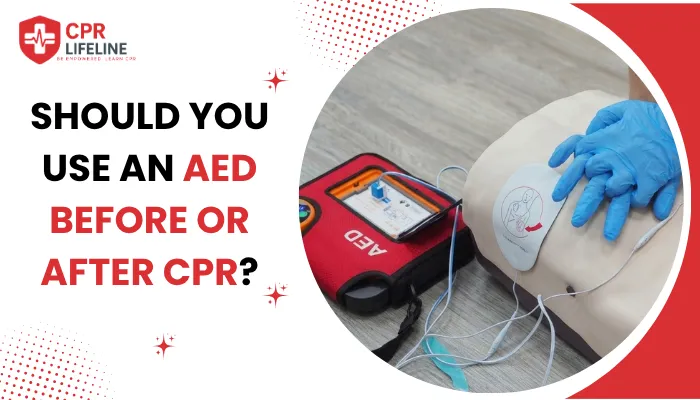

You should start CPR first and use the AED the moment it arrives, because the two work as a sequence and neither one replaces the other. Chest compressions keep blood flowing to the brain and heart while someone retrieves the device, and the shock from the AED can then restore a normal rhythm that compressions alone cannot correct.
Many bystanders still hesitate because they believe the defibrillator is the more important tool or that only trained responders may use it. Current American Heart Association guidance removes the confusion by asking rescuers to begin compressions immediately, to send a second person for the AED, and to follow the device’s voice prompts without waiting for any set period of CPR.
In this blog, you will learn what comes first between CPR and defibrillation, why starting CPR immediately matters, the benefits of using an AED early, how to use an AED during CPR, special situations to handle, and common mistakes to avoid.
What Comes First: CPR or Defibrillation?
The American Heart Association (AHA) places early CPR before rapid defibrillation in its 2025 Chain of Survival. This sequence means you should start CPR immediately when someone becomes unresponsive and does not breathe normally or only gasps. Ask someone to retrieve an AED while you continue CPR. You do not need to perform CPR for a set amount of time before using the device.
For a typical adult cardiac arrest, you should follow these steps:
- Recognize cardiac arrest: Check whether the person responds and breathes normally. Occasional gasping does not count as normal breathing.
- Call emergency services: Call 911 or your local emergency number. Use speakerphone so you can follow the dispatcher’s instructions.
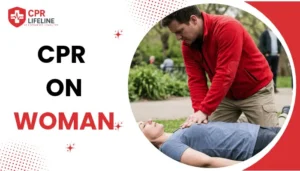
- Begin CPR: Start chest compressions immediately. If you have CPR training, provide rescue breaths according to your training. If you lack training or cannot provide breaths, perform hands-only CPR on an adult.
- Get an AED: Ask another person to find and bring the nearest AED while you continue CPR.
- Apply the AED pads: Turn on the device, expose the person’s chest, and attach the pads according to the diagrams.
- Follow the AED instructions: Stop touching the person while the device analyzes the heart rhythm. Deliver a shock if the AED advises one.
- Resume CPR: Restart chest compressions immediately after a shock or a no-shock recommendation.
In a monitored cardiac arrest, the situation may differ. If a defibrillator is already connected or immediately available and identifies a shockable rhythm, such as ventricular fibrillation (VF) or pulseless ventricular tachycardia (pVT), healthcare professionals should deliver a shock promptly rather than delay defibrillation for a predetermined period of CPR.
Why Is It Important to Start CPR Immediately?
During cardiac arrest, the heart stops pumping blood effectively, depriving the brain and other vital organs of oxygen. Brain damage can begin within about 4 to 6 minutes without oxygen, so every minute without CPR matters. Chest compressions help maintain blood circulation until the heart’s rhythm can be treated. Starting CPR promptly is especially important when an AED is not yet available, as compressions help maintain circulation while the device is retrieved and prepared.
A 2026 study published in Shock examined 72 studies involving more than 2.9 million out-of-hospital cardiac arrests. It found that bystander CPR was associated with 44% higher odds of survival to hospital discharge compared with no bystander CPR. These findings highlight the importance of starting chest compressions without delay. Once an AED is available, use it promptly and follow its instructions.
What Are the Benefits of Using an AED Early?
An AED can deliver a potentially life-saving shock when cardiac arrest is caused by a shockable heart rhythm, such as ventricular fibrillation or pulseless ventricular tachycardia. Using the device as soon as it becomes available can reduce the time to defibrillation and improve the chances of a successful outcome.
Here are some of the benefits of using an AED:
1. Improves the Chances of Survival
For a person in cardiac arrest with a shockable rhythm, early defibrillation is one of the most important factors affecting survival. The longer the heart remains in an abnormal rhythm without treatment, the less likely a shock is to be successful. Using an AED promptly can improve the person’s chance of surviving until advanced medical care is available.
2. Helps Restore an Organized Heart Rhythm
During ventricular fibrillation, the heart’s electrical activity becomes disorganized, preventing it from pumping blood effectively. An AED analyzes the heart rhythm and delivers a shock if one is advised. The shock interrupts the abnormal electrical activity and may allow the heart to resume an organized rhythm.
3. Limits the Effects of Interrupted Blood Flow
During cardiac arrest, the brain and other vital organs receive little or no blood flow. Starting CPR helps maintain some circulation, while early defibrillation may help correct a shockable rhythm. Together, these actions can reduce the time the body spends without effective circulation and improve the possibility of a better recovery. A 2025 study titled Immediate Defibrillation and Outcomes in Shockable Cardiac Arrest found that immediate defibrillation was associated with a higher one-month survival rate of 32.5%, compared with 29.1% for delayed defibrillation.
How to Use an AED During CPR
An AED is designed to guide rescuers through the defibrillation process using voice prompts, visual instructions, and sometimes written messages on a screen. You do not need to identify the heart rhythm yourself. The device analyzes it and determines whether a shock is advised.
You should follow these steps when the AED arrives:
1. Turn On the AED and Prepare the Chest
Open the AED case and turn on the device using its power button or by opening its lid, depending on the model. Follow the voice instructions and expose the person’s chest so the electrode pads can make direct contact with the skin.
If the chest is wet, quickly wipe it dry. Remove clothing, jewelry, or medication patches that interfere with pad placement, using appropriate precautions. If thick chest hair prevents the pads from adhering, follow the device’s instructions and use a razor from the AED kit if necessary. IfIf another rescuer is available, one should continue CPR while the other prepares the AED.
2. Attach the AED Electrode Pads
Remove the adhesive pads from their packaging and attach them to the person’s bare chest according to the placement diagrams.
For a typical adult:
- Place one pad on the upper right side of the chest, below the collarbone.
- Place the second pad on the lower left side of the chest, below the armpit.
Press the pads firmly against the skin to ensure proper contact. Make sure they do not touch each other. The AED may provide alternative placement instructions for people with smaller chests or implanted medical devices.
3. Allow the AED to Analyze the Heart Rhythm
Once the pads are attached, the AED will analyze the person’s heart rhythm. It will instruct everyone to stop touching the person. Clearly announce, “Stand clear!” and visually confirm that nobody is touching them. This brief interruption is necessary because movement or contact can interfere with the AED’s analysis.
4. Deliver a Shock if Advised
If the AED detects a shockable rhythm, it will announce that a shock is advised. Some fully automatic AEDs deliver the shock without requiring you to press a button. Follow the device’s prompts.
The two main shockable rhythms are:
- Ventricular fibrillation (VF): The heart’s lower chambers produce rapid, disorganized electrical activity. Instead of contracting effectively, the heart muscle quivers and cannot pump blood normally.
- Pulseless ventricular tachycardia (pVT): The lower chambers beat extremely fast, preventing the heart from pumping enough blood to maintain circulation. The person has no detectable pulse.
An electrical shock briefly interrupts the abnormal electrical activity, potentially allowing the heart’s natural electrical system to restore a more organized rhythm.
5. Resume CPR Whether or Not a Shock Is Advised
After delivering a shock, immediately resume CPR, beginning with chest compressions. Do not stop to check for a pulse or wait to see whether the person wakes up.
If the AED announces that no shock is advised, resume CPR immediately as well.
A no-shock recommendation does not mean the person has recovered. The device may have detected a non-shockable rhythm, such as:
- Asystole: No detectable electrical activity in the heart.
- Pulseless electrical activity (PEA): Electrical activity is present, but the heart is not producing an effective pulse or pumping blood.
Neither condition is treated with an AED shock. CPR and advanced medical care remain essential.
Continue following the device’s instructions. Many AEDs prompt another rhythm analysis after approximately two minutes of CPR.
Special Situations When Performing CPR and Using an AED
Although the basic steps of CPR and AED use remain the same, certain situations may require additional precautions or adjustments. Knowing how to respond in these circumstances can help you provide safe and effective assistance without delaying life-saving care.
Here are some special situations to be aware of when performing CPR and using an AED:
Some situations call for quick adjustments. The core steps don’t change: call emergency services, start compressions, and use the AED as soon as it arrives.
- Multiple rescuers: Divide the tasks so nothing is delayed. One person performs compressions, another calls emergency services and brings the AED, and a third attaches the pads. Trained rescuers should switch the compressor about every two minutes, ideally during rhythm analysis, to keep compressions effective.
- Children and infants: Use pediatric pads or a pediatric setting if available. If not, use adult pads rather than delaying the shock. Make sure the pads don’t touch each other. If the chest is too small, place one pad on the front and one on the back.
- Wet conditions: Move the person away from standing water and dry the chest before attaching the pads so they stick properly.
- Oxygen equipment: Move oxygen masks and tubing away from the chest before a shock, since oxygen can feed a fire.
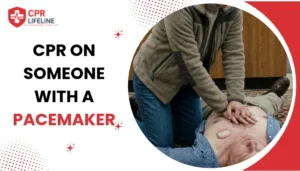
- Pacemakers and implanted defibrillators: If you see or feel a lump under the skin, place the pad about an inch (2.5 cm) away from it rather than over it. You should perform CPR even on people with pacemaker or implanted defibrillators.
- Medication patches: Remove any patch on the chest and wipe the skin clean before applying pads, since residue can cause burns. Use gloves if available.
- Chest hair: Press the pads down firmly. If the AED signals poor contact, replace them with a fresh set or shave the area with the kit’s razor.
- Jewelry and bras: Move necklaces aside, and shift or remove an underwire bra only if it blocks pad placement.
- Cracking ribs: Broken ribs during compressions are common and are not a reason to stop. Continue compressions without interruption.
- Fatigue: If you are tiring or can’t reach a depth of about 2 to 2.4 inches (5 to 6 cm) in an adult, switch with another rescuer.
Common Mistakes to Avoid When Using CPR and an AED
During a cardiac emergency, even small mistakes can cause unnecessary delays or interrupt life-saving care. Understanding what to avoid when performing CPR and using an AED can help you respond more confidently and ensure each step is carried out correctly.
You should avoid these common mistakes when performing CPR and using an AED:
- Waiting for an AED Before Starting CPR: Start chest compressions immediately while someone else retrieves the AED. Do not delay CPR while waiting for the device.
- Delaying AED Use: Use an available AED as soon as possible rather than waiting to complete several CPR cycles. Follow its prompts once it is ready.
- Touching the Person During Rhythm Analysis: Make sure no one touches the person while the AED analyzes the heart rhythm. This allows the device to assess the rhythm without interference.
- Not Resuming CPR After a Shock: Immediately restart chest compressions after the AED delivers a shock. Do not pause to check for a pulse unless you are a trained healthcare professional following an appropriate protocol.
- Stopping CPR After a No-Shock Recommendation: A no-shock recommendation does not mean the person is no longer in cardiac arrest. Resume CPR immediately and follow the AED’s instructions.
- Removing AED Pads Too Early: Keep the electrode pads attached during resuscitation. The AED may need to analyze the rhythm again and deliver another shock if indicated.
- Assuming AEDs Require Professional Training: Public-access AEDs are designed for use by bystanders and provide voice and visual instructions. Turn on the device and follow its prompts.
CPR and AED Together Save Lives
CPR and AED use work as one sequence: recognize the arrest, call emergency services, start compressions, apply the AED as soon as it arrives, and resume compressions after every analysis. Each step shortens the time the brain and heart spend without circulation, and none of them requires you to diagnose the rhythm or wait for permission. Starting compressions immediately keeps blood moving while the device is on its way, and using the AED the moment it is ready gives a shockable rhythm the best chance of being corrected. Even imperfect action from a bystander gives the person a far better chance of survival than hesitation.
Knowing this sequence is the first step, but performing it calmly under pressure takes practice, since even a well-informed bystander can freeze when a real emergency begins. CPR training is important because hands-on practice with compressions, pad placement, and AED prompts builds the confidence that reading alone cannot. CPR Lifeline, an American Heart Association-certified training site serving Tennessee and Georgia, offers BLS, ACLS, and PALS courses that combine online learning with a short in-person skills check. Book your CPR class today!
Faqs

Chris Peters
Chris Peters is a certified American Heart Association instructor and firefighter since 1996 with over 30 years of emergency response experience. After answering thousands of 911 calls, he founded CPR Lifeline to provide AHA-certified training that transforms bystanders into confident lifesavers who act decisively when seconds count