
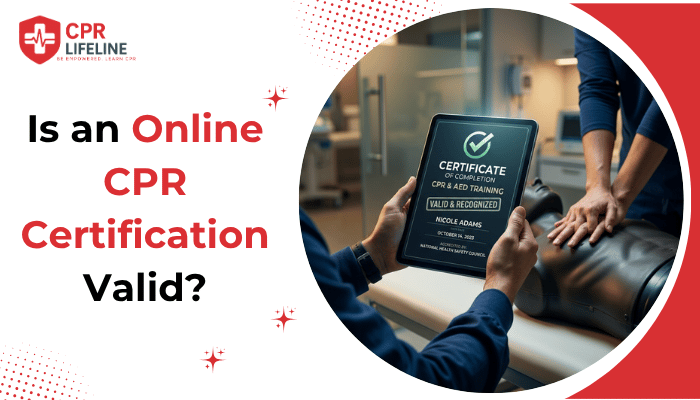
If you need CPR certification for work, school, a license, or just to be prepared, you might wonder if an online course counts. The answer depends on what type of online CPR course you take and who needs to accept your certification. Some CPR courses are designed to be completed entirely online. Others use online learning for the knowledge portion and require a hands-on skills session before you receive a course completion card.
A fully online CPR certification is valid, but only for some purposes. It works well for personal learning, and many employers accept it if they don’t require a hands-on skills test. It is usually not enough on its own for healthcare jobs, childcare roles, or other licenses that require you to demonstrate your skills in person.
In this blog, you’ll learn when an online CPR course is valid, when it’s not, the benefits and drawbacks of fully online training, and how to choose a course that actually meets your certification requirements.
What Is an Online CPR Certification?
An online CPR certification course teaches you how to respond to a cardiac emergency through digital lessons. The training typically covers how to recognize cardiac arrest, perform chest compressions, give rescue breaths, use an AED and more. Lessons often include videos, demonstrations, and quizzes to reinforce the material before you take a final exam.
After completing the required coursework and passing the exam, you receive a certificate or certification card based on the course. Some CPR programs are fully online, while others offer blended learning, which combines online coursework with an in-person skills check. Before enrolling, confirm whether the certification meets the requirements of your employer, school, licensing board, or other organization.
Is a Fully Online CPR Certification Valid?
An online-only CPR course can provide useful CPR education, but it does not meet the requirements of every workplace or profession. Whether it is accepted depends on who requires the certification and whether hands-on skills verification is required. For jobs that require demonstrated CPR skills, a blended CPR course is often the better option.
When a Fully Online CPR Course May Not Be Valid
- Workplace requirements: Many employers require CPR certification with a hands-on skills assessment. An online-only course does not provide an opportunity for an instructor to evaluate your compression technique, hand placement, or AED skills.
- Healthcare jobs: Healthcare professionals often need BLS, PALS, ACLS or another specific CPR credential. These courses have defined training and skills requirements, so a general online CPR certificate might not meet the employer’s expectations.
- Childcare and licensed professions: Certain childcare positions, professional licenses, and regulated roles have specific CPR training requirements. These requirements often include hands-on skills practice or assessment.
- Employer-specific policies: Even when an online course is legitimate, an employer might only accept certification from a specific training organization or course format. You should always confirm the requirement before enrolling.
When Fully Online CPR Training Can Be Valid
- Personal learning: A fully online course can help you learn the basic steps of CPR, AED use, and emergency response for personal preparedness.
- Workplaces that accept online training: Some employers accept online-only CPR courses for their employees. If your workplace does not require a skills assessment, an online course might meet its training policy.
- Recertification or refreshers: If you already hold a valid, hands-on-verified certification, a fully online refresher can help you stay current on guidelines between renewal periods, even if it doesn’t replace your original certification.
The key difference between fully online and blended learning is education versus demonstrated skill. An online course teaches you what to do during a cardiac emergency. A hands-on session gives you an opportunity to practice those skills and demonstrate proper technique.
Fully Online CPR Training vs. Blended CPR Learning
Both CPR certification course formats cover the same basic facts and guidelines through digital lessons, but they prepare you for a real emergency in very different ways. Fully online training gives you the flexibility to learn the steps at your own pace. Blended training adds an in-person session where you practice CPR and other hands-on skills.
Here’s a quick side-by-side look at how the two CPR training formats compare.
| Feature | Fully Online CPR Training | Blended CPR Training |
|---|---|---|
| Course format | Entire course is completed online | Online coursework followed by hands-on training |
| Hands-on practice | Usually not included | Includes hands-on CPR practice |
| Travel required | Usually none | Required for the hands-on portion |
| Best for | Personal learning and workplaces that accept online-only training | Healthcare professionals and others who need hands-on skills verification |
| Employer acceptance | Only if your employer doesn’t require a hands-on test | Accepted by most employers, including those with strict requirements |
What Are the Benefits of Fully Online CPR Training?
Fully online CPR training gives you more flexibility in how and when you complete your certification. It is especially useful for people who have busy schedules, limited access to training centers, or prefer to complete coursework independently.
Here are some of the main benefits of a fully online CPR class:
1. Flexible Scheduling
You do not have to attend a class at a specific time. You can complete lessons when your schedule allows, whether you have time before work, after school, or during a break in your day. This flexibility is useful for healthcare workers, students, parents, and other people with changing schedules.
2. Learn From Anywhere
Fully online coursework lets you study without traveling to a training center at all. You can access your lessons from home, work, or another suitable location using a computer, tablet, or other compatible device. This is helpful if you live far from a training location or have difficulty attending regular classroom sessions.
3. Lower Training Costs
Fully online training is usually the cheapest CPR certification option because there’s no classroom or skills session to schedule. Organizations training several employees might also save on classroom space and scheduling. Before enrolling, confirm that the course you’re choosing is truly self-contained and doesn’t require a separate skills session you’d need to pay for later.
4. Interactive Course Content
Fully online CPR courses often use videos, demonstrations, quizzes, animations, and emergency scenarios to explain important concepts. These materials help you see how CPR and AED procedures work rather than relying only on written instructions. Interactive assessments also give you a way to check your understanding as you move through the course.
5. Convenient Recertification
Fully online learning can make CPR renewal easier when your certification allows an online-only format. You can review important concepts, refresh your knowledge, and complete required coursework without attending a full classroom session. Keep in mind that some certifications still require a hands-on skills assessment for renewal, even if the original course didn’t.
What Are the Limitations of Fully Online CPR Training?
Fully online CPR training is convenient, but it has some limitations, since it doesn’t include an in-person skills session. Understanding these limitations helps you decide whether a fully online course is enough for your needs or whether a blended course would be a better fit.
Here are the main drawbacks of fully online training to keep in mind before you enroll:
1. No Physical CPR Practice
A screen can show you how to position your hands and perform chest compressions, but a fully online course gives you no way to practice those movements on a manikin. So, you have fewer opportunities to develop proper technique before responding to a real emergency.
2. No Instructor Feedback
In a blended or in-person class, an instructor can watch your technique and point out problems with your compressions, hand placement, or AED use. A fully online course doesn’t include this kind of direct feedback on your physical skills, since there’s no hands-on portion to observe.
3. May Not Meet Your Job Requirements
Many employers do not accept a fully online course. Healthcare organizations, schools, childcare facilities, and other workplaces often require a hands-on skills assessment, which means you’d need a blended course instead. Completing a fully online course without checking these requirements first could leave you with a certificate your employer won’t accept.
4. Less Preparation for Real Emergencies
Knowing the steps of CPR is different from performing them under pressure. Hands-on practice helps you become familiar with the physical demands of compressions, switching between tasks, and using an AED. In a fully online course, you cannot practice, so you have less experience applying what you learned in a realistic setting.
5. Course Quality Varies
Not every fully online CPR course provides the same level of instruction or assessment. Some focus mainly on basic information, while others follow a more structured training program. Before enrolling, check who provides the course, what it covers, how you’re assessed, and whether the resulting certification meets your specific requirements.
How to Choose the Right Online CPR Certification
Choosing an online CPR course starts with knowing what you need the certification for. A course that works for personal training might not satisfy a workplace or healthcare requirement. Taking these steps before enrolling helps you avoid choosing a course that is convenient but does not meet the requirements for your job, school, or professional role.
Use the checklist below to find the course that’s the right fit for you.
Know Your Course Requirements
Do not assume every CPR course meets the same requirements. Your employer might require Heartsaver CPR/AED, CPR and First Aid, BLS, or another specific course. Check with your employer before selecting a course to make sure you choose the correct training.
Consider Hands-On Training
Check whether your certification needs a hands-on skills assessment. If it does, choose a blended course that combines online coursework with an in-person skills session. For example, AHA HeartCode BLS requires students to complete a hands-on skills session after the online portion before receiving the BLS course completion card.
Research the Training Provider
Look for a recognized training organization and confirm who issues the course completion card. If your employer specifically requires AHA or another named provider, make sure the course you select follows that requirement. The provider should also clearly explain the course format and completion process.
Review the Certification Card and Validity Period
Confirm what certificate you’ll receive and how long it’s valid before you pay for a course. Check whether it’s the specific card your employer requires, and note the renewal date so you’re not caught off guard. Many major CPR credentials are valid for two years, but this depends on the course and training organization.
Compare the Full Cost
Look beyond the advertised online course price. If the certification requires an in-person skills session, check whether it’s included or requires a separate payment. Don’t choose a course just because it looks cheap upfront. It could end up costing you more once you factor in the skills session, or leave you with a certificate that doesn’t meet your requirements at all.
How to Get CPR Certified Online
The process of online CPR certification is straightforward and mostly follows the same steps, regardless of the provider or course. You complete most of the training on your own schedule. If your certification requires hands-on training, you’ll also need to attend an in-person skills session.
Here’s how to get CPR certified online from start to finish:
- Choose a recognized provider. Look for accreditation from the American Heart Association, the American Red Cross, or another organization your employer accepts.
- Select the right certification level. Options typically include Adult CPR, Child CPR, Infant CPR, CPR plus AED, or BLS, PALS, ACLS for healthcare providers.
- Complete the online coursework. Work through the video lessons and instructional content at your own pace.
- Pass the written exam. Most accredited courses require a passing score between 70 and 80 percent.
- Complete the skills session, if required. Attend an in-person session where an instructor checks your technique on a manikin.
- Get your certificate. Once you pass, your certification is issued digitally, physically, or both, so keep a copy and note your renewal date.
The time it takes to complete the full CPR process typically ranges from a few hours to a couple of weeks, depending on how quickly you can schedule the in-person portion.
Learn Life-Saving Skills On Your Schedule
Online CPR certification is not automatically invalid because you complete the training online. What matters is the type of course, the credential you receive, and the requirements of the organization asking for your certification. For some learners, online CPR training provides a convenient way to learn essential emergency response information. For people who need a credential that includes hands-on CPR competency, blended learning provides online coursework followed by a skills session.
If you need certification for a job or professional requirement, check the requirements first, then choose the course format that meets them. CPR Lifeline offers American Heart Association blended training, including BLS, ACLS, and PALS courses, so you can complete your coursework online and finish with a hands-on skills session. Ready to get certified? Explore CPR Lifeline’s AHA course options and find a format that fits your schedule.
Faqs

Chris Peters
Chris Peters is a certified American Heart Association instructor and firefighter since 1996 with over 30 years of emergency response experience. After answering thousands of 911 calls, he founded CPR Lifeline to provide AHA-certified training that transforms bystanders into confident lifesavers who act decisively when seconds count