
First-time CPR students often walk into their course unsure of what to expect. Questions like how hard the skills are to learn, whether the test is difficult to pass, and how long the course takes are common concerns before day one. That uncertainty can make people hesitant to sign up in the first place, even when they know CPR certification is something they need.
A CPR certification course teaches you how to recognize cardiac emergencies, perform cardiopulmonary resuscitation, and respond effectively until professional medical help arrives. Most people complete the course in a single day, and no prior medical knowledge is required.
This blog walks you through every stage of a CPR certification course. You will learn what topics are covered, how hands-on practice works, what the certification test involves, and how to prepare so you arrive ready and confident.
What Is a CPR Certification Course?
A CPR certification course is a structured training program that teaches participants how to respond to cardiac and breathing emergencies. Courses are offered by accredited organizations such as the American Heart Association and the American Red Cross, and they follow evidence-based guidelines updated regularly by resuscitation science experts. Training is available for everyday individuals, workplace teams, and healthcare professionals, with course content and certification level adjusted to match each audience. Most certifications remain valid for two years before a renewal course is required.
CPR courses are available in two primary formats. Classroom-based courses deliver all instruction and hands-on practice in a single in-person session. Blended learning courses combine online video instruction with a shorter in-person skills session, which offers more scheduling flexibility without sacrificing the hands-on practice required for certification. Employers in healthcare, education, and public safety frequently require staff to hold current CPR credentials, and the format you choose should align with both your schedule and any requirements set by your employer or licensing body. A standard CPR certification course covers the following core content areas:
- CPR fundamentals
- Adult CPR
- Child CPR
- Infant CPR
- AED training
- Choking response techniques
What Topics Are Covered During CPR Training?
CPR training follows guidelines established by the American Heart Association and reviewed by the International Liaison Committee on Resuscitation (ILCOR), ensuring every course reflects the most current evidence in resuscitation science. Instruction begins with emergency recognition, teaching participants how to identify the signs of cardiac arrest, assess a victim’s responsiveness, and activate emergency services quickly. From there, courses move into the core physical skills of CPR, covering proper hand placement, compression depth, compression rate, and rescue breathing technique. Participants also learn how critical it is to minimize interruptions to chest compressions, as continuous blood flow to the brain is the primary goal during cardiac arrest.
Most CPR courses cover techniques for three distinct age groups, each requiring a different approach. Adult CPR uses two-hand compressions at a depth of at least two inches and a rate of 100 to 120 compressions per minute. Child CPR uses one or two hands, depending on the child’s size, with a shallower compression depth. Infant CPR uses a two-finger technique with gentle rescue breaths sized to the infant’s small lung capacity. Beyond compressions and rescue breaths, participants learn how to operate an Automated External Defibrillator, respond to choking in adults, children, and infants, and coordinate with a second rescuer when one is available. Each of these skills is introduced through an instructor demonstration before participants practice them directly.
How Does Hands-On CPR Practice Work?
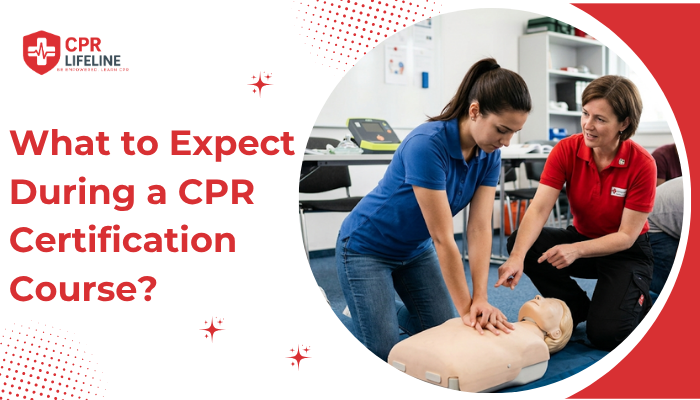
Hands-on practice is the most important part of any CPR certification course. Watching a demonstration builds awareness, but physically performing compressions and rescue breaths on a training manikin is what develops real muscle memory and confidence. Research published in Circulation, the American Heart Association’s flagship journal, consistently shows that hands-on practice significantly improves CPR skill retention compared to instruction alone. Each participant works directly with age-appropriate manikins representing adults, children, and infants, giving them the opportunity to practice the correct technique for each age group before the skills assessment.
Instructors observe each participant during practice and provide immediate feedback on compression depth, hand placement, rate, and rescue breath delivery. Many training programs use manikins equipped with feedback indicators that signal whether compressions are reaching the correct depth and rate in real time. Practice sessions also include AED simulations, where participants power on a training AED, apply pads, and follow audio prompts through a simulated cardiac emergency. Toward the end of the course, many programs run team-based emergency scenarios that require participants to coordinate roles, maintain compression quality, and communicate clearly under simulated pressure. These scenarios mirror real-world conditions and help participants transition from practicing individual skills to responding as a complete emergency team.
How Long Does a CPR Certification Course Take?
Most CPR certification courses are completed in a single day, with total course time ranging from two to eight hours depending on the certification level and format. Basic CPR courses designed for the general public tend to run on the shorter end, while healthcare provider courses that cover advanced skills and two-rescuer CPR require more time. Blended learning formats reduce in-person time by moving the instructional portion online, but the hands-on skills session is always completed in person. The table below outlines typical durations for the most common course types:
| Course Type | Typical Duration |
|---|---|
| Basic CPR | 2-4 Hours |
| CPR/AED | 3-5 Hours |
| CPR + First Aid | 4-8 Hours |
| Healthcare Provider BLS | 4-6 Hours |
Planning your schedule around the full course duration is important. Arriving late or leaving early can disqualify you from receiving certification, as most accredited programs require full participation in both the instructional and hands-on components. Healthcare professionals enrolling in a Basic Life Support course should expect a longer session that includes advanced scenarios and two-rescuer coordination practice. Regardless of course type, the majority of participants complete training and receive their certification the same day.
What Happens During the CPR Certification Test?
The CPR certification test has two components: a practical skills evaluation and, in many programs, a written knowledge assessment. The skills evaluation is the more significant of the two. During this portion, your instructor observes you performing CPR on a manikin and evaluates your technique against a standardized checklist. Compression depth, compression rate, hand placement, rescue breath delivery, and AED operation are all assessed. You must demonstrate each skill correctly and consistently to pass.
The written assessment, where required, tests your understanding of cardiac emergency recognition, CPR procedures, AED operation, and choking response. Multiple-choice questions cover the material from the instructional portion of the course. Most participants find the written assessment straightforward when they have engaged actively during practice sessions. If you do not pass on your first attempt, most accredited programs allow you to retake the assessment on the same day or schedule a retest shortly after, often at no additional cost.
How to Prepare for Your CPR Certification Course
Preparation before your course day sets the tone for your success during training. A few practical steps can make the experience smoother and help you focus fully on learning and practicing.
- Get adequate sleep the night before: CPR training is physically demanding and requires mental focus. Arriving well-rested helps you absorb instruction and perform better during hands-on practice and skills assessments.
- Eat a light meal before arriving: Certification courses often run for several hours without breaks for meals. Eating something light before you arrive prevents hunger from distracting you or reducing your energy during practice sessions.
- Wear comfortable, loose-fitting clothing: You will be kneeling, bending forward, and performing chest compressions repeatedly. Loose, flexible clothing makes the physical components much easier.
- Bring required identification: Some accredited programs require a valid ID for certification issuance. Confirm what your training provider requires before the course day.
- Arrive early: Give yourself enough time to check in, find your seat, and settle in before instruction begins. Late arrivals may not be permitted to join a session already in progress.
- Participate actively: Engage fully during every practice opportunity. Ask your instructor to correct your technique during practice sessions, not after the skills assessment has begun.
What Certification Do You Receive After Completing CPR Training?
Participants who pass both the skills evaluation and written assessment receive an official CPR certification card from the accrediting organization. Courses offered through the American Heart Association issue an AHA-recognized credential that is accepted by employers, licensing boards, and healthcare institutions across the United States. The certification card includes your name, the course completed, the issue date, and the expiration date. Most certifications are valid for two years from the date of completion, after which a renewal course is required to maintain active credentials.
Certification is issued either as a physical card, a digital credential, or both, depending on the training provider. Digital credentials can be stored on your phone and shared electronically with employers, which simplifies the verification process. Some employers and licensing agencies require certification from a specific accrediting body, so confirming those requirements before enrolling ensures your credential will be accepted. Renewal courses are typically shorter than initial certification courses since participants are refreshing existing skills rather than learning them for the first time. Staying ahead of your expiration date matters because many employers and licensing bodies do not accept lapsed credentials, even by a single day. Scheduling your CPR recertification before your current certification expires keeps you continuously compliant and prepared.
Which CPR Course Format Is Right for You?
The right CPR course format depends on your schedule, learning preferences, and any requirements set by your employer or licensing body. Classroom-based courses deliver everything in a single in-person session with direct instructor interaction. Blended learning courses move the instructional portion online and reserve the shorter in-person session for hands-on practice and skills testing. This is the format most people use when they decide to get CPR certified online. Healthcare professionals pursuing advanced credentials such as Basic Life Support certification should confirm their chosen format meets employer or credentialing requirements before enrolling.
The table below compares the most common CPR course formats to help you identify the best fit:
| Format | Advantages | Considerations |
|---|---|---|
| Classroom | Direct instructor feedback, single session | Fixed schedule, less flexibility |
| Blended Learning | Flexible study, shorter in-person time | Requires online pre-work |
| Healthcare BLS | Advanced skills, employer recognized | Longer duration |
| Workplace CPR | Job-specific training, team participation | May require employer coordination |
No format is universally better than another. What matters most is that the course is offered by an accredited provider, includes mandatory hands-on practice, and results in a credential your employer or licensing agency will accept. Participants in Tennessee and Georgia can explore available course formats and scheduling options through CPR Lifeline’s class listings to find a program that fits their needs.
Ready to Start Your CPR Certification Journey?
A CPR certification course takes you from uncertainty to confidence in a single day. Through structured instruction, hands-on manikin practice, and a straightforward skills assessment, you develop the ability to recognize a cardiac emergency and respond effectively before professional help arrives. Understanding what the course involves before you walk in removes the anxiety that holds many people back from signing up in the first place.
The next step is choosing a course that fits your schedule and meets your certification requirements. CPR Lifeline offers AHA-certified CPR, BLS, ACLS, and PALS courses across Tennessee and Georgia, with flexible scheduling options for both individuals and workplace teams. Browse available CPR certification classes and register for a session that works for you.
Faqs
A CPR certification course includes instructor-led teaching, hands-on practice on training manikins, and a skills assessment. Most courses are completed in a single day and cover adult, child, and infant CPR, AED operation, and choking response techniques. No prior medical knowledge is required to participate.
Most CPR courses take between two and six hours depending on the certification level and format. Basic CPR courses run on the shorter end, while healthcare provider BLS courses can take up to six hours. Blended learning formats reduce in-person time by moving instruction online before the skills session.
No, most participants pass on their first attempt. The test includes a practical skills evaluation and, in many programs, a multiple choice written assessment. Participants who engage actively during hands-on practice sessions are well prepared for both components.
Bring a valid ID if your training provider requires one for certification issuance. Wear comfortable clothing that allows you to kneel and move freely. Blended learning participants should complete all online modules before arriving at the in-person session.
Most CPR certifications are valid for two years from the date of completion. After that period, a renewal course is required to maintain active credentials. Many employers and licensing bodies do not accept lapsed certifications, so scheduling renewal before your expiration date is strongly recommended.
Classroom courses deliver all instruction and hands-on practice in a single in-person session. Blended learning courses split the instructional content into an online module completed before the in-person skills session. Both formats result in the same certification, but blended learning offers more scheduling flexibility.
Many employers in healthcare, education, childcare, and public safety require staff to hold current CPR certification as a condition of employment or licensing. The specific certification required varies by role and employer, so confirming requirements with your employer or licensing body before enrolling ensures you choose the right course.
No, fully online CPR certification is not recognized by most employers or licensing bodies. Accredited programs require an in-person hands-on skills session to confirm competency. Blended learning courses offer online instruction paired with a required in-person component, which is the closest option to a fully remote format.

Chris Peters
Chris Peters is a certified American Heart Association instructor and firefighter since 1996 with over 30 years of emergency response experience. After answering thousands of 911 calls, he founded CPR Lifeline to provide AHA-certified training that transforms bystanders into confident lifesavers who act decisively when seconds count