
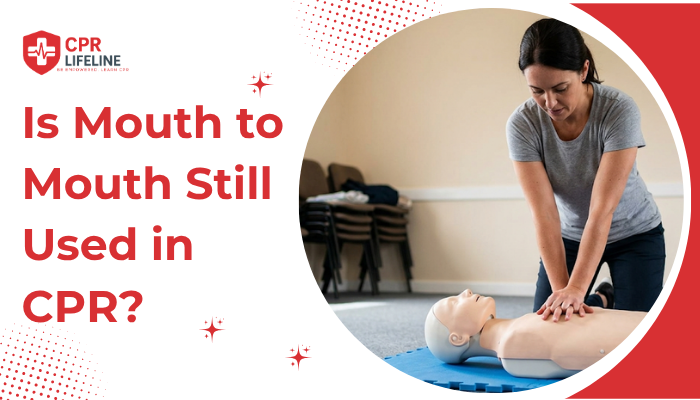

Many people hesitate to help during a cardiac arrest because they fear giving mouth-to-mouth breaths. That hesitation is understandable, but it has also cost lives. The good news is that CPR guidelines have evolved specifically to address that barrier and make it easier for bystanders to act.
Mouth-to-mouth is still used in CPR, but it is no longer required in every situation. The American Heart Association now recommends hands-only CPR for most adult sudden cardiac arrest cases, meaning chest compressions alone can be enough to keep someone alive until help arrives. Rescue breaths still play an important role in specific emergencies, including drowning, drug overdose, and cardiac arrest in infants and children.
This blog explains when mouth-to-mouth CPR is still necessary, why the guidelines changed, how to perform hands-only CPR correctly, and what actually gives a victim the best chance of survival depending on the situation.
Is Mouth-to-Mouth Still Recommended During CPR?
Mouth-to-mouth CPR is still used in some emergencies, but hands-only CPR is now the recommended approach for most adult sudden cardiac arrest cases. The American Heart Association confirms that for adults who collapse suddenly, continuous chest compressions without rescue breaths can be just as effective in the critical first minutes of response. Rescue breaths remain necessary when cardiac arrest stems from a breathing emergency, specifically in cases of drowning, drug overdose, respiratory arrest, and cardiac arrest in infants and children.
The distinction between cardiac arrest and respiratory arrest determines whether rescue breaths are needed. In sudden cardiac arrest, the heart stops abruptly while oxygen is still present in the bloodstream, making immediate compressions the priority. In respiratory arrest, the body has already been deprived of oxygen before the heart stops, and rescue breaths become essential to survival.
Why Did CPR Guidelines Change?
CPR guidelines changed in 2008 when the American Heart Association published a science advisory recommending that bystanders should prioritize chest compressions over rescue breaths for adult sudden cardiac arrest. The main reason for this change was bystander hesitation. Studies consistently showed that many people refused to perform mouth-to-mouth on a stranger, resulting in victims receiving no CPR at all. Placing compressions first removed that barrier and made it easier for anyone to act immediately without prior training.
Rescue breaths were not removed from CPR entirely. For trained and certified responders, conventional CPR combining compressions and rescue breaths remains the standard, and understanding the difference between BLS and CPR helps clarify why the expectations differ between bystanders and healthcare providers. Hands-only CPR was designed to increase bystander response, not to replace the full skill set that certified providers carry.
When Are Rescue Breaths Still Necessary?
Rescue breaths remain essential when oxygen deprivation is the primary cause of collapse rather than a sudden cardiac event. In these situations, the body has already been starved of oxygen before the heart stops, meaning compressions alone cannot address the underlying problem. Drowning, drug overdose, and respiratory arrest are the three most common emergencies where rescue breaths are a necessary part of the response. In each of these cases, restoring oxygen to the bloodstream is just as urgent as restoring circulation.
Children and infants are another critical exception. Unlike adults, younger patients most commonly experience cardiac arrest as a result of breathing failure rather than a sudden heart problem. This means their bodies are typically oxygen-depleted before the heart stops, making rescue breaths a required part of CPR rather than an optional addition. For infants, two gentle puffs of air are delivered after every 30 compressions using a two-finger compression technique. For children, the same 30:2 ratio applies with compressions scaled to the child’s size.
How to Perform Hands-Only CPR Correctly
Hands-only CPR removes the rescue breath component entirely, but it still requires correct technique to be effective. Sloppy compressions, wrong positioning, or poor pacing during the steps of CPR can significantly reduce the chances of survival. Following each step precisely is what makes the difference between effective and ineffective CPR.
- Confirm the scene is safe before approaching the victim.
- Tap the shoulders and shout to check for responsiveness.
- Call 911 immediately, or direct a nearby person to call and request an AED.
- Place the heel of your dominant hand on the center of the chest, on the lower half of the sternum, and interlace your other hand on top.
- Push hard and fast, compressing at least 2 inches deep at a rate of 100 to 120 compressions per minute.
- Allow full chest recoil between compressions without lifting your hands off the chest.
- Switch rescuers every two minutes when possible to maintain compression quality.
- Continue without stopping until emergency services arrive, an AED is ready, or the person shows clear signs of recovery.
Mouth-to-Mouth vs Hands-Only CPR: Which Works Better?
The core difference between the two comes down to who is performing CPR and what caused the emergency. Hands-only CPR is designed for untrained bystanders responding to adult sudden cardiac arrest, where oxygen is still present in the bloodstream, and immediate compressions are the priority. Mouth-to-mouth CPR is the standard for trained and certified responders, and it remains the required approach in oxygen-dependent emergencies like drowning, drug overdose, respiratory failure, and cardiac arrest in children and infants. Both approaches use the same compression rate of 100 to 120 per minute, but conventional CPR adds two rescue breaths after every 30 compressions to restore oxygen alongside circulation.
| Feature | Hands-Only CPR | Mouth-to-Mouth CPR |
|---|---|---|
| Rescue Breaths | None | 2 breaths every 30 compressions |
| Best For | Adult sudden cardiac arrest | Drowning, overdose, children, infants |
| Recommended For | Untrained bystanders | Trained and certified responders |
| Compression Rate | 100–120 per minute | 100–120 per minute |
| Primary Goal | Maintain blood circulation | Restore both circulation and oxygen |
| Ease of Use | Simpler, lower barrier to act | Requires training for correct technique |
Why Are People Unwilling to Give Mouth-to-Mouth CPR?
Bystander hesitation around mouth-to-mouth CPR is one of the biggest barriers to survival in cardiac arrest. Studies have consistently shown that a large number of bystanders choose not to act, or delay acting, specifically because of the rescue breath requirement. Understanding why people hesitate helps explain why guidelines evolved and why addressing these concerns directly saves lives.
Fear of Disease Transmission
Many bystanders worry about contracting an infection through mouth-to-mouth contact. For sudden cardiac arrest, this fear has little real reason behind it. There are very few documented cases of disease transmission through CPR rescue breaths, and the risk to a rescuer performing compressions-only is essentially negligible.
Fear of Causing Harm
Some bystanders hold back because they are afraid of injuring the victim, particularly around rib fractures from chest compressions. A broken rib is a possible outcome of CPR, but it is not a life-threatening injury. Cardiac arrest without intervention is fatal, and whether you can get sued for doing CPR is a concern that Good Samaritan laws were specifically designed to address.
Lack of Training and Confidence
Many bystanders have never received formal CPR training, and without it, performing rescue breaths feels intimidating and uncertain. Even people who have been trained in the past may feel their skills have faded. This is one of the strongest arguments for regular CPR recertification, and knowing how long CPR certification lasts is an important first step for anyone considering a renewal.
Discomfort With Physical Intimacy
Performing mouth-to-mouth on a stranger involves a level of physical closeness that many people find uncomfortable, particularly across gender, cultural, or personal boundaries. This discomfort is a real psychological barrier and one of the primary reasons the American Heart Association made hands-only CPR a recognized and supported option for bystanders.
Here’s What Matters Most Today
Mouth-to-mouth CPR is not outdated, but it is no longer the default action for every situation. For adult sudden cardiac arrest, hands-only CPR is a proven and effective option in real emergencies that removes the barriers keeping bystanders from acting. For drowning, drug overdose, respiratory failure, and cardiac arrest in children and infants, rescue breaths still remain a critical part of the response. The situation dictates the technique, and knowing the difference is what makes your response effective rather than just well-intentioned.
Getting certified is the most reliable way to build that knowledge and put it into practice under pressure. CPR Lifeline offers AHA-certified BLS, ACLS, and PALS courses with flexible scheduling designed for both healthcare professionals and everyday individuals. Whether you are learning for the first time or renewing an existing certification, our CPR courses give you the hands-on training to respond correctly regardless of what the emergency demands.
Faqs
Yes. Mouth-to-mouth CPR is still used in specific emergencies where oxygen deprivation is the primary cause of collapse. This includes drowning, drug overdose, respiratory arrest, and cardiac arrest in children and infants. For adult sudden cardiac arrest, hands-only CPR is now the recommended approach for untrained bystanders.
The guidelines changed in 2008 because research showed that bystander hesitation around rescue breaths was preventing people from performing CPR at all. Placing compressions first removed that barrier, reduced the time to first compression, and increased the number of bystanders willing to respond.
Yes, hands-only CPR is effective and produces survival outcomes comparable to conventional CPR when performed with consistent depth and pacing. For oxygen-dependent emergencies, however, rescue breaths remain a necessary part of the response.
Trained and certified responders should perform mouth-to-mouth CPR, particularly in emergencies involving drowning, drug overdose, or cardiac arrest in children and infants. Untrained bystanders are encouraged to perform hands-only CPR and let emergency dispatchers guide them through the process.
The risk is extremely low, but there are very few documented cases of disease transmission through rescue breaths during CPR. The risk of not acting in a cardiac arrest emergency far outweighs the minimal risk of infection to the rescuer.
The standard ratio for conventional CPR is 30 chest compressions followed by 2 rescue breaths. This cycle repeats continuously until emergency medical services arrive, an AED becomes available, or the person shows clear signs of recovery.
Yes. Children and infants most commonly experience cardiac arrest due to breathing failure rather than a sudden heart problem. Rescue breaths are a required part of CPR for pediatric patients, and the technique is adjusted based on the child's size and age.
Perform hands-only CPR immediately. Continuous chest compressions without rescue breaths are far better than no CPR at all. Call 911 and keep compressing at a rate of 100 to 120 per minute until professional help arrives.

Chris Peters
Chris Peters is a certified American Heart Association instructor and firefighter since 1996 with over 30 years of emergency response experience. After answering thousands of 911 calls, he founded CPR Lifeline to provide AHA-certified training that transforms bystanders into confident lifesavers who act decisively when seconds count