
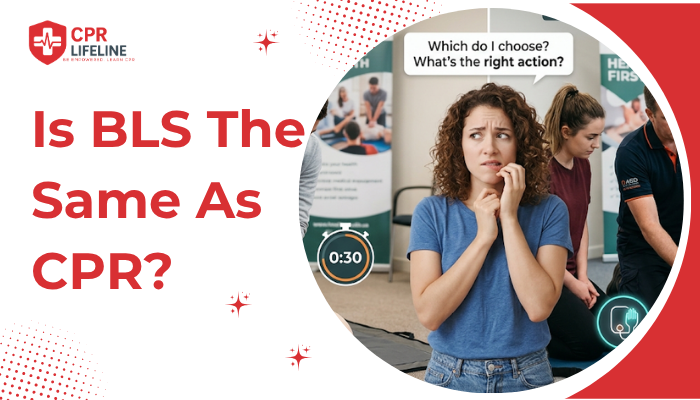
BLS and CPR are not the same thing, but it is easy to see why so many people confuse them. Both involve life-saving techniques, and both come up in emergency response training. The confusion stems from one key fact i.e CPR is actually a core component of BLS, not a separate or equivalent system.
Knowing the difference makes the real difference. CPR is a single emergency technique that uses chest compressions and rescue breaths to keep blood and oxygen circulating when the heart stops. BLS is a broader protocol used by healthcare providers that includes CPR along with AED operation, airway management, and team-based resuscitation. CPR is one part of BLS, not a replacement for it. Employers in hospitals, clinics, and other medical environments have specific requirements, and a basic CPR card often does not meet them.
In this blog, we discuss what CPR and BLS each involve, how they differ in scope and audience, and who needs which certification. Whether you are a healthcare professional, a first responder, or someone exploring your training options, understanding this distinction helps you make the right call before an emergency demands it.
What Is CPR?
CPR stands for cardiopulmonary resuscitation. It is a hands-on emergency technique used to keep blood and oxygen moving through the body when the heart has stopped beating. Without it, brain damage can begin in as little as four to six minutes after cardiac arrest. The technique has two core components: chest compressions and rescue breaths. Chest compressions manually pump blood through the heart. Rescue breaths deliver oxygen directly into the lungs. Together, they sustain the body’s vital functions until emergency medical help arrives.
There are mainly two types of CPR: Traditional CPR and Hands-only CPR. Traditional CPR combines chest compressions with rescue breaths and is the standard taught in most certified courses. Hands-only CPR uses continuous chest compressions without rescue breaths and is recommended by the American Heart Association for untrained bystanders responding to sudden cardiac arrest in adults.
CPR is designed for anyone to learn. It requires no medical background, and most CPR certification courses take between two and four hours to complete. Learning it gives you the ability to act in those critical first minutes before paramedics arrive.
What Is BLS? (Basic Life Support Overview)
BLS stands for Basic Life Support. It is a higher-level emergency response protocol designed for healthcare providers and trained medical personnel. Where CPR is a single skill, BLS is a structured system of skills used together to manage life-threatening emergencies. A BLS-certified provider is trained in four core areas: high-quality CPR, AED operation, airway management, and team-based resuscitation.
The team-based element is what most distinguishes BLS from standard CPR training. In a hospital or clinical setting, emergencies are rarely handled by one person alone. BLS prepares providers to communicate clearly, assign roles, and rotate responsibilities during a resuscitation effort without losing compression quality. According to the American Heart Association, BLS training is built around real-world clinical scenarios that reflect the demands of professional medical environments. Roles that require this level of training include nurses, paramedics, medical assistants, and respiratory therapists. Choosing the right BLS certification course ensures you meet employer requirements before stepping into a clinical role.
BLS vs CPR: Key Differences You Need to Know
BLS and CPR share the same goal which is to keep a person alive during a medical emergency. The differences lie in scope, audience, and skill depth. Understanding these distinctions helps you identify exactly which certification applies to your role or workplace.
| Feature | CPR | BLS |
|---|---|---|
| Core Skills | Chest compressions and rescue breaths | CPR, AED use, airway management, team response |
| Target Audience | General public and non-medical professionals | Healthcare providers and trained responders |
| Training Duration | 2 to 4 hours | 4 to 6 hours |
| Teamwork Focus | Individual response | Coordinated team-based response |
| Common Settings | Workplaces, schools, public spaces | Hospitals, clinics, emergency medical services |
1. Core Skills
CPR focuses on two foundational actions that are, chest compressions and rescue breaths. BLS builds on that foundation by adding AED operation, airway management, and structured team-based resuscitation. The result is a wider, more clinically comprehensive skill set designed for professional emergency response.
2. Target Audience
CPR is designed for everyone, including bystanders, teachers, parents, and workplace employees with no medical background. BLS is built specifically for healthcare providers who respond to emergencies in clinical or professional settings. The skill level and scenario complexity in BLS training reflect that difference directly.
3. Training Duration
A standard CPR course takes between two and four hours to complete. Whereas, BLS courses run typically between four and six hours, due to the additional skills and clinical scenarios involved. Both certifications are valid for two years before renewal is required.
4. Teamwork Focus
CPR is primarily an individual response skill taught for one-rescuer situations. BLS introduces team dynamics, including role assignment, clear communication, and rescuer rotation during prolonged resuscitation efforts. This team-based approach reflects the reality of how emergencies are managed in hospital and clinical environments.
5. Common Settings
CPR is most commonly used in public spaces, workplaces, schools, and homes where bystander response is the first line of action. BLS is applied in hospitals, clinics, ambulances, and emergency departments where coordinated medical teams manage cardiac and respiratory emergencies. The setting largely determines which certification is appropriate for your role.
When Do You Need BLS Instead of CPR?
BLS is required when your role places you in a clinical or professional medical environment. Nurses, paramedics, emergency medical technicians, medical assistants, dentists, and respiratory therapists are all expected to hold a current BLS certification. Most hospitals and healthcare facilities will not allow staff to work without one. OSHA guidelines and healthcare accreditation standards also influence which certification employers require, so checking your employer’s specific requirements before enrolling in a course is always the right first step.
CPR certification is appropriate for roles outside of direct clinical care. Teachers, childcare workers, fitness instructors, lifeguards, and workplace safety officers typically meet their requirements with a standard CPR course. That said, some non-medical employers are now requesting BLS-level training for staff in high-risk environments. When in doubt, ask your employer or licensing board which certification they recognize. Selecting the right CPR or BLS course from an accredited provider ensures your certification is valid and accepted wherever your role demands it.
How to Choose Between BLS and CPR Certification
Start by identifying what your job or situation actually requires. Check your employer’s hiring requirements, your state’s licensing board guidelines, or your school’s clinical placement criteria. Healthcare roles in hospitals, clinics, and emergency services almost always require BLS. Roles in education, fitness, childcare, or general workplace safety typically require standard CPR. Your certification choice should match the environment you work in, not just the level of training you feel comfortable with.
Once you know what is required, choose an accredited provider. The American Heart Association and the American Red Cross are the two most widely recognized certifying bodies in the United States. Both offer in-person, blended, and online options depending on your schedule and learning preference. CPR courses typically take two to four hours to complete, while BLS courses run four to six hours. Both certifications renew every two years, so building renewal into your professional calendar keeps you compliant and prepared. Exploring your CPR and BLS training options through a certified provider ensures your credentials are recognized by employers and meet current resuscitation guidelines.
Know Which One You Need
CPR and BLS both save lives, but they serve different people in different settings. CPR gives anyone the ability to respond in a crisis. BLS prepares healthcare providers to manage that crisis with precision, coordination, and clinical-level skill. Knowing which one applies to your role is not a minor detail. It determines whether your certification meets employer requirements, satisfies licensing boards, and holds up when it matters most.
If you are ready to get certified or need to renew your certifications, make sure you train with a provider that meets American Heart Association standards and offers hands-on skills validation. CPR Lifeline offers BLS certification courses across multiple locations, with flexible scheduling built around working professionals. Getting certified is a straightforward process, and the skill you walk away with is one you carry for life.
Faqs
No. CPR is a single life-saving technique that involves chest compressions and rescue breaths. BLS is a broader emergency response protocol that includes CPR along with AED use, airway management, and team-based resuscitation skills.
No. Most healthcare employers and licensing boards require BLS certification specifically. A standard CPR card does not meet BLS requirements, even if the course content partially overlaps.
Healthcare providers need BLS certification. This includes nurses, paramedics, emergency medical technicians, medical assistants, dentists, and respiratory therapists. Most hospitals and clinical facilities require a current BLS card before allowing staff to work.
A BLS certification course typically takes four to six hours to complete. Standard CPR courses run shorter, usually between two and four hours, depending on the provider and course format.
Both BLS and CPR certifications require renewal every two years. Staying current with your certification ensures your skills and knowledge reflect the latest resuscitation guidelines.
Yes, AED operation is a core component of BLS training. BLS-certified providers learn how to use an automated external defibrillator as part of a coordinated response to cardiac arrest.
Check with your employer or licensing board first. Healthcare roles almost always require BLS. If you work outside of a clinical setting, a standard CPR certification is likely sufficient. When in doubt, choosing BLS certification gives you a higher level of preparedness that covers both professional and personal emergency situations.

Chris Peters
Chris Peters is a certified American Heart Association instructor and firefighter since 1996 with over 30 years of emergency response experience. After answering thousands of 911 calls, he founded CPR Lifeline to provide AHA-certified training that transforms bystanders into confident lifesavers who act decisively when seconds count