
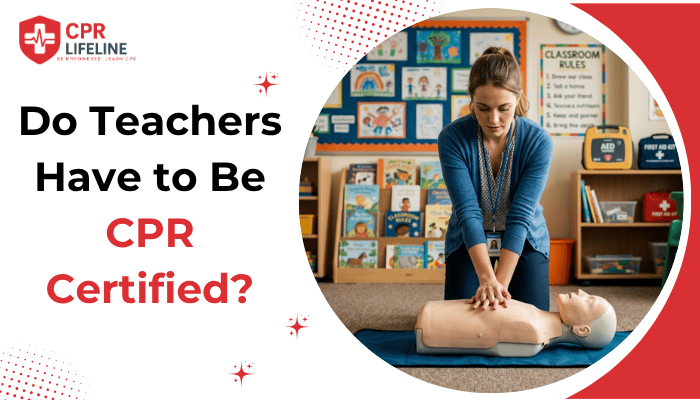
If you’re a teacher, or thinking about becoming one, you’ve probably wondered whether CPR certification is required by law. It’s a common question because teacher licensing requirements and school safety policies vary from state to state.
CPR certification for teachers depends on where you teach and what you teach. There isn’t a single national law that requires every teacher to be CPR certified. Each state sets its own requirements, and school districts may have additional policies. A teacher in one state may be required to maintain CPR certification, while someone in the same role in another state may not.
Learn whether teachers are required to be CPR certified, which states and roles require it, and why it’s worth having even where it isn’t legally mandatory.
Do All Teachers Need CPR Certification?
No, not all teachers need to be CPR certified. CPR requirements for teachers vary depending on the state, school district, and the type of teaching role. Some states require all teachers to have current CPR certification as part of their licensing requirements. Others only require certain teachers, such as PE teachers, coaches, health teachers, or staff who work with younger students, to complete CPR training.
Individual schools or districts may still require certification as part of their employment policies, even when a state does not have a specific CPR requirement. Many schools require CPR training because teachers are often the first adults available to respond during a medical emergency. Cardiac arrest happens more often in children than people realize. An American Heart Association policy statement found that between 7,000 and 23,000 out-of-hospital cardiac arrests occur in children each year, with nearly 39% of those events in youth being sports-related. That is exactly why trained teachers in schools lead to faster response times and a safer environment for everyone.
State-by-State CPR Requirements for Teachers
CPR certification requirements for teachers are different in each state and can change when new laws are passed. Some states require CPR certification for all licensed teachers, while others only require it for certain teaching roles. Always check the latest requirements with your state’s department of education or your local school district before signing up for a course.
Here’s how different states approach CPR certification for teachers:
1. States That Require CPR Certification for Most Teachers
Some states require CPR certification as part of getting or keeping a teaching license. These states are Arkansas, California, Indiana, Michigan, New York, Virginia, and West Virginia. The exact rules can vary but CPR training is usually tied to teacher licensing or certification.
2. States That Require CPR for Specific Teaching Roles
Some US states only require CPR certification for certain positions. Examples are Tennessee, Alabama, Illinois, Iowa, Kansas, Kentucky, Louisiana, Maryland, Massachusetts, Minnesota, Mississippi, Missouri, Nebraska, Nevada, New Hampshire, New Jersey and more. The roles that require CPR certification vary by state but often include physical education teachers, coaches, health teachers, and other staff responsible for student safety.
3. States Without a Statewide CPR Requirement
Several states don’t currently require teachers to have CPR certification under state law. They are Alaska, Arizona, Connecticut, Delaware, Florida, Georgia, Hawaii, Idaho, Maine, Montana, Ohio, Pennsylvania, Texas, Washington, and Wisconsin. But many school districts have their own hiring rules that require CPR certification, even when the state doesn’t require it.
4. States With School-Level CPR Requirements
Some states require schools, instead of individual teachers, to have trained staff on campus. For example, Colorado requires each school to have at least one staff member trained in CPR. Certification isn’t compulsory for every teacher.
Which Teachers Are Expected to Have CPR Training?
Certain teaching roles are more likely to require CPR certification because of their responsibilities. These roles often involve supervising higher-risk activities or responding to student emergencies. Knowing which positions commonly require CPR training can help you find out if certification is expected for your role.
Some of the most common school positions that require or recommend CPR certification include:
Physical Education and Health Teachers: PE and health teachers supervise physical activities where injuries, heat-related illnesses, breathing emergencies, and sudden cardiac arrest are more likely to occur.
Coaches and Athletic Staff: Student athletes face a higher risk of sudden cardiac arrest during sports and hard exercise. Coaches are often expected to know CPR and how to use an Automated External Defibrillator (AED).
School Nurses: School nurses are usually required to keep their CPR certification as part of their professional license. They are usually the first medical responders for students and staff during school hours.
Driver’s Education Instructors: Some states specifically require driver’s education instructors to have CPR certification because of the safety risks that come with behind-the-wheel training.
Special Education Teachers and Aides: Educators who work with students who have medical conditions, seizure disorders, or physical disabilities should be ready to respond quickly if an emergency happens.
Early Childhood Educators: Teachers and daycare staff who care for infants and young children are often required to complete CPR training. This training typically includes infant and child CPR because younger children face a higher risk of choking and breathing emergencies.
Cafeteria Staff and Playground Supervisors: Many schools certify lunchroom and playground staff because choking incidents, falls and other injuries often happen during meals and recess.
If you’re unsure whether CPR certification is required for your position, check your state’s education or licensing requirements and your school district’s policies. Even when classroom teachers aren’t required to be certified, staff in specialized roles often need to maintain current CPR certification.
Why Is CPR Certification Important for Teachers?
Teachers keep students safe throughout the school day. Medical emergencies such as cardiac arrest, choking, severe allergic reactions, and breathing difficulties can happen without warning, so knowing how to respond quickly is essential.
Here are five key reasons why CPR certification is an essential skill for every teacher:
Immediate Emergency Response
Medical emergencies rarely happen when healthcare professionals are present. In most school settings, teachers are the first adults to reach a student in distress. Teachers who know how to recognize cardiac arrest, start CPR, and use an AED can help keep blood flowing to the brain and other vital organs until emergency responders arrive. Those first few minutes often make the biggest difference in whether someone survives.
CPR Saves Lives During School Emergencies
Schools deal with all kinds of medical emergencies, not just cardiac arrest. Students or staff might choke during lunch, have a severe asthma attack, react to an allergen, or become unresponsive from an underlying condition. CPR certification for teachers teaches how to assess the situation, call for help, start chest compressions, and respond correctly until advanced medical care shows up.
Creates a Safer Learning Environment
Parents trust schools to keep their kids safe every single day. Having CPR-certified teachers on staff strengthens a school’s overall emergency preparedness and gives families peace of mind that trained people are around if something goes wrong. A school with several CPR-certified employees is better prepared to handle emergencies.
Builds Confidence During High-Stress Situations
CPR emergencies can be overwhelming if you have no training. CPR training helps teachers stay calm under pressure by giving them hands-on practice and clear steps to follow. Instead of freezing up or panicking, trained teachers are more likely to act fast, communicate with other staff and provide care until professional help takes over.
Supports School Safety Policies
Many schools encourage or require CPR certification for teachers, coaches, and other staff as part of their safety policies. CPR training helps staff respond more effectively during emergencies. It also prepares teachers for field trips, athletic events, after-school programs, and other situations where medical help may not be immediately available.
Hesitation is often the biggest barrier for teachers who are new to CPR, and legal concern is part of that hesitation. Most states, including Tennessee and Georgia, have Good Samaritan laws that protect teachers who act in good faith during an emergency. Understanding whether you can get sued for doing CPR can make that first moment of action feel far less intimidating.
What CPR Training for Teachers Covers?
CPR courses for teachers are designed to focus on the types of emergencies teachers are most likely to face while caring for students. Most CPR certification courses cover a wider range of emergency response skills because teachers work closely with children throughout the day.
Here’s what CPR training typically includes for teachers:
- Recognizing cardiac arrest and other emergencies: Teachers learn to identify the signs of cardiac arrest, choking, and severe allergic reactions so they can respond quickly and perform high-quality CPR.
- Hands-on CPR skills: Training includes practicing chest compressions and rescue breaths on manikins, with separate techniques taught for adults, children, and infants.
- AED use: Teachers learn how to operate an Automated External Defibrillator safely, including how to apply the pads and follow the device’s prompts during an emergency.
- Choking response: Courses cover how to help someone who is choking, with specific techniques for infants, children, and adults.
- Activating emergency services: Teachers are trained on when and how to call 911 and how to communicate clearly with emergency responders until help arrives.
Most CPR programs for teachers also include pediatric-specific training, since teachers are far more likely to respond to a medical emergency involving a child than an adult.
Protect Your Students With CPR Training
Whether CPR certification is legally required for teachers depends on the state, the role, and sometimes the school district. But even if it is not legally required, being prepared for a medical emergency is a responsibility every educator shares. If you’re a teacher and you’re not sure what your state or district requires, check directly with your school administration or state department of education, since these laws can change from year to year.
Emergencies in schools don’t wait for someone with the right training to show up. The teacher in the room is often the first line of response. A few hours of training is often all it takes. Many teachers complete the educational part at home and only need to attend a brief skills session, which is how online CPR certification is structured for school staff. If you’re ready to get certified, CPR Lifeline provides AHA-certified CPR courses through a convenient blended learning format with same-day certification upon successful completion.
Faqs

Chris Peters
Chris Peters is a certified American Heart Association instructor and firefighter since 1996 with over 30 years of emergency response experience. After answering thousands of 911 calls, he founded CPR Lifeline to provide AHA-certified training that transforms bystanders into confident lifesavers who act decisively when seconds count