



Cardiac arrest is a medical emergency where every second matters. When the heart suddenly stops pumping effectively, the brain and other vital organs quickly lose the oxygen they need to function. A fast, coordinated response keeps blood flowing to vital organs, restarts the heart through defibrillation when appropriate, and provides the medical care needed for treatment and recovery.
The Chain of Survival provides a framework for responding to cardiac arrest from the moment the emergency is recognized through long-term recovery. It includes several critical actions, such as activating emergency services, performing high-quality CPR, using an AED when appropriate, providing advanced resuscitation, delivering post-cardiac arrest care, and supporting recovery. Each step contributes to the overall response, and delays in one part of the process can affect the next.
In this blog, you will learn about the six links of the Chain of Survival and how each one supports a timely response to cardiac arrest. You will also learn how the Chain of Survival differs for adults and children and how the response can vary between out-of-hospital and in-hospital cardiac arrest.
What Is the Chain of Survival?
The Chain of Survival is a series of coordinated actions designed to improve the chances of survival after cardiac arrest. It describes how early recognition, immediate intervention, emergency medical care, and continued treatment work together to restore circulation, protect vital organs, and support recovery. Each part of the chain is known as a link, and the links are connected because timely action at one stage can help make the next stage more effective.
The concept emphasizes that cardiac arrest is a time-critical emergency and that every second matters. The response can begin with a bystander recognizing the emergency and activating the emergency response system, followed by CPR and defibrillation when appropriate, and then advanced medical treatment and post-cardiac arrest care. By bringing these actions together as one coordinated process, the Chain of Survival provides a framework for responding quickly and effectively to cardiac arrest.
What Are the 6 Links of the Chain of Survival?
The American Heart Association expanded the Chain of Survival from five links to six in its 2020 guidelines by adding Recovery as the final link. This addition highlights the importance of care after the initial emergency, including rehabilitation and support for cardiac arrest survivors.
The following sections explain each link, its purpose, and how it contributes to the overall care of a person experiencing cardiac arrest.
Link 1: Recognition and Activation
The first link focuses on quickly recognizing cardiac arrest and activating the emergency response system. Suspect cardiac arrest when a person is unresponsive and not breathing normally or is only gasping. Call for emergency medical help immediately so professional care can begin as soon as possible.
For bystanders, the priority is to recognize the emergency, call for help, and begin lifesaving actions without waiting to identify the exact cause. Activating emergency services early also helps trained responders and AEDs reach the person as quickly as possible.
Link 2: High-Quality CPR
High-quality CPR helps maintain blood flow to the brain and other vital organs when the heart stops pumping effectively. CPR does not usually restart the heart, but it helps preserve vital organ function while further treatment is arranged. Effective CPR requires chest compressions at the right rate and depth, complete chest recoil, and as few interruptions as possible.
For adults, current CPR guidance recommends chest compressions at a rate of 100 to 120 compressions per minute and a depth of about 5 to 6 cm (2 to 2.4 inches). Trained rescuers who are able and willing to provide rescue breaths should combine chest compressions with ventilation. Start CPR as soon as you recognize cardiac arrest.
Link 3: Rapid Defibrillation
Rapid defibrillation plays a critical role when cardiac arrest involves a shockable rhythm, such as ventricular fibrillation (VF) or pulseless ventricular tachycardia (pVT). An automated external defibrillator (AED) analyzes the person’s heart rhythm and determines whether a shock is needed. If the AED detects a shockable rhythm, it provides instructions for delivering the shock.
CPR and defibrillation work together during cardiac arrest. CPR helps maintain blood flow while someone retrieves and prepares the AED. Defibrillation can then restore an effective heart rhythm when a shockable rhythm is present. Using an AED as soon as possible is therefore an important part of the response.
Link 4: Advanced Resuscitation
Trained emergency medical professionals and healthcare teams provide advanced resuscitation. Depending on the patient’s condition, they may manage the airway, provide assisted ventilation, monitor the heart rhythm, establish intravenous or intraosseous access, give resuscitation medications, perform advanced defibrillation, and identify and treat reversible causes.
These interventions build on the early actions taken by bystanders and first responders. Advanced resuscitation provides additional medical support while the team works to restore and maintain effective circulation.
Link 5: Post-Cardiac Arrest Care
When the heart starts beating effectively again, known as return of spontaneous circulation (ROSC), the patient still needs ongoing medical care. Post-cardiac arrest care focuses on stabilizing the patient, protecting the brain and other vital organs, finding and treating the cause of cardiac arrest, and preventing further complications.
Depending on the patient’s condition, the healthcare team follows a structured framework such as the ACLS Post-Cardiac Arrest Care Algorithm to support breathing and oxygenation, maintain blood pressure and circulation, monitor the heart, manage body temperature, assess neurological function, and treat conditions such as acute coronary syndromes when appropriate. Continued monitoring remains important because cardiac arrest can affect the body even after circulation returns.
Link 6: Recovery
Recovery is the final link and recognizes that cardiac arrest care continues after the immediate emergency. Some survivors experience physical, neurological, cognitive, emotional, or psychological challenges after cardiac arrest. These effects vary from person to person.
Recovery may include physical or neurological rehabilitation, cognitive assessment, psychological support, occupational or speech therapy, follow-up medical care, and support for the survivor and their family. This link emphasizes the importance of ongoing care as survivors return to daily life.
Adult Chain of Survival vs. Pediatric Chain of Survival
The basic purpose of the Chain of Survival is the same for adults and children. Both require rapid recognition of cardiac arrest, appropriate resuscitation, restoration of circulation, advanced care, and support for recovery. However, the causes of cardiac arrest and some resuscitation priorities differ between the two age groups.
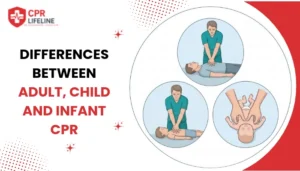
The table below highlights the key differences in causes, CPR techniques, and resuscitation priorities between adults and children.
| Feature | Adult Chain of Survival | Pediatric Chain of Survival |
|---|---|---|
| Common Cause | Often cardiac in origin, such as sudden cardiac events or arrhythmias | Often related to respiratory or circulatory problems, such as respiratory failure, choking, drowning, or shock |
| First Link Focus | Recognize cardiac arrest and activate the emergency response system immediately | Recognize cardiac arrest and activate the emergency response system. Early recognition and treatment of respiratory or circulatory problems can also help prevent cardiac arrest |
| Compression Depth | At least 2 inches (5 cm) but no more than 2.4 inches (6 cm) | About one-third of the chest depth, approximately 1.5 inches (4 cm) for infants and 2 inches (5 cm) for children |
| Compression Technique | Two hands on the lower half of the sternum | 1 or 2 hands depending on size for children. 2 fingers for a single rescuer or 2-thumb–encircling hands technique for two rescuers for infants. |
| CPR Ratio | 30:2 for both single and two-rescuer CPR | 30:2 for a single rescuer and 15:2 for two trained rescuers |
| Rescue Breaths | Hands-only CPR is appropriate for an untrained bystander who is unwilling or unable to provide breaths | Ventilation is especially important because pediatric cardiac arrest often follows respiratory problems |
| AED Use | Use an AED as soon as possible when indicated | Use an AED as soon as possible when indicated. Pediatric pads or a pediatric attenuator are preferred when available |
Chain of Survival in Out-of-Hospital vs. In-Hospital Cardiac Arrest
The Chain of Survival applies to both out-of-hospital cardiac arrest (OHCA) and in-hospital cardiac arrest (IHCA), but the response can differ depending on where the cardiac arrest occurs. The main difference is the availability of trained healthcare professionals, medical equipment, and immediate access to advanced resuscitation.
Out-of-Hospital Cardiac Arrest
Out-of-hospital cardiac arrest occurs outside a healthcare facility, such as at home, in a workplace, in a public location, or elsewhere in the community. Because professional medical help is not usually immediately available, bystanders often play an important role in the early links of the Chain of Survival. The response may begin with a bystander recognizing cardiac arrest, activating the emergency response system, starting CPR, and retrieving and using an AED when one is available. Emergency medical services then provide additional resuscitation and transport when appropriate.
In-Hospital Cardiac Arrest
In-hospital cardiac arrest occurs within a healthcare facility where trained staff, monitoring equipment, emergency equipment, and resuscitation teams are already available. Healthcare professionals may recognize signs of deterioration before cardiac arrest occurs or identify the arrest immediately when it happens. This setting allows the healthcare team to quickly activate a resuscitation response, begin high-quality CPR, provide defibrillation when indicated, manage the airway, administer medications, monitor the patient, and provide advanced and post-cardiac arrest care.
Every Link Matters When Every Second Counts
The Chain of Survival provides a clear framework for responding to cardiac arrest, starting with recognizing the emergency and continuing through treatment and recovery. Each link has an important role in the response, and timely action helps move the patient from one stage of care to the next. Understanding the Chain of Survival also helps you see why quick action and proper care are important throughout a cardiac arrest emergency.
Whether cardiac arrest occurs in a child or adult, at home or in a healthcare facility, timely action remains essential. CPR Lifeline provides AHA CPR certification courses to help individuals develop the knowledge and practical skills needed to respond effectively in an emergency. Knowing the Chain of Survival and having the right training can help you respond with greater confidence when every second matters.
Faqs
The Chain of Survival is important because cardiac arrest requires rapid, coordinated intervention. Early recognition, CPR, defibrillation, advanced resuscitation, post-cardiac arrest care, and recovery each contribute to the overall response.
There is not one link that is universally considered the most important. The Chain of Survival works as a connected sequence in which each link contributes to the overall outcome. For a bystander witnessing cardiac arrest, rapid recognition, activation of emergency services, and immediate CPR are critical early actions.
Start CPR as soon as you recognize cardiac arrest, while activating emergency medical services and using an AED as soon as it is available. Early CPR maintains blood flow to vital organs until you can provide more definitive treatment, such as defibrillation or advanced resuscitation.
Early recognition helps rescuers call emergency services, start CPR, and use an AED as soon as possible. Recognizing cardiac arrest quickly helps ensure these lifesaving steps begin without delay.
The overall principles are similar, but the causes of cardiac arrest and resuscitation priorities differ. Adult cardiac arrest is often associated with cardiovascular causes, whereas pediatric cardiac arrest is more commonly associated with respiratory or other non-cardiac causes. Pediatric CPR and advanced resuscitation also require age and size-appropriate techniques and equipment.
The American Heart Association added Recovery as the sixth link in its 2020 guidelines to recognize the ongoing physical, cognitive, emotional, and psychological needs of cardiac arrest survivors after the initial emergency.
CPR training teaches you how to recognize cardiac arrest, perform high-quality CPR, use an AED, and respond appropriately until professional medical help arrives.

Chris Peters
Chris Peters is a certified American Heart Association instructor and firefighter since 1996 with over 30 years of emergency response experience. After answering thousands of 911 calls, he founded CPR Lifeline to provide AHA-certified training that transforms bystanders into confident lifesavers who act decisively when seconds count