




Cardiac arrest survival depends heavily on the quality of CPR, and quality is measured by more than just compression depth or rate. One of the most critical and often overlooked metrics is chest compression fraction, the percentage of total resuscitation time during which chest compressions are actively being delivered. Many rescuers perform compressions correctly but lose valuable seconds through unnecessary pauses, and those lost seconds reduce blood flow to the brain and lower the chances of survival.
You can achieve a high chest compression fraction by minimizing pauses in compressions, preparing interventions before stopping, coordinating team roles efficiently, and resuming compressions immediately after any necessary interruption. Each of these actions directly affects how much oxygenated blood reaches the heart and brain during the resuscitation window.
This blog explains what chest compression fraction means, why experts target a high compression fraction, what causes it to drop, and which practical techniques help maintain continuous compressions during real emergencies.
What Is Chest Compression Fraction and Why Does It Matter?
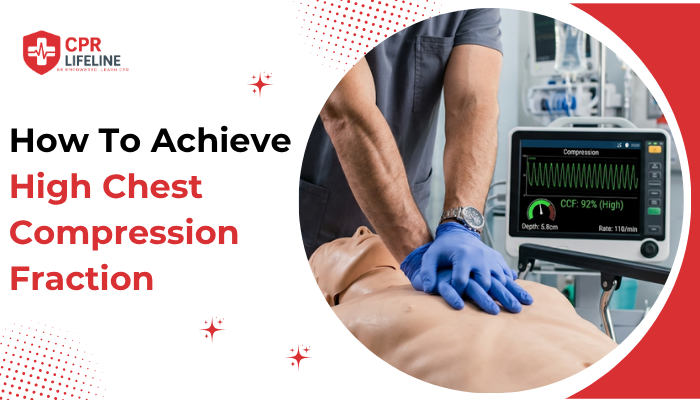
Chest compression fraction (CCF) measures the percentage of total CPR time during which chest compressions are actively being delivered. It is calculated by dividing the total time spent performing compressions by the total resuscitation time and expressing the result as a percentage. A CCF of 80% means compressions were active for 80% of the resuscitation effort, with the remaining 20% accounting for necessary pauses such as rhythm analysis, defibrillation, and airway management. Current resuscitation guidelines recommend maintaining a CCF of at least 60%, with many systems targeting 80% or higher whenever possible.
CCF matters because every pause in compressions causes coronary perfusion pressure to drop rapidly. Coronary perfusion pressure is the force that drives blood into the heart muscle during CPR, and it takes several compression cycles to rebuild after each interruption. A low CCF means the heart and brain are spending more time without adequate blood flow, which directly reduces the likelihood of return of spontaneous circulation and neurologically intact survival. According to the American Heart Association, CCF is one of the key metrics used to evaluate CPR quality in both clinical and emergency medical service settings. Achieving a high CCF requires deliberate preparation, efficient team coordination, and a clear understanding of what high-quality CPR looks like in practice.
What Causes Low Chest Compression Fraction?
Low chest compression fraction almost always results from pauses that are too long, too frequent, or poorly timed. Each interruption individually may seem brief, but the cumulative effect on coronary perfusion pressure is significant and directly reduces the likelihood of survival. These are the most common causes that drive CCF below the recommended threshold.
Prolonged Rhythm Analysis and Pulse Checks
Stopping compressions to analyze heart rhythm or check for a pulse is necessary, but doing it for too long is one of the most damaging interruptions in a resuscitation effort. A pause of just 10 seconds can cause coronary perfusion pressure to drop to near zero, requiring multiple compression cycles to rebuild. Pulse and rhythm checks should never exceed 10 seconds, and rhythm analysis should be performed with minimal hands-off time whenever possible.
Pre-Shock and Post-Shock Pauses
Delays in resuming compressions immediately before and after defibrillation are among the most critical contributors to low CCF. These pauses occur at the exact moment when the heart needs the most circulatory support. Charging the defibrillator while compressions are still in progress and resuming compressions within seconds of shock delivery are two of the most effective ways to reduce this hands-off time.
Poorly Coordinated Airway Management
Stopping compressions entirely to manage the airway, insert an advanced airway device, or reposition equipment adds significant hands-off time across a resuscitation effort. Airway management should be coordinated around the compression cycle rather than replacing it. Assigning a dedicated airway manager as part of a structured team response prevents compressions from being interrupted unnecessarily during this step.
Team Communication Failures
Without clearly assigned roles, rescuers hesitate, overlap responsibilities, or wait for direction instead of acting. These coordination gaps create unplanned pauses that accumulate quickly and are entirely preventable with proper team structure. Defining roles before interventions begin and using closed-loop communication during resuscitation keeps every team member acting with purpose and without delay.
Lack of Training and Confidence in Lay Rescuers
In bystander CPR situations, lack of confidence, fear of causing harm, and unfamiliarity with correct technique all contribute to longer and more frequent pauses. Hesitation before starting compressions and interruptions during the response reduce CCF before it ever has a chance to build. Regular CPR training and recertification is the most direct way to close that confidence gap and reduce the hands-off time that costs victims the most.
Practical Ways to Increase Chest Compression Fraction
Achieving a high chest compression fraction requires deliberate action before, during, and after every interruption in the resuscitation effort. The goal is not to eliminate all pauses but to shorten them, plan for them, and recover from them as quickly as possible. These are the most effective techniques for keeping CCF at or above the recommended threshold.
Minimize Compression Pauses
Every interruption in compressions should have a purpose and a time limit. The AHA recommends keeping all pauses under 10 seconds wherever possible. Before stopping compressions for any reason, the team should be ready to act immediately so that the interruption is as short as it can be.
Prepare Equipment Before Stopping Compressions
Charging the defibrillator, positioning airway equipment, and setting up any necessary interventions should happen while compressions are still in progress. Stopping compressions to prepare equipment that could have been readied in advance adds unnecessary hands-off time that directly lowers CCF.
Assign Clear Team Roles Before Interventions Begin
Designating a compressor, an airway manager, and an AED operator before the resuscitation effort begins eliminates hesitation and overlap during critical moments. Each team member should know their role and act within it without waiting for direction. Structured role assignment is the single most effective way to prevent the communication failures that cause unplanned pauses.
Resume Compressions Immediately After Every Interruption
Returning to compressions within seconds of rhythm analysis, shock delivery, or airway intervention prevents coronary perfusion pressure from dropping to zero and keeps the resuscitation effort moving forward. Post-shock pauses are particularly damaging, and compressions should resume without delay regardless of whether the rhythm analysis shows a change.
Rotate Compressors Every Two Minutes
Compression quality degrades with rescuer fatigue, and a fatigued compressor will unconsciously reduce depth and rate without realizing it. Rotating to a fresh compressor every two minutes maintains consistent compression quality and keeps CCF high throughout the resuscitation effort. The rotation itself should be practiced so it can be executed in under five seconds.
Use CPR Feedback Devices
Real-time CPR feedback devices monitor compression depth, rate, and pause duration, giving the team immediate data on CCF performance during the resuscitation. Studies have shown that feedback devices significantly improve compression quality and reduce hands-off time by making performance visible in the moment. Many advanced BLS and ACLS certification courses now incorporate feedback technology as part of hands-on training so rescuers are familiar with it before they face a real emergency.
Which Factors Influence Chest Compression Fraction in Professional and Lay Rescuer CPR?
Chest compression fraction does not look the same across every resuscitation scenario. The factors that influence CCF vary significantly depending on whether the response involves a trained medical team, a single bystander, or the environment where the arrest occurs.
- Professional Responder Factors: Structured teams with defined roles, advanced equipment, and performance monitoring tools give professional responders a significant advantage in maintaining high CCF. However, complex interventions like advanced airway placement and medication administration require carefully timed pauses that must stay under 10 seconds to protect compression continuity. Post-resuscitation debriefs and real-time feedback devices help professional teams identify CCF gaps and improve future performance.
- Lay Rescuer Factors: Most bystanders act alone without a team to share responsibilities or rotate compressions, which places the full physical and cognitive demand of resuscitation on one person. Hesitation, lack of confidence, and unfamiliarity with correct technique are the most common causes of unnecessary pauses in bystander CPR. Regular CPR training directly reduces hands-off time by building the muscle memory and decision-making confidence needed to act without hesitation.
- Environmental Factors: Crowded public spaces, confined areas like vehicles or narrow corridors, and remote locations all create physical barriers that affect compression quality and rescuer rotation. Delayed EMS response in rural settings extends total resuscitation time, placing greater demand on bystander CCF performance for longer periods. Awareness of these variables helps rescuers adapt their approach and prioritize compression continuity regardless of the conditions they face.
CCF Is the Metric That Separates Good CPR From Great CPR
Chest compression fraction is not a technicality reserved for clinical debriefs. It is a direct measure of how much of your resuscitation effort is actually working. Correct compression depth and rate matter, but they only deliver value during the seconds compressions are actively happening. Every unnecessary pause, every hesitation, and every poorly timed intervention chips away at the CCF and reduces the blood flow keeping the brain alive. Minimizing interruptions, preparing equipment in advance, assigning clear team roles, and rotating compressors on schedule are not advanced skills. They are deliberate habits that anyone trained in high-quality CPR can build and maintain.
Cardiac arrest does not give you time to figure things out as you go. The confidence to act without hesitation and the knowledge to keep compressions going through every stage of a resuscitation effort come from proper training. CPR Lifeline offers AHA-certified CPR, BLS, ACLS, and PALS courses that go beyond the basics and prepare you to perform under real pressure. Visit CPR Lifeline to find a course that matches your role and get the training that turns good intentions into great CPR.
Faqs
Chest compression fraction (CCF) measures the percentage of total resuscitation time during which chest compressions are actively being delivered. It is calculated by dividing total compression time by total resuscitation time and expressing the result as a percentage.
A good chest compression fraction is at least 60%. Most resuscitation guidelines encourage achieving 80% or higher whenever possible, as higher CCF values are consistently associated with improved survival outcomes in both in-hospital and out-of-hospital cardiac arrest.
You can achieve a high CCF by minimizing pauses, preparing equipment before stopping compressions, assigning clear team roles, resuming compressions immediately after every interruption, rotating compressors every two minutes, and using real-time CPR feedback devices when available.
Low CCF is most commonly caused by prolonged rhythm analysis, unnecessary pulse checks, pre-shock and post-shock pauses, poorly coordinated airway management, and team communication failures. In lay rescuer settings, lack of confidence and training are also significant contributing factors.
The American Heart Association recommends keeping all compression pauses under 10 seconds. Pauses longer than 10 seconds cause coronary perfusion pressure to drop significantly, requiring multiple compression cycles to rebuild to an effective level.
Every pause in compressions reduces coronary perfusion pressure, which is the force driving blood into the heart muscle during CPR. A low CCF means the heart and brain spend more time without adequate blood flow, directly reducing the likelihood of return of spontaneous circulation and neurologically intact survival.
Yes. Compression quality degrades with rescuer fatigue, and a fatigued compressor will unconsciously reduce depth and rate. Rotating to a fresh compressor every two minutes maintains consistent compression quality. The rotation itself should take no longer than five seconds to minimize hands-off time.
Yes. Real-time CPR feedback devices monitor compression depth, rate, and pause duration, giving rescuers immediate performance data during resuscitation. Studies have shown that feedback devices significantly improve compression quality and reduce hands-off time by making CCF performance visible in the moment.

Chris Peters
Chris Peters is a certified American Heart Association instructor and firefighter since 1996 with over 30 years of emergency response experience. After answering thousands of 911 calls, he founded CPR Lifeline to provide AHA-certified training that transforms bystanders into confident lifesavers who act decisively when seconds count