
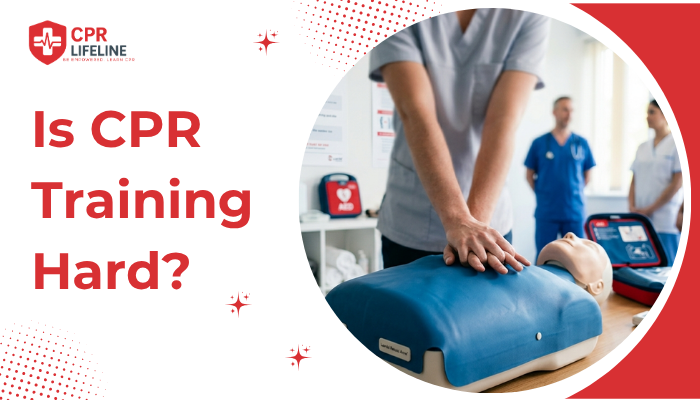

CPR training feels challenging for beginners, but most people complete it in a few hours. People who hesitate to enroll assume it requires medical knowledge, physical strength, or a background in healthcare. Though it requires none of these things, as it is built for everyday people, and the skills involved are designed to be learned quickly, practiced repeatedly, and retained long after the course ends.
A standard CPR course covers two areas: a short theory component and a hands-on practice session. The theory explains what cardiac arrest is, why immediate response matters, and how each step of CPR supports blood flow to the brain and vital organs. The hands-on portion is where you practice chest compressions, rescue breaths, and AED operation on a training mannequin with direct feedback. Most people complete their first CPR certification in a single sitting, often in under four hours.
The difficulty of CPR training is often exaggerated. The physical demands are manageable with correct technique, and the skills assessment is straightforward for anyone who practices attentively during the course. In this blog, we break down exactly what the course involves, what challenges to expect, and how to walk in prepared and walk out certified.
What is CPR?
CPR, or cardiopulmonary resuscitation, is an emergency procedure performed when a person’s heart stops beating or they stop breathing normally. It combines chest compressions and rescue breaths to manually keep blood and oxygen circulating through the body when the heart can no longer do it on its own. Without this circulation, the brain begins to suffer permanent damage within 4 to 6 minutes. CPR buys critical time between the moment of cardiac arrest and the arrival of emergency medical services.
Cardiac arrest is not the same as a heart attack. A heart attack occurs when blood flow to the heart is blocked, while cardiac arrest is the sudden loss of all heart function. CPR maintains blood flow to the brain and vital organs until a defibrillator or advanced medical care can restore a normal heart rhythm. Understanding this difference matters because it clarifies what CPR actually does and why starting it immediately can mean the difference between surviving with minimal brain damage or none at all.
Is CPR Training Hard for Beginners?
CPR training is not hard for most beginners because it teaches basic, repetitive skills that are designed to be learned quickly, even with no prior medical experience. The core actions involve delivering chest compressions at the correct rate and depth on the center of the chest. Most standard CPR courses take between 2 and 4 hours to complete, which is intentional as the skills involved do not require advanced knowledge. They only require correct technique, which instructors guide you through step by step during the hands-on portion of the course.
Here is what makes CPR training accessible for beginners:
- The skills are repetitive by design. Chest compressions follow a fixed rate, depth, and rhythm that you practice until the actions become automatic.
- Instructors provide real-time feedback. They correct your form, depth, and pace during practice so your technique improves within the same session.
- Mannequins remove real-world pressure. Practicing on a training mannequin lets you focus entirely on building correct technique without the anxiety of a real emergency.
- Completion rates are high across all age groups. CPR courses are successfully completed by teenagers, seniors, and everyone in between, regardless of fitness level or prior knowledge.
- Hands-only CPR lowers the learning curve further. Beginners who are not comfortable with rescue breaths can focus entirely on chest compressions, which is a recognized and effective technique on its own.
What Happens During a CPR Training Course?
CPR courses combine short theory lessons with hands-on practice and a final skills assessment. You spend the least amount of time listening and the most amount of time practicing. Most standard CPR courses take between 2 and 4 hours, depending on the certification type. The American Heart Association offers both in-person and blended learning formats, where students complete the theory component online at their own pace before attending a shorter in-person skills session.
Here is what a standard CPR course looks like:
- Instructor demonstration. Your instructor walks through each skill before you attempt it, covering hand placement, compression depth, rescue breath technique, and AED operation.
- Mannequin practice. You practice chest compressions and rescue breaths on a training mannequin, which makes up the majority of class time.
- Real-time feedback. Many modern training mannequins provide instant feedback on compression depth and rate, showing you exactly where your technique needs adjustment.
- Final skills assessment. You perform a short practical test in front of your instructor to confirm you can execute each skill correctly and at the right pace.
What Skills Do You Learn in CPR Training?
Chest compressions, rescue breaths, and AED operation are the three core skills that are taught in CPR training. Each skill builds on the previous one, and all three are practiced repeatedly during the hands-on portion of the course.
Chest Compressions
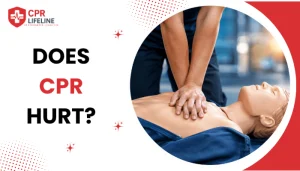
Chest compressions are the most physically demanding skill in CPR. You press down at least 2 inches into the center of the chest at a rate of 100 to 120 compressions per minute. Full chest recoil between each compression is required. Avoid leaning on the chest as it reduces blood flow and lowers the effectiveness of each compression.
Rescue Breaths
Rescue breaths follow a ratio of 30 chest compressions to two breaths, with each breath lasting approximately one second. You must use the correct head-tilt and chin-lift technique to keep the airway open during delivery. If you are not trained or comfortable with rescue breaths, hands-only CPR remains a valid and effective alternative.
AED Operation
AED operation is the most straightforward skill in the course. The device provides clear voice instructions that guide you through every step, from pad placement to shock delivery. You follow the prompts exactly as given, and the AED handles all analysis and timing decisions automatically.
What Makes CPR Training Feel Difficult?
Physical effort is the most immediate challenge in CPR training. According to a manikin study on rescuer fatigue and chest compression decay, compression quality can begin to decline after 60 to 90 seconds of continuous effort, with both depth and rate affected as the rescuer tires. Effective compressions require you to press down using your body weight with straight arms rather than pushing with your arm muscles. This technique feels unnatural at first, and most beginners default to using arm strength, which leads to faster fatigue and shallower compressions.
Performance pressure is the second major factor. Coordinating 30 compressions with 2 rescue breaths at the correct pace requires rhythm and timing that takes a few practice rounds to develop. Some learners also tense up during the final skills assessment, which disrupts the same rhythm they performed confidently during practice. Based on a CPR study on feedback‑enhanced chest compression training, guided feedback on rate and depth during practice helps reduce performance decline, and skill accuracy improves measurably with repetition.
How Can You Pass CPR Training Easily?
You pass CPR training by arriving prepared, focusing on depth and rhythm during practice, and applying instructor feedback in real time. The skills assessment is straightforward. It tests the same actions you practice repeatedly throughout the course, so consistency matters more than perfection.
Here are the most effective preparation tips to cpr training:
- Practice your compression rhythm before the course. Use a song between 100 and 120 BPM to internalize the correct pace before your first class. Stayin’ Alive by the Bee Gees at 103 BPM is the most widely used reference in CPR training programs worldwide.
- Use body weight, not arm strength. Keep your arms straight and press down using your upper body weight. It delivers deeper compressions with significantly less fatigue.
- Watch a short pre-course review video. Reviewing the basic steps beforehand reduces the cognitive load during training, so you spend more time refining technique and less time absorbing new information.
- Stay calm during the skills assessment. Slow down slightly if needed and focus on depth and rhythm. The assessment is not designed to fail you. It is designed to confirm you can perform the actions you have already practiced.
Who Should Take CPR Training and Why?
CPR training is not reserved only for healthcare professionals. Parents, teachers, employees, and bystanders all benefit from knowing how to respond during a cardiac emergency. A parent serves as the first responder in a home emergency, just as a teacher acts as the first responder in a classroom or an employee in a workplace incident. In each of these situations, the person closest to the victim determines the outcome before emergency services ever arrive on the scene.
Administering early CPR can double or triple a person’s chance of survival, and that survival window depends entirely on whether someone nearby knows what to do. Every second without blood flow increases the risk of permanent brain damage. CPR training gives you the ability to act in that window with confidence, correct technique, and no hesitation. But you should also understand what certifications involve and how long they stay active.
Should You Take CPR Training Even If It Feels Difficult?
CPR training is manageable for most people because it teaches simple, repeatable actions with guided practice. The physical effort and performance pressure are real challenges, but both respond directly to preparation and repetition. You do not need medical experience, exceptional fitness, or prior first aid knowledge to complete the course and walk out certified.
The skills you learn in CPR training are ones you hope never to use. But cardiac arrest does not announce itself, and the person closest to the victim is rarely a medical professional. Knowing how to act in that moment, with the right technique and the right rhythm, is what determines whether someone survives. If you are ready to build that skill, CPR Lifeline offers certified courses designed for everyday people at locations near you.
Faqs
CPR training is not hard for most people. The course teaches basic, repetitive skills that are designed to be learned in a single session with no prior medical experience required. The core actions are straightforward, and the challenges it has improves significantly with guided practice.
A standard CPR course takes between 2 and 4 hours to complete. A Basic Life Support course for healthcare providers runs closer to 4 to 5 hours. Blended learning options, where you complete the theory component online beforehand, can reduce the in-person session to as little as 30 to 40 minutes. The total time depends on the certification type and the training format you choose.
Yes. CPR training is designed for everyday people with no medical background. It is successfully completed by teenagers, seniors, teachers, parents, and workplace employees across all fitness levels. The skills are simple and repetitive by design, and instructors provide hands-on feedback throughout the course to ensure every participant can perform them correctly.
CPR certification needs to be renewed every two years. It applies to most standard certifications from major training organizations, including the American Heart Association and the American Red Cross. Healthcare professionals working in hospitals or emergency medical settings may be required to renew annually, depending on their employer's compliance requirements.
No. You do not need to be physically fit to learn or perform CPR. Effective chest compressions rely on correct body positioning and the use of body weight rather than arm strength. Positioning yourself directly above the chest with straight arms significantly reduces the physical demand. Most people of average fitness can perform CPR correctly after a single training session.
Yes, but it is uncommon. The skills assessment at the end of the course tests whether you can perform chest compressions, rescue breaths, and AED operation at the required standard. Most training providers allow you to repeat the assessment if you do not pass on the first attempt.
Research consistently shows that CPR skills begin to deteriorate within months after initial training, with significant degradation occurring after one year. This is why certification renewal is required every two years and why regular practice between certifications is strongly recommended. Reviewing compression technique and BPM rhythm periodically helps maintain the muscle memory built during your initial course.

Chris Peters
Chris Peters is a certified American Heart Association instructor and firefighter since 1996 with over 30 years of emergency response experience. After answering thousands of 911 calls, he founded CPR Lifeline to provide AHA-certified training that transforms bystanders into confident lifesavers who act decisively when seconds count