


Finding someone unresponsive is one of the most alarming situations a person can face. The instinct to shake them, call their name, or wait to see what happens can feel overwhelming. Acting on those instincts without a clear plan, however, can make the situation worse. Incorrect handling of an unresponsive person can obstruct the airway, worsen a spinal injury, or delay emergency care that could save their life.
When a person is unresponsive but breathing, the priority is protecting their airway, calling emergency services, and monitoring their condition closely until professional help arrives. CPR is not required unless normal breathing stops.
Learn how to check responsiveness and breathing, when to call emergency services, how to place someone in the recovery position, when CPR becomes necessary, and the most common mistakes to avoid when responding to this emergency.
What Does It Mean When a Person Is Unresponsive but Breathing?
An unresponsive person does not react to voice, touch, or stimulation. They cannot answer questions, follow instructions, or protect their own airway. A sleeping person will wake with a firm tap or loud voice, but an unresponsive person will not. The fact that they are still breathing means the heart is functioning and oxygen is still reaching the brain, but that status can change without warning, which is why continuous monitoring is essential from the moment you identify the situation.
Several medical conditions can cause a person to become unresponsive while still breathing:
- Fainting (syncope): A sudden drop in blood flow to the brain causes brief loss of consciousness, most commonly triggered by dehydration, heat, pain, or emotional stress.
- Stroke: A blocked or ruptured blood vessel in the brain can cause sudden loss of consciousness alongside other neurological symptoms.
- Seizure: A seizure can leave a person unresponsive and disoriented in the minutes immediately following the event.
- Diabetic emergency: Severely low or high blood sugar can impair brain function rapidly and cause loss of consciousness.
- Head injury: Trauma to the head can cause immediate or delayed loss of consciousness depending on the severity of the injury.
- Drug or alcohol overdose: Both can suppress the central nervous system and cause unresponsiveness while breathing continues.
- Heat stroke: Extreme overheating causes the body’s temperature regulation to fail and can result in sudden loss of consciousness.
- Low blood oxygen: Conditions that reduce oxygen delivery to the brain, including severe asthma or choking, can cause unresponsiveness even when breathing is present.
How Do You Check Whether Someone Is Truly Unresponsive?
Checking responsiveness takes less than ten seconds and should happen before any other action. Speed matters, but accuracy matters more. A person who appears unresponsive may simply be deeply asleep, heavily intoxicated, or in a postictal state following a seizure. Confirming true unresponsiveness before calling emergency services ensures you give the dispatcher accurate information and take the correct next steps.
Follow these 7 steps to determine whether a person is unresponsive:
- Step 1. Ensure the scene is safe: Look for hazards before approaching. Do not put yourself at risk by rushing toward someone in an unsafe environment.
- Step 2. Tap the shoulders firmly: Place both hands on the person’s shoulders and tap firmly while calling out loudly. Use their name if you know it.
- Step 3. Shout loudly: Ask clearly and directly whether they are okay. A person who is deeply asleep or briefly faint may respond to a loud voice even without physical stimulation.
- Step 4. Look for any response: Watch for eye movement, facial expression, limb movement, or any sound. Even a groan or slight movement counts as a response and changes your assessment.
- Step 5. Open the airway: Tilt the head back gently and lift the chin to open the airway. This prevents the tongue from blocking the throat in an unconscious person.
- Step 6. Check for breathing: Look for chest rise, listen for breath sounds, and feel for air movement against your cheek. Check for up to ten seconds before concluding that breathing is absent or abnormal.
- Step 7. Call emergency services if unresponsive: Dial 911 immediately if the person does not respond to voice or touch. Do not leave them alone to make the call. Use a phone on speaker or instruct a bystander to call while you stay with the person.
What Should You Do Immediately If They Are Breathing?
Confirming that an unresponsive person is breathing is not the end of the response. It is the beginning of active monitoring and airway protection until emergency services arrive. Breathing can deteriorate rapidly, and every action from this point forward is designed to keep the airway open, prevent complications, and ensure the person receives professional care as quickly as possible.
The first and most important action is calling 911 immediately, even if the person appears stable. An unresponsive person always requires professional medical evaluation regardless of how normal their breathing seems. While waiting for help, keep the airway open by maintaining the head tilt and chin lift position. Loosen any tight clothing around the neck or chest that could restrict breathing or circulation. Place a blanket or coat over the person to prevent heat loss, particularly in cool or outdoor environments.
Do not leave the person alone at any point. Monitor breathing continuously by watching for chest rise and fall. Conditions can change without warning, and a person who is breathing normally one minute may stop breathing the next. Send a bystander to meet emergency responders at the entrance if needed, but remain beside the patient yourself. Be ready to begin CPR immediately if breathing stops or becomes abnormal. When you already know how to perform CPR, you can act without hesitation the moment it matters most.
How Do You Place Someone in the Recovery Position?
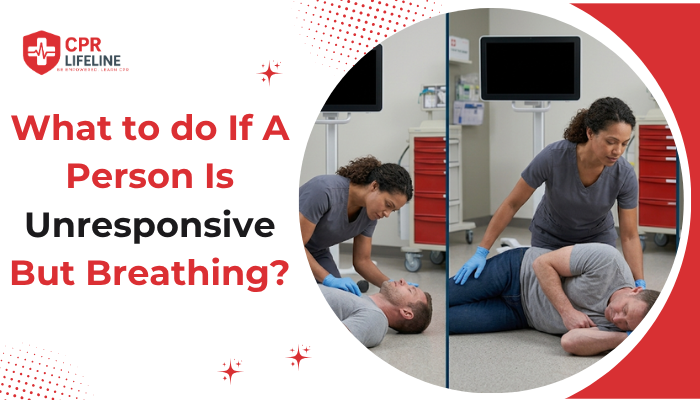
When a person is unresponsive but still breathing, the recovery position places them on their side in a supported posture. This keeps the airway clear and allows any fluid or vomit to drain away from the throat. It is one of the most important first aid skills for managing an unresponsive person and should be used any time there is no suspected spinal injury. Do not attempt the recovery position if you have any reason to believe the person has injured their neck or spine. In that case, keep them still and maintain the airway with a jaw thrust until emergency responders arrive.
Follow these 8 steps to place someone in the recovery position correctly:
- Step 1. Kneel beside the person: Position yourself on one side of the person at chest level. Make sure they are lying flat on their back before you begin.
- Step 2. Position the nearest arm: Extend the arm closest to you outward at a right angle to the body with the elbow bent and the palm facing upward. This arm acts as a support brace during the roll.
- Step 3. Bring the far arm across the chest: Take the person’s far hand and place the back of it against their near cheek. Hold it there to guide the head during the roll.
- Step 4. Bend the far knee: Reach across and pull the far knee upward so the foot stays flat on the ground. This bent knee provides the leverage needed to roll the person onto their side.
- Step 5. Roll them toward you: Using the bent knee as leverage, gently pull the person onto their side toward you. Guide the head with the hand still held against the cheek to keep the neck aligned during the roll.
- Step 6. Adjust the head position: Tilt the head back slightly and lift the chin to keep the airway open. The hand placed against the cheek helps maintain this position without additional support.
- Step 7. Adjust the top knee: Position the top knee at a right angle to the body so it acts as a stable base and prevents the person from rolling forward or backward.
- Step 8. Monitor breathing continuously: Stay beside the person and watch for chest rise and fall. Be prepared to begin CPR immediately if normal breathing stops at any point.
When Should You Call Emergency Services?
Call 911 immediately any time a person is unresponsive, regardless of whether they are breathing. Do not wait to see whether the person recovers on their own, and do not attempt to drive them to a hospital yourself. Dispatchers can guide you through the correct response while professional help is on the way, and paramedics can begin treatment before the person reaches a hospital. Certain situations require an emergency call without any hesitation:
- The cause of unresponsiveness is unknown
- Breathing is slow, shallow, noisy, or irregular
- The lips, fingernails, or skin appear blue or gray
- A seizure has lasted longer than five minutes, or the person does not regain consciousness afterward
- A stroke is suspected based on facial drooping, arm weakness, or slurred speech
- Head trauma has occurred or is suspected
- Drug or alcohol overdose is possible
- The person is pregnant
- The person is a child or infant
- A diabetic emergency is suspected, and the person does not respond to treatment
Some of these situations carry a higher risk of rapid deterioration than others. A suspected stroke, for example, requires emergency intervention within a narrow time window to minimize permanent brain damage. The consequences of calling too early are far less serious than the consequences of calling too late.
When Does an Unresponsive Person Need CPR?
CPR is indicated only when a person is unresponsive and not breathing normally. Delivering CPR to a person who is breathing can cause unnecessary injury, including rib fractures and internal damage. The presence of normal breathing confirms that the heart is still pumping blood effectively, which means the body’s circulation does not require external support. Continue monitoring breathing and maintaining the airway until emergency responders arrive.
The critical distinction to understand is the difference between normal breathing and agonal breathing. Agonal breathing consists of infrequent, irregular gasps that can sound like snoring or gurgling. It is a reflex action caused by the brainstem during cardiac arrest and is not effective respiration. A person displaying agonal breathing is not breathing normally and requires immediate CPR. Begin chest compressions the moment normal breathing stops or becomes absent, and use an AED as soon as one is available. Understanding the difference between sudden cardiac arrest and a heart attack helps clarify why the presence or absence of normal breathing is the single most important factor in deciding whether CPR is needed. Do not delay compressions to recheck for a pulse. If the person is unresponsive and not breathing normally, begin CPR immediately.
What Mistakes Should You Avoid?
The most dangerous mistakes made during this emergency are not dramatic errors. They are small, well-intentioned actions that feel instinctive but cause real harm. Knowing what not to do is just as important as knowing what to do, and avoiding these mistakes can be the difference between a stable situation and a rapidly deteriorating one.
These are the most common mistakes to avoid when responding to an unresponsive but breathing person:
- Leaving the person alone: An unresponsive person cannot protect their own airway or call for help. Leaving them unattended, even briefly, removes the only safeguard between a stable condition and a fatal complication.
- Shaking them vigorously: Shaking an unresponsive person can worsen a spinal injury, trigger a seizure, or cause additional trauma. Tap the shoulders firmly once to check responsiveness and do not repeat it forcefully.
- Assuming they are asleep: Unresponsiveness and deep sleep look similar but require completely different responses. Always perform the full responsiveness check before concluding that the person is simply sleeping.
- Giving food or water: An unresponsive person cannot swallow safely. Introducing anything into the mouth risks aspiration, where fluid or food enters the airway and causes choking or lung damage.
- Placing a pillow under the head: Elevating the head can flex the neck forward and close off the airway. Keep the head in a neutral position with the chin lifted to maintain an open airway.
- Delaying the call to emergency services: Many bystanders wait to see whether the person recovers before calling 911. Every minute of delay reduces the window for effective medical intervention, particularly in stroke and cardiac emergencies.
- Ignoring changes in breathing: Breathing that was normal a minute ago can become labored, irregular, or absent without warning. Continuous monitoring is not optional. It is the most important thing you can do while waiting for help to arrive.
What Should You Remember While Waiting for Emergency Help?
The time between calling 911 and the arrival of emergency responders is when bystander action matters most. A person’s condition can change significantly during that window, and staying focused on a clear set of priorities is what keeps the situation from deteriorating further. Panic is the most common barrier to effective bystander response, and having a mental checklist to follow replaces panic with purposeful action.
Keep these priorities in mind while waiting for help to arrive:
- Stay calm and focus on monitoring, not on predicting what happens next.
- Watch the chest rise and fall continuously without interruption.
- Maintain the head tilt and chin lift to keep the airway open.
- Turn the person onto their side immediately if they vomit.
- Note any changes in breathing, skin color, or responsiveness to relay to responders.
- Be ready to begin CPR the moment normal breathing stops or becomes absent.
Knowing What to Do Before Every Second Counts
An unresponsive but breathing person needs immediate action, not a wait-and-see approach. Check responsiveness, assess breathing, call emergency services without delay, place the person in the recovery position when appropriate, and monitor their condition continuously until professional help arrives. CPR is only required if normal breathing stops, but being prepared to make that transition instantly is what separates an effective bystander response from a hesitant one.
The skills covered in this guide are not difficult to learn, but they do require hands-on practice to perform confidently under pressure. CPR Lifeline offers AHA-certified CPR courses across Tennessee and Georgia that cover exactly these scenarios, from airway management and recovery positioning to CPR and AED use. Browse available CPR certification courses and register for a session that prepares you to respond before an emergency puts those skills to the test.
Faqs
Call 911 immediately, open the airway using a head tilt and chin lift, and place the person in the recovery position if there is no suspected spinal injury. Monitor breathing continuously and stay with the person until emergency responders arrive. Begin CPR only if normal breathing stops.
The recovery position places an unresponsive but breathing person on their side in a stable, supported position that keeps the airway open and allows fluid or vomit to drain away from the throat. Use it any time a person is unresponsive and breathing without a suspected spinal injury. Do not use it if head or neck trauma is possible.
Tap the person's shoulders firmly and shout loudly to check for any response. Open the airway by tilting the head back and lifting the chin, then check for breathing by looking for chest rise, listening for breath sounds, and feeling for air movement for up to ten seconds. Call 911 immediately if there is no response.
No, CPR is not required if the person is breathing normally. CPR is indicated only when a person is unresponsive and not breathing normally. Monitor breathing continuously and begin CPR immediately if normal breathing stops or is replaced by infrequent, irregular gasping.
Agonal breathing consists of infrequent, irregular gasps that can sound like snoring or gurgling. It is not normal breathing and should not be mistaken for a sign that the person is breathing adequately. A person displaying agonal breathing requires immediate CPR.
Call 911 immediately any time a person is unresponsive, regardless of whether they are breathing. Do not wait to see whether the person recovers on their own. Situations requiring an immediate call include suspected stroke, seizure lasting longer than five minutes, head trauma, drug or alcohol overdose, and any case where the cause of unresponsiveness is unknown.
Do not leave the person alone, shake them vigorously, give them food or water, place a pillow under their head, or delay calling emergency services. These actions can worsen a spinal injury, block the airway, or reduce the window for effective medical intervention. Stay beside the person, monitor breathing, and follow dispatcher instructions until help arrives.
The most common causes include fainting, stroke, seizure, severely low blood sugar, head trauma, drug or alcohol overdose, heat stroke, and low blood oxygen. Identifying the possible cause while monitoring the person gives emergency responders critical information that can accelerate the correct diagnosis and treatment on arrival.

Chris Peters
Chris Peters is a certified American Heart Association instructor and firefighter since 1996 with over 30 years of emergency response experience. After answering thousands of 911 calls, he founded CPR Lifeline to provide AHA-certified training that transforms bystanders into confident lifesavers who act decisively when seconds count