

BLS and ACLS are both life-saving certifications, but they are not interchangeable. Healthcare professionals often find themselves unsure which one their role requires, whether one can substitute for the other, or whether they need both. Choosing the wrong certification can mean failing to meet employer requirements or arriving underprepared for the emergencies your position demands.
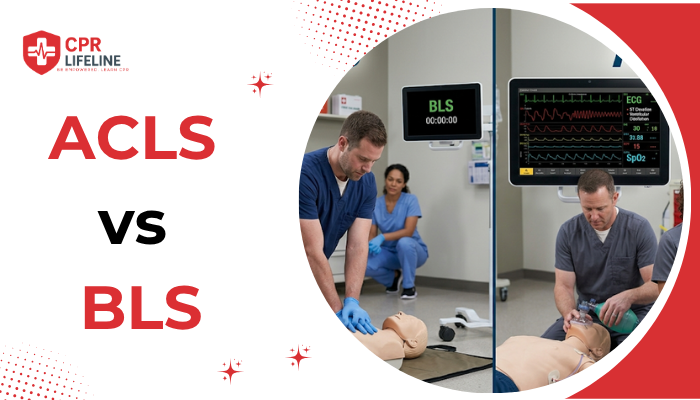
BLS teaches fundamental life-saving skills including CPR, AED use, and rescue breathing for adults, children, and infants. ACLS builds on that foundation by adding advanced cardiac emergency management, ECG interpretation, emergency medications, airway management, and team leadership skills for healthcare professionals who respond to complex cardiac events.
This blog breaks down what each certification covers, who needs each one, how the two compare side by side, and how to decide which certification matches your current role and career goals.
What Is BLS?
Basic Life Support, or BLS, is a certification program that teaches healthcare providers and trained responders how to recognize and respond to life-threatening emergencies involving cardiac arrest, respiratory failure, and airway obstruction. BLS training equips participants with the foundational skills needed to sustain life until advanced medical care arrives or takes over. It is the entry-level cardiac emergency certification recognized across healthcare settings and is required by most employers before a provider begins patient-facing work. The American Heart Association’s BLS course is the most widely accepted version and is designed specifically for healthcare professionals rather than the general public.
BLS certification covers six core skill areas that every provider must demonstrate competency in before receiving their credential:
- Adult CPR with correct compression depth, rate, and full chest recoil
- Child CPR using age-appropriate technique and compression depth
- Infant CPR with two-finger compression method and gentle rescue breaths
- AED operation including pad placement, rhythm analysis, and shock delivery
- Rescue breathing for patients with a pulse but absent or inadequate breathing
- Choking relief techniques for conscious adults, children, and infants
BLS also introduces the basics of two-rescuer CPR and team coordination, laying the groundwork for the more advanced team dynamics covered in ACLS. Understanding the components of high-quality CPR is central to BLS training, as every skill taught in the course depends on maintaining compression quality throughout a resuscitation effort.
What Is ACLS?
Advanced Cardiovascular Life Support, or ACLS, is a certification program that builds on BLS skills to prepare healthcare professionals for managing complex cardiac, respiratory, and neurological emergencies. Where BLS focuses on immediate physical response, ACLS adds clinical decision-making, pharmacological knowledge, and team leadership skills required to manage a resuscitation effort from start to finish. Current BLS certification is a prerequisite for ACLS in most programs because the course assumes participants already understand CPR, rescue breathing, and defibrillation.
ACLS training covers ECG rhythm recognition, emergency medications including epinephrine and amiodarone, advanced airway management, and cardiac arrest algorithms. Providers work through stroke response protocols and acute coronary syndrome management using a team-based simulation format known as a megacode. The American Heart Association developed the ACLS curriculum to reflect the most current evidence in resuscitation science and updates it on a regular basis to incorporate new findings from organizations such as the International Liaison Committee on Resuscitation.
ACLS vs BLS: Side-by-Side Comparison
BLS and ACLS occupy different levels of the emergency response hierarchy, and understanding exactly where they differ helps providers identify which certification their role requires. BLS builds the physical skills that form the foundation of every cardiac emergency response. ACLS takes those skills and layers clinical judgment, pharmacology, and advanced team coordination on top of them. A provider with only BLS is equipped to initiate and sustain a resuscitation effort. A provider with ACLS is equipped to lead one.
| Feature | BLS | ACLS |
|---|---|---|
| Difficulty | Beginner | Advanced |
| ECG Interpretation | No | Yes |
| Cardiac Medications | No | Yes |
| Airway Management | Basic | Advanced |
| Prerequisite | None | BLS required |
| Target Audience | Healthcare providers and general public | Advanced healthcare professionals |
Yes, ACLS is significantly harder than BLS. It requires mastery of cardiac rhythm recognition, emergency medication protocols, advanced airway techniques, resuscitation algorithms, and code team leadership. BLS focuses on physical skills that most participants can learn and demonstrate competently within a single training session.
Who Needs BLS Certification?
BLS certification is required for any healthcare provider or trained responder who may need to respond to a cardiac or breathing emergency as part of their professional role. Most healthcare employers require current BLS credentials before a new hire begins patient contact, and many licensing boards require it as a condition of maintaining an active professional license.
BLS certification is commonly required for the following roles:
- Nurses and nursing students
- Dental professionals and dental assistants
- Emergency medical technicians and paramedic students
- Medical assistants and clinical support staff
- Physical, occupational, and respiratory therapists
- Lifeguards and aquatic safety personnel
- Fitness professionals and personal trainers
- Teachers and school staff
- Childcare providers and early education professionals
- Healthcare students across all clinical disciplines
Many childcare providers are also required by state licensing regulations to hold current CPR credentials alongside BLS. Understanding why every childcare provider should be CPR certified outlines the specific risks and responsibilities that make that requirement necessary.
Who Needs ACLS Certification?
ACLS certification is designed for healthcare professionals who work in high-acuity clinical environments where advanced cardiac emergencies are a routine part of patient care. Employers in emergency medicine, critical care, and perioperative settings typically require current ACLS certification as a condition of employment.
ACLS certification is commonly required for:
- Emergency physicians and residents
- ICU and critical care nurses
- Emergency room and trauma nurses
- Paramedics and advanced EMTs
- Respiratory therapists in critical care settings
- Anesthesiologists and nurse anesthetists
- Hospital code team and rapid response team members
- Nurse practitioners and physician assistants in acute care settings
Providers pursuing ACLS should confirm that their current BLS certification is valid before enrolling, as most ACLS programs will not admit participants without proof of active BLS credentials.
Can You Take ACLS Without BLS?
No, most ACLS programs will not admit participants without current BLS certification. ACLS assumes that every participant already understands CPR technique, AED operation, rescue breathing, and basic airway management. Those skills are not taught again in ACLS. Providers who arrive without a solid BLS foundation struggle to keep pace with the clinical decision-making and advanced algorithm content that ACLS builds on top of those fundamentals. The American Heart Association requires current BLS certification as a prerequisite for its ACLS Provider course, and most hospital credentialing departments apply the same standard when verifying staff certifications.
The reasoning behind this requirement goes beyond administrative policy. A provider managing a cardiac arrest algorithm, interpreting an ECG rhythm, and directing medication administration simultaneously cannot afford to be uncertain about compression depth, ventilation timing, or AED operation. BLS certification confirms that those foundational skills are already automatic before the advanced content of ACLS is introduced. Employers in critical care and emergency medicine apply the same logic when setting their own internal certification requirements. Providers who are not yet BLS certified should complete that course first and allow enough time to practice the core skills before enrolling in ACLS.
Skills You Learn in BLS vs ACLS
The skills gap between BLS and ACLS reflects the difference in clinical responsibility between the two certification levels. BLS builds the hands-on emergency response skills that every healthcare provider needs as a baseline. ACLS takes those skills and expands them into a full clinical framework for managing complex cardiac emergencies from initial recognition through post-resuscitation care. The table below shows exactly how the skill sets compare across both certifications:
| BLS Skills | ACLS Skills |
|---|---|
| Adult, Child, and Infant CPR | Advanced CPR Algorithms |
| AED Operation | ECG Rhythm Recognition |
| Rescue Breathing | Manual Defibrillation |
| Choking Relief | IV Medications |
| Basic Airway Management | Advanced Airway Management |
| Two-Rescuer CPR | Code Team Leadership |
| Basic Patient Assessment | Stroke and ACS Algorithms |
Every skill in the BLS column is a prerequisite for the corresponding ACLS skill on the right. A provider cannot interpret a shockable rhythm on an ECG without first understanding how defibrillation works at the BLS level. A provider cannot lead a code team without first understanding how two-rescuer CPR coordination functions. The progression from BLS to ACLS is not simply a matter of difficulty. It is a deliberate clinical ladder where each level of certification prepares the provider for greater responsibility in managing life-threatening emergencies.
Certification Requirements and Renewal
Both BLS and ACLS certifications are valid for two years and require a renewal course before expiration to maintain active credentials. Most employers and licensing boards do not accept lapsed certifications, even by a single day. Renewal courses are shorter than initial certification courses but still require a hands-on skills evaluation and a written assessment before a new credential is issued.
BLS renewal refreshes core skills and incorporates any updates to AHA guidelines since the previous certification period. ACLS renewal requires demonstrated competency in ECG rhythm recognition, emergency medication protocols, advanced airway management, and megacode simulation. Providers who allow their certification to lapse may be required to complete the full initial course rather than the shorter renewal format, depending on how long the gap has been and their employer’s policy. Understanding what to expect during a CPR certification course helps providers approach both initial and renewal training prepared to pass on the first attempt.
Which Certification Should You Choose?
The right certification depends on your clinical role, your work environment, and what your employer or licensing body requires. BLS is the correct starting point for any provider who needs a foundational cardiac emergency credential, works in a general healthcare or public safety setting, or is entering the healthcare field for the first time. ACLS is the appropriate next step for providers who manage advanced cardiac emergencies, work in high-acuity environments such as the ICU or emergency department, or are responsible for leading resuscitation teams. Use the decision guide below to identify which certification fits your current situation:
Choose BLS if you:
- Need a foundational CPR certification for employment or licensing
- Work in general healthcare, education, childcare, or public safety
- Are entering a healthcare program or clinical role for the first time
- Need to meet employer compliance requirements for patient-facing work
- Are a first responder who does not manage advanced cardiac interventions
Choose ACLS if you:
- Treat complex cardiac emergencies as a routine part of your role
- Work in emergency medicine, critical care, or perioperative settings
- Lead or participate in hospital code teams or rapid response teams
- Need to interpret ECG rhythms and administer emergency medications
- Hold or are pursuing an advanced clinical practice credential
When in doubt, check with your employer or licensing board before enrolling. Many advanced practice roles require both certifications, with BLS serving as the active prerequisite for ACLS.
Which Life Support Certification Matches Your Career Goals?
BLS and ACLS serve different purposes at different levels of clinical responsibility. BLS builds the foundational skills every healthcare provider needs to initiate and sustain a response to cardiac and breathing emergencies. ACLS expands those skills into a complete clinical framework for managing complex resuscitation events, interpreting cardiac rhythms, administering emergency medications, and leading code teams. Neither certification replaces the other, and for many advanced practice roles, both are required. Reviewing your employer’s requirements and your career trajectory before enrolling ensures you choose the certification that matches where you are and where you are headed.
The clearest next step is confirming what your role requires and getting certified before your position demands it. CPR Lifeline offers AHA-certified BLS and ACLS courses across Tennessee and Georgia with flexible scheduling for healthcare professionals at every stage of their career. Browse available BLS and ACLS certification courses and register for a session that keeps your credentials current and your clinical skills sharp.
Faqs

Chris Peters
Chris Peters is a certified American Heart Association instructor and firefighter since 1996 with over 30 years of emergency response experience. After answering thousands of 911 calls, he founded CPR Lifeline to provide AHA-certified training that transforms bystanders into confident lifesavers who act decisively when seconds count