


Many people believe CPR restarts the heart the moment compressions begin. But, the medical reality differs significantly from that assumption. CPR rarely restarts the heart on its own, and understanding what it actually does changes how seriously you take the decision to learn it.
When the heart stops, blood and oxygen stop reaching the brain. Irreversible brain damage can begin in as little as four to six minutes without intervention. CPR does not fix the underlying problem that caused the heart to stop. What it does is manually keep oxygenated blood circulating through the body, buying critical time until a defibrillator or emergency medical treatment can restore a normal heart rhythm.
This blog explains what happens when the heart stops, what CPR actually does during cardiac arrest, when a defibrillator is needed, how to perform CPR correctly, and what the survival statistics actually look like when bystanders act immediately.
What Happens When the Heart Stops?
Cardiac arrest happens when the heart suddenly stops pumping blood due to an electrical malfunction. Unlike a heart attack, which is caused by a blockage in the arteries, cardiac arrest is a purely electrical problem. The heart’s signals become chaotic or stop entirely, causing the heart muscle to quiver ineffectively or cease contracting altogether. The most common electrical disturbance behind sudden cardiac arrest is ventricular fibrillation, a condition where the heart’s lower chambers fire erratically instead of pumping in a coordinated rhythm.
The consequences are immediate and severe. When the heart stops pumping, oxygenated blood stops reaching the brain and vital organs within seconds. The person loses consciousness, collapses, and stops breathing normally. Gasping or agonal breathing may occur, but this is not normal breathing and should be treated as a sign of cardiac arrest. Without intervention, brain damage begins in four to six minutes and becomes irreversible shortly after. Every minute that passes without CPR or defibrillation reduces the chance of survival by approximately seven to ten percent. Acting within those first few minutes is what determines whether the victim survives with meaningful neurological function intact.
Can CPR Actually Restart a Stopped Heart?
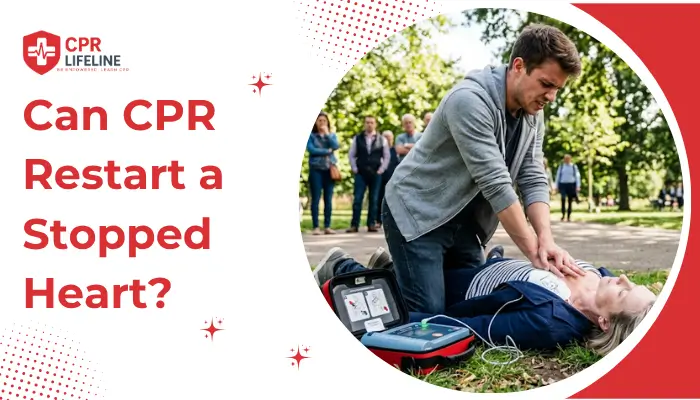
CPR does not restart the heart in most cases. This is one of the most widely held misconceptions about emergency response, largely reinforced by television and film portrayals where a few chest compressions bring someone back to full consciousness. In reality, CPR has one primary function which is to keep oxygenated blood circulating through the body until a defibrillator or advanced medical treatment restores a normal heart rhythm. CPR keeps blood flowing, but defibrillation is what actually restores the heart’s rhythm in most cardiac arrest cases. A defibrillator delivers a controlled electrical shock that interrupts the chaotic electrical activity in the heart and gives it the opportunity to reset into a normal rhythm.
CPR alone cannot deliver that shock, but it preserves the condition of the heart and brain during the window between collapse and defibrillation, making the defibrillator significantly more likely to be effective when it arrives. According to the American Heart Association, CPR performed immediately after cardiac arrest can double or triple survival rates by maintaining blood flow until defibrillation is available. Spontaneous return of circulation during CPR alone does occasionally occur, particularly in respiratory arrest where the heart has not fully stopped but the patient has ceased breathing, though these cases are the exception rather than the rule. In the vast majority of sudden cardiac arrest cases, survival depends on the combination of immediate CPR, early defibrillation, and rapid access to emergency medical care.
How CPR Helps During Cardiac Arrest
CPR works by manually replicating the pumping function of the heart. When you perform chest compressions, you physically press down on the sternum to squeeze the heart between the breastbone and the spine, forcing blood out into circulation. Releasing the pressure allows the heart to refill with blood before the next compression. This cycle keeps oxygenated blood moving to the brain and vital organs, preventing the irreversible damage that begins within minutes of cardiac arrest.
Compression depth and rate determine how effectively this manual pumping works. The AHA recommends compressing at least 2 inches deep at a rate of 100 to 120 compressions per minute for adults. Shallow compressions or an inconsistent pace significantly reduces the amount of blood reaching the brain, which directly affects whether the victim survives with neurological function intact.
Rescue breaths complement compressions by replenishing the oxygen content of the blood being circulated. While hands-only CPR is appropriate for untrained bystanders responding to adult sudden cardiac arrest, conventional CPR delivers oxygen more effectively in emergencies where breathing failure is the primary cause of collapse. Regardless of which approach is used, high-quality compressions with minimal interruptions remain the single most critical factor in keeping the window of survival open until emergency medical help arrives.
When Is an AED Needed Instead of CPR Alone?
An AED is needed when the heart is in a shockable rhythm, most commonly ventricular fibrillation or pulseless ventricular tachycardia. In these rhythms, the heart still has electrical activity but is not pumping blood effectively. CPR alone cannot correct these rhythms. It sustains blood flow until the AED can deliver a shock that interrupts the chaotic electrical activity and gives the heart the opportunity to reset into a normal rhythm. AEDs are designed to analyze the heart’s electrical activity automatically and determine whether a shock is appropriate before delivering one, making them safe for untrained bystanders to use.
CPR and an AED work together, not independently. CPR maintains circulation and preserves the heart’s responsiveness to defibrillation, while the AED delivers the shock that restores normal rhythm. Survival rates drop by seven to ten percent for every minute defibrillation is delayed, which is why retrieving an AED while CPR is in progress is critical. AEDs are now widely available in airports, schools, gyms, and shopping centers, and most CPR and AED certification courses train you to use both skills together so you are fully prepared when an emergency demands it.
How to Perform CPR Correctly
Performing CPR correctly requires following each step of CPR in the right order without unnecessary delays. Before starting, confirm that the person is unresponsive by tapping their shoulders and shouting. Call 911 immediately or direct a specific person nearby to call before beginning compressions.
- Check for responsiveness by tapping the shoulders firmly and shouting.
- Call 911 immediately or direct a specific person nearby to call and request an AED.
- Position your hands by placing the heel of your dominant hand on the center of the chest, on the lower half of the sternum, and interlace your other hand on top.
- Push hard and fast, compressing at least 2 inches deep at a rate of 100 to 120 compressions per minute.
- Allow full chest recoil between compressions without lifting your hands off the chest.
- Deliver rescue breaths if you are trained, giving 2 breaths after every 30 compressions and watching for a visible chest rise.
- Use an AED as soon as one becomes available, following the device prompts without pausing compressions any longer than necessary.
- Continue without stopping until emergency services arrive, the AED instructs you to stop, or the person shows clear signs of recovery.
How Effective Is CPR? Survival Rates and Statistics
CPR effectiveness depends heavily on how quickly it begins after cardiac arrest. Approximately 350,000 out-of-hospital cardiac arrests occur in the United States every year, and nearly 90 percent of them are fatal. The survival gap between those who receive immediate bystander CPR and those who do not is significant. Research published in the journal Circulation found that bystander CPR can double or triple survival rates in out-of-hospital cardiac arrest, and a closer look at how effective CPR is explains why acting immediately matters so much.
The setting where cardiac arrest occurs also plays a major role in survival outcomes. Cardiac arrest in public settings has a higher survival rate than cardiac arrest at home, largely because bystanders in public are more likely to act and AEDs are more readily accessible. Approximately 45 percent of out-of-hospital cardiac arrest victims survive when a bystander performs CPR before EMS arrives. At home, where most cardiac arrests actually occur, bystander response rates are considerably lower, which directly contributes to poorer outcomes. Each step in the chain of survival, which includes early recognition, immediate CPR, rapid defibrillation, and advanced medical care, builds on the last. Removing any one of those links reduces survival odds dramatically.
The Truth About CPR and Cardiac Arrest
CPR does not restart the heart on its own, but it does something equally critical, it keeps the brain and vital organs alive long enough for defibrillation and emergency medical treatment to work. The difference between a victim who survives cardiac arrest with full neurological function and one who does not often comes down to whether bystander CPR began in those first few minutes. High-quality compressions, minimal interruptions, and early AED use are not separate actions. They are a coordinated response, and every element depends on the one before it.
Cardiac arrest does not wait for a convenient moment, and neither should your preparation. The gap between knowing CPR exists and actually knowing how to perform it correctly is where lives are lost. CPR Lifeline offers flexible, AHA-certified training options that fit around your schedule, whether you are a first-time learner or someone whose certification has lapsed. Visit CPR Lifeline to find a course near you and close that gap before an emergency forces the question.
Faqs
No. CPR does not restart the heart in most cases. It keeps oxygenated blood circulating to the brain and vital organs until a defibrillator or emergency medical treatment can restore a normal heart rhythm.
CPR manually replicates the pumping function of the heart through chest compressions. This keeps blood flowing to the brain and vital organs, preventing irreversible damage during the window between collapse and defibrillation.
CPR maintains blood circulation but cannot correct the heart's electrical rhythm. A defibrillator delivers a controlled electrical shock that interrupts chaotic heart activity and gives the heart the opportunity to reset into a normal rhythm. Both work together as part of the same emergency response.
Brain damage can begin in as little as four to six minutes without oxygen. Irreversible damage occurs shortly after, which is why immediate bystander CPR is critical in the first moments following cardiac arrest.
Bystander CPR can double or triple survival rates in out-of-hospital cardiac arrest compared to waiting for emergency services to arrive. Approximately 45 percent of cardiac arrest victims survive when a bystander performs CPR before EMS arrives.
An AED should be used as soon as one becomes available. CPR should continue without interruption while someone retrieves the AED, and compressions should resume immediately after each shock is delivered.
Yes, for adult sudden cardiac arrest. Hands-only CPR produces survival outcomes comparable to conventional CPR when performed with consistent depth and pacing. Rescue breaths remain necessary for drowning, drug overdose, and cardiac arrest in children and infants.
No. CPR effectiveness depends on how quickly it begins, the quality of compressions, the underlying cause of cardiac arrest, and how rapidly defibrillation and advanced medical care become available. Immediate, high-quality CPR gives the victim the best possible chance of survival.

Chris Peters
Chris Peters is a certified American Heart Association instructor and firefighter since 1996 with over 30 years of emergency response experience. After answering thousands of 911 calls, he founded CPR Lifeline to provide AHA-certified training that transforms bystanders into confident lifesavers who act decisively when seconds count