
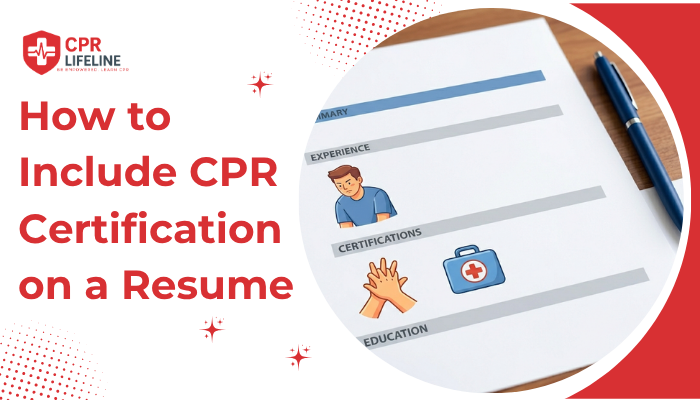


Many healthcare, childcare, fitness, and safety-focused employers require CPR certification before you even reach the interview stage. Having it is one thing, and knowing how to present it on your resume is another. A certification that is buried, mislabeled, or formatted inconsistently can be overlooked by both recruiters and applicant tracking systems.
CPR certification on a resume does more than check a compliance box. It signals emergency preparedness, shows that you meet workplace safety standards, and adds immediate credibility to your application. For roles where it is a stated requirement, placing it prominently can be the deciding factor between moving forward or being screened out.
This blog covers exactly where to put CPR certification on your resume, how to format it correctly, industry-specific examples, whether expired certification is worth including, and how to make sure your credentials are visible to ATS software.
Where to Put CPR Certification on a Resume
Placement depends on your industry, experience level, and how important CPR certification is to the role you are applying for. The goal is to make it visible without disrupting the natural flow of your resume. There are three sections where CPR certification fits most effectively.
In a Dedicated Certifications Section
A dedicated certifications section is the most appropriate placement for most resumes. It keeps your credentials organized, easy to scan, and clearly separated from your work experience and education. Place this section below your experience or education, depending on which is stronger.
Use this format:
- CPR and First Aid Certified – American Red Cross – Expires June 2027
- Basic Life Support (BLS) – American Heart Association – Expires December 2026
In Your Resume Summary
Including CPR certification in your resume summary works well when the role specifically requires it and you want it to appear at the very top of the page. This is particularly effective for healthcare and childcare roles where certification is a non-negotiable requirement.
Use this format:
- Certified nursing assistant with three years of clinical experience and an active BLS and CPR certification through the American Heart Association.
- Dedicated childcare professional with Pediatric First Aid and CPR certification and five years of early childhood education experience.
In Your Education Section
Placing CPR certification in your education section is appropriate when you are a student or recent graduate with limited work experience. In this case, certifications sit naturally alongside your academic credentials and help fill out a resume that does not yet have extensive professional history to draw from. This placement is less common for experienced candidates and should be moved to a dedicated certifications section once your resume has more professional content to stand on.
Use this format:
- CPR and First Aid Certified – American Red Cross – Expires June 2027
- Bachelor of Science in Nursing – State University – Graduated May 2024
- Basic Life Support (BLS) – American Heart Association – Expires December 2026
In Your Skills Section
Listing CPR certification in a skills section is most useful for entry-level candidates or roles where it is one of several relevant qualifications rather than a primary requirement. This placement works well for babysitters, lifeguards, personal trainers, and teachers who want to keep their certifications visible without creating a full dedicated section. Pairing it with related skills like First Aid, AED operation, or emergency response strengthens the entry further.
Use this format:
- CPR and First Aid Certified – American Red Cross
- AED Trained – CPR/AED Certified, NASM Compliant
How to Format CPR Certification Correctly
Correct formatting does two things, it makes your certification readable to a human recruiter and scannable by applicant tracking systems. Many employers use ATS software that searches for specific certification keywords like “BLS,” “CPR certified,” and “First Aid.” Inconsistent or abbreviated formatting can cause your credentials to be missed entirely, even when you hold the exact certification the employer requires.
Every CPR certification entry on your resume should include four elements, which are the full certification name, the issuing organization, the expiration date, and the current status, where relevant. Use consistent formatting throughout your entire resume, and always spell out abbreviations the first time they appear. “BLS” should be written as “Basic Life Support (BLS)” on first reference, particularly for roles outside of healthcare where recruiters may not recognize the abbreviation.
| Element | What to Include | Example |
|---|---|---|
| Certification Name | Full official title | Basic Life Support (BLS) |
| Issuing Organization | Certifying body | American Heart Association |
| Expiration Date | Month and year | Expires December 2026 |
| Status | Active or expired | Active |
Here is how a correctly formatted certifications section looks in practice:
- Basic Life Support (BLS) – American Heart Association – Expires December 2026 – Active
- CPR and First Aid Certified – American Red Cross – Expires June 2027 – Active
- CPR/AED Certified – National CPR Foundation – Expires March 2026 – Active
Resume Examples for CPR Certification
The way you present CPR certification on your resume should reflect the industry you are applying to. Different roles place different levels of importance on emergency response credentials, and tailoring your formatting to match those expectations makes your resume more relevant and easier to scan. Here are three industry-specific examples to guide your formatting.
Healthcare Resume Example
Healthcare employers expect CPR and BLS certification to appear in a clearly labeled certifications section. Recruiters and ATS systems in this field actively search for terms like “BLS,” “ACLS,” and “CPR certified,” so using official certification names is non-negotiable.
- Basic Life Support (BLS) – American Heart Association – Expires December 2026 – Active
- CPR Certified – American Red Cross – Expires June 2027 – Active
- Advanced Cardiovascular Life Support (ACLS) – American Heart Association – Expires December 2026 – Active
Childcare Resume Example
Childcare roles frequently require Pediatric First Aid alongside CPR certification. Listing both together signals that you are prepared for the specific emergencies most likely to occur in a childcare setting. This combination can be placed in either a certifications or skills section, depending on how much other professional content your resume contains.
- Pediatric First Aid and CPR Certified – American Red Cross – Expires August 2026
- Emergency response procedures
- AED trained
Fitness Trainer Resume Example
Personal trainers and fitness professionals are often required to hold CPR and AED certification as part of their industry compliance. Many certifying bodies like NASM and ACE mandate it as a condition of certification. Make that compliance explicit on your resume so employers do not have to ask.
- CPR and AED Certified – American Red Cross – NASM Requirement Compliant – Expires May 2027
- Certified Personal Trainer (CPT) – NASM – Expires October 2026
Should You Include Expired CPR Certification?
Yes, you can include expired CPR certification on your resume, but only under specific conditions. Listing it without any context or disclosure can mislead employers and damage your credibility if discovered during the hiring process. Transparency is the most important factor when deciding whether to include it.
Expired certification still holds value when the role you are applying for requires CPR and you are actively in the process of renewing. In this case, include the certification with its expiration date clearly listed and add a brief note indicating that renewal is scheduled or in progress. This shows employers that you are aware of the lapse and are taking steps to address it. An expired certification with no renewal plan is better left off the resume entirely, particularly for roles in healthcare, childcare, or emergency response where active certification is a compliance requirement.
Active certification always carries stronger hiring value. Most CPR certifications expire every two years, and renewing before you apply removes the issue entirely. Getting your CPR certification renewed through an accredited provider ensures your credentials are current, recognized by employers, and aligned with the latest resuscitation guidelines.
Common CPR Certification Resume Mistakes To Avoid
Small formatting and placement errors can cause your CPR certification to be overlooked by recruiters or filtered out by ATS software. These are the six most common mistakes candidates make and how to avoid each one.
Excluding the Expiration Date
Leaving out the expiration date raises an immediate red flag for employers, particularly in regulated industries. Recruiters need to confirm that your certification is current before moving forward. Always include the month and year your certification expires alongside the certification title and issuing organization.
Using Abbreviations Without Clarification
Writing “BLS” or “CPR” without spelling out the full certification name can cause ATS systems to miss your credentials entirely. Always write the full certification name on first reference, for example Basic Life Support (BLS), before using the abbreviation. This applies especially to resumes targeting roles outside of clinical healthcare.
Placing Certification Deep in the Resume
Placing CPR certification at the bottom of a long resume reduces its visibility significantly. When a job posting lists CPR as a requirement, your certification should appear in a visible section that recruiters reach within the first scan. A dedicated certifications section near the top half of the page is the safest placement.
Using Inconsistent Formatting
Mixing formats across certification entries, such as listing one with an expiration date and another without, creates a disorganized impression. Every certification entry should follow the same structure: certification name, issuing organization, expiration date, and status.
Listing Unrecognized or Informal Certifications
Not all CPR certifications carry equal weight with employers. Certifications from unaccredited or unrecognized providers may be disregarded entirely. Choose well-known organizations like the American Heart Association or the American Red Cross to make sure your certificate is officially accepted.
Including Expired Certification Without Context
Listing an expired certification without disclosing the expiration date or renewal status is one of the fastest ways to lose an employer’s trust. Always label expired certifications clearly and include a note if renewal is in progress. Keeping your CPR certification current through a recognized provider removes this issue from your resume entirely.
The Right Way to List CPR on Your Resume
CPR certification adds real value to your resume, but only when it is presented correctly. Place it in a visible section, use the full official certification name, include the issuing organization and expiration date, and match your wording to the language used in the job posting. These small formatting decisions determine whether your credential gets noticed by a recruiter or filtered out by an ATS system before anyone even reads your application.
Keeping your certification active is just as important as listing it correctly. Most CPR certifications expire every two years, and an outdated credential can raise doubts about your preparedness in roles where emergency response readiness is a baseline expectation. So, if yours is about to lapse (or you still need to earn one), the process of getting CPR certified online is usually the fastest way to stay current. CPR Lifeline offers AHA-certified CPR, BLS, ACLS, and PALS courses with flexible scheduling built around working professionals. Our certification courses ensure your credentials stay current, recognized, and ready to back up every application you send.
Faqs
The most appropriate placement for CPR certification is a dedicated certifications section. Healthcare professionals can place it alongside licenses, while entry-level candidates or those in non-medical roles can list it in a skills section. When CPR certification is a stated job requirement, place it in a prominent section that appears in the top half of your resume.
Every CPR certification entry should include four elements: the full certification name, the issuing organization, the expiration date, and the active status. For example: Basic Life Support (BLS) - American Heart Association - Expires December 2026 - Active. Use the same format consistently across all certification entries on your resume.
Yes, but only if you disclose the expiration date clearly and are actively in the process of renewing. An expired certification listed without context can mislead employers and damage your credibility. Active certification always carries stronger hiring value, and renewing before you apply removes the issue entirely.
Yes. CPR certification increases your eligibility in regulated industries including healthcare, childcare, education, fitness, and emergency services. Many employers in these fields require active certification before extending a job offer, and listing it prominently signals emergency preparedness and compliance with workplace safety standards.
Always spell out the full certification name on first reference, for example Basic Life Support (BLS), before using the abbreviation. ATS software may not recognize abbreviations alone, and recruiters outside of clinical healthcare may not be familiar with the shorthand.
Certifications issued by the American Heart Association and the American Red Cross are the most widely recognized across all industries. The National CPR Foundation is also broadly accepted. Certifications from unaccredited or informal providers may not meet employer or licensing board requirements, so always train with a recognized certifying body.
Most CPR certifications expire every two years. Scheduling your renewal before the expiration date ensures there is no lapse in your credentials and keeps your resume accurate and compliant with employer requirements at all times.
Yes, including CPR certification in your resume summary is effective when the role specifically requires it and you want it visible at the very top of the page. This works particularly well for healthcare and childcare roles where active certification is a non-negotiable hiring requirement.

Chris Peters
Chris Peters is a certified American Heart Association instructor and firefighter since 1996 with over 30 years of emergency response experience. After answering thousands of 911 calls, he founded CPR Lifeline to provide AHA-certified training that transforms bystanders into confident lifesavers who act decisively when seconds count