
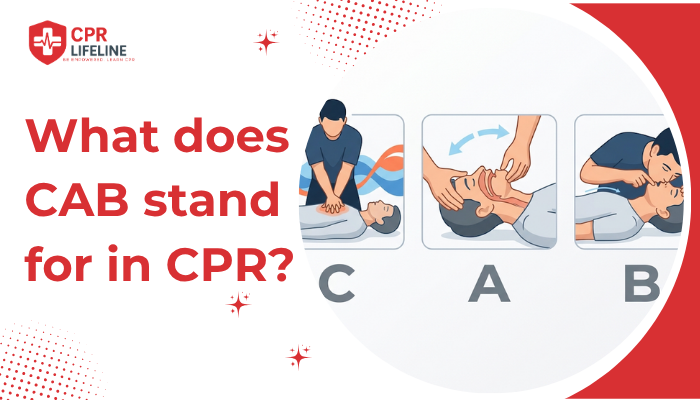


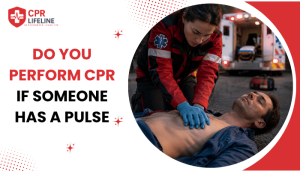
CAB stands for Compressions, Airway, and Breathing. It is the sequence recommended by the American Heart Association for performing CPR on adults who experience sudden cardiac arrest. In this order, chest compressions come first because restoring blood circulation is the most time-sensitive action in the first moments after the heart stops.
CAB replaced the previous ABC sequence, which prioritized Airway and Breathing before Compressions. Research showed that delays in starting compressions were costing critical seconds and reducing survival rates. In 2010, the American Heart Association formally adopted CAB as the updated standard across all levels of CPR training, placing immediate compression at the front of the emergency response sequence.
In this blog, we will break down what CAB means, why the sequence changed, how to perform it correctly, and the most common mistakes to avoid.
What Does CAB Stand for in CPR?
CAB is the foundational sequence of modern CPR. Each letter represents a critical step in the emergency response process, and the order is intentional. Chest compressions come first because restoring blood circulation is the most time-sensitive priority in cardiac arrest.
C – Chest Compressions
The letter “C” in CAB stands for chest compression, which is the most critical step in the CAB sequence. When the heart stops, compressions manually pump blood to the brain and vital organs to prevent irreversible damage. To perform compression, place the heel of your dominant hand on the center of the chest, interlace your other hand on top, and push down at least 2 inches deep at a rate of 100 to 120 compressions per minute. Without immediate compressions, oxygen delivery to the brain stops entirely within minutes.
A – Airway
The letter “A” in CAB represents the airway. Opening the airway ensures that oxygen can travel freely into the lungs before rescue breaths are delivered. A clear airway is what makes rescue breathing effective, and without it, breaths fail to reach the lungs. To open the airway, tilt the head back gently and lift the chin forward using the head-tilt chin-lift technique, which prevents the tongue from blocking the throat in an unconscious person.
B – Breathing (Rescue Breaths)
The “B” in CAB refers to breathing. Rescue breaths deliver oxygen directly into the lungs when a person can no longer breathe on their own. They are given after every 30 chest compressions, with each breath lasting about one second and producing a visible chest rise. To deliver them, pinch the nose shut, create a seal over the mouth, and breathe in slowly and steadily. This combined cycle of compressions and breaths sustains the body’s basic functions until emergency medical help arrives.
Why Did CPR Change From ABC to CAB?
Before 2010, CPR followed the ABC sequence (Airway, Breathing, then Compressions). Rescuers were trained to open the airway and deliver rescue breaths before starting chest compressions. That approach cost critical seconds, and research consistently showed those delays were reducing survival rates. The American Heart Association updated its CPR guidelines in 2010 after evidence confirmed that immediate chest compressions produced significantly better outcomes in cardiac arrest. In the first moments after the heart stops, restoring blood circulation is far more urgent than managing the airway.
Bystander hesitation around mouth-to-mouth breathing was another factor driving the change. Many untrained bystanders were reluctant to perform rescue breaths, which meant victims received no CPR at all. Placing compressions first lowered that barrier and made it easier for bystanders to act immediately. According to the American Heart Association, hands-only CPR, which uses compressions without rescue breaths, is now a recognized and effective option for adult cardiac arrest when performed by untrained bystanders. Starting compressions without delay keeps coronary perfusion pressure high, which is directly linked to improved survival outcomes. Learning the components of high-quality CPR helps you understand exactly why compression quality and timing are non-negotiable in the CAB sequence.
How to Perform CAB CPR Step by Step
Performing CAB CPR correctly requires following each step in the right order without unnecessary delays. Before starting, confirm that the person is unresponsive, call 911 or instruct someone nearby to call, and begin immediately.
Step 1: Start Chest Compressions
Place the heel of your dominant hand in the center of the person’s chest, directly on the lower half of the sternum. Place your other hand on top and interlace your fingers. Push hard and fast, compressing at least 2 inches deep at a rate of 100 to 120 compressions per minute. Allow the chest to fully recoil between each compression without lifting your hands off the chest.
Step 2: Open the Airway
After 30 compressions, tilt the person’s head back gently and lift the chin forward using the head-tilt chin-lift technique. This moves the tongue away from the back of the throat and creates a clear passage for air. Quickly check for any visible obstruction before delivering rescue breaths.
Step 3: Deliver Rescue Breaths
Pinch the person’s nose shut, create a seal over their mouth, and give 2 slow rescue breaths lasting about one second each. Watch for a visible rise in the chest with each breath. An undetected chest rise means the airway is not fully open or the seal is not tight enough.
Step 4: Continue Until Help Arrives
Return immediately to chest compressions and repeat the 30:2 cycle without interruption. Use an AED as soon as one becomes available, following the device prompts without stopping compressions any longer than necessary. Continue the cycle until emergency medical services arrive and take over, or until the person begins showing signs of recovery. Understanding when to stop CPR is just as important as knowing how to start it.
When Should You Use CAB in CPR?
CAB CPR applies to any adult who is unresponsive and not breathing normally. This includes victims of sudden cardiac arrest, drowning, drug overdose, or any situation where the heart has stopped, and normal breathing is absent. Before starting, confirm unresponsiveness by tapping the person’s shoulders firmly and shouting. Call 911 immediately or direct someone nearby to call before beginning chest compressions.
The CAB sequence is specifically designed for adult CPR, but the approach changes depending on who you are helping. Infant CPR uses two fingers instead of both hands for compressions, and the depth is adjusted to about 1.5 inches. For children, one or two hands are used depending on the child’s size, with a compression depth of around 2 inches. Healthcare providers are also trained to assess pulse before starting CPR, while bystanders without medical training should skip the pulse check and begin chest compressions immediately if the person is unresponsive and not breathing.
Common CAB CPR Mistakes to Avoid
Even rescuers with good intentions can make mistakes when under pressure. Most CPR errors involve poor technique, bad timing, or hesitation. Avoiding these six common CAB mistakes can greatly improve the victim’s chance of survival.
1. Compressing Too Shallow
Compressions that do not reach at least 2 inches deep fail to generate enough pressure to move blood through the heart. Many rescuers underestimate how much force is actually required. Push harder than what feels natural and trust your technique.
2. Incorrect Hand Placement
Placing your hands too high, too low, or off-center reduces compression effectiveness and increases the risk of injury. Always position the heel of your hand on the lower half of the sternum, directly in the center of the chest.
3. Compressing Too Slowly
A compression rate below 100 per minute is not fast enough to maintain adequate blood circulation. To maintain the necessary rhythm during an emergency, aim for a rate of 100 to 120 compressions per minute, which is why many people rely on the tempo of specific songs to do cpr to, like “Stayin’ Alive” by the Bee Gees.
4. Interrupting Compressions Too Often
Every pause in compressions causes coronary perfusion pressure to drop, reducing the heart’s chance of restarting. According to AHA CPR performance standards, interruptions should be kept to under 10 seconds whenever possible. Keep pauses as short as possible and return to compressions right away after giving rescue breaths or using an AED.
5. Not Allowing Full Chest Recoil
Leaning on the chest between compressions prevents it from fully expanding, which limits the amount of blood returning to the heart. Allow the chest to recoil fully between compressions without removing your hands from the chest.
6. Forgetting to Call Emergency Services
CPR buys you time, but it does not replace emergency medical care. Many rescuers get so focused on starting compressions that calling for help becomes an afterthought. Calling 911 or directing someone to call before starting chest compressions ensures that professional help is on the way. If you are alone, put the phone on speaker, place it next to the victim, and start compressions immediately while the dispatcher stays on the line. Emergency dispatchers can also guide you through the CPR process in real time if you are unsure of the steps to perform CPR.
Knowing CAB in CPR Can Be the Difference Between Life and Death
CAB stands for Compressions, Airway, and Breathing, and the order is not random. Chest compressions come first because restoring blood circulation is the single most time-sensitive action in cardiac arrest. Every step in the sequence exists for a reason, and performing each one correctly, from compression depth to rescue breath timing, directly affects the survival chance of the victim. Understanding what CAB stands for in CPR is only the first step. Knowing how to apply it under pressure is what actually saves lives.
CPR is a skill that fades without proper training, and true confidence in an emergency comes from practice rather than simply knowing what to do. CPR Lifeline offers AHA-certified CPR, BLS, ACLS, and PALS courses designed for both healthcare professionals and everyday individuals who want to be prepared. Whether you are getting certified for the first time or renewing an existing credential, our CPR and life support courses give you the hands-on experience and clinical knowledge to respond effectively when it counts most.
Faqs
CAB stands for Compressions, Airway, and Breathing. It is the sequence recommended by the American Heart Association for performing CPR, with chest compressions prioritized first to restore blood circulation during cardiac arrest.
Compressions maintain blood flow to the brain and vital organs during cardiac arrest. Delaying compressions to open the airway first costs critical seconds and significantly reduces survival chances, which is why the AHA updated its guidelines in 2010 to place compressions at the front of the sequence.
CAB is the standard sequence for adult CPR. Infant and child CPR follow modified approaches, including adjusted hand placement, compression depth, and breath delivery, to account for differences in body size and physiology.
Current AHA guidelines recommend delivering 100 to 120 compressions per minute. Compressing at a rate below 100 per minute is not sufficient to maintain adequate blood circulation during cardiac arrest.
Yes. Bystanders without formal training can still perform hands-only CPR, which focuses entirely on chest compressions without rescue breaths. Emergency dispatchers are also trained to guide bystanders through CPR steps in real time over the phone.
For adults, compressions should reach a depth of at least 2 inches but no more than 2.4 inches. Shallow compressions do not generate enough pressure to move blood effectively through the heart, which reduces the chance of survival.
Every interruption in compressions causes the coronary perfusion pressure to drop rapidly. The AHA recommends keeping all pauses under 10 seconds to maintain blood flow and preserve the heart's chance of restarting. Minimizing interruptions is one of the most critical factors in high-quality CPR.
Yes. Using an AED is a key part of the emergency response sequence. An AED should be applied as soon as one becomes available, and compressions should be paused only for the time it takes to deliver a shock before resuming immediately.

Chris Peters
Chris Peters is a certified American Heart Association instructor and firefighter since 1996 with over 30 years of emergency response experience. After answering thousands of 911 calls, he founded CPR Lifeline to provide AHA-certified training that transforms bystanders into confident lifesavers who act decisively when seconds count