
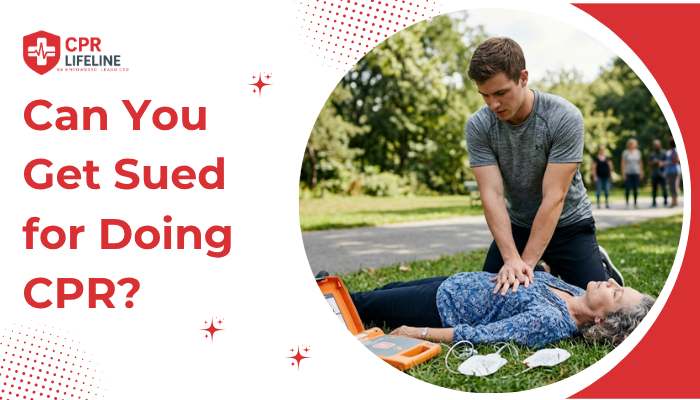


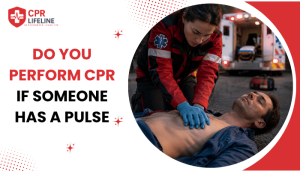
When a person collapses from cardiac arrest, quick action can mean the difference between life and death. Yet many bystanders hesitate to start CPR, fearing they could face legal trouble if something goes wrong. The truth is that the U.S. Good Samaritan laws are designed to protect people who step in to help during emergencies.
In this blog, we explain what these laws mean, when they protect you from getting sued for doing CPR, and how CPR certification can strengthen both your confidence and your legal safety.
Understanding Good Samaritan Laws in the U.S.
Good Samaritan laws are state-level statutes that protect individuals who voluntarily provide emergency assistance in good faith. Every U.S. state and the District of Columbia has enacted its own version of these laws. The goal is simple, i.e to encourage bystanders to help during sudden medical emergencies without fear of being sued.
Good Samaritan laws basically aim to:
- Promote bystander intervention in life-threatening situations.
- Remove the fear of civil lawsuits after honest mistakes.
- Balance volunteer protection with responsible behavior.
- Protect ordinary citizens who act responsibly and compassionately to save lives.
Note: The Tennessee Good Samaritan Law (T.C.A. § 63-6-218) protects any person who provides emergency care in good faith at the scene of an accident or emergency, as long as the person acts without expectation of payment and not with gross negligence.
The Georgia Good Samaritan Law (O.C.G.A. § 51-1-29) similarly protects bystanders, healthcare professionals, and organizations who voluntarily perform CPR or use an AED in an emergency.
5 Conditions That Place You Under Samaritan Law
Good Samaritan protection applies only when specific conditions are met. These 5 criteria establish when your actions are legally covered:
The event must be a true emergency.
Legal protection applies only to unforeseen emergencies, not routine care.
Your actions must be voluntary.
People acting freely to help are protected. Professionals on duty (e.g., EMTs, paramedics, nurses at work) already have a legal duty to respond and may not qualify under these laws.
The person must consent to your help.
If the victim is conscious and clearly refuses assistance, you should respect that. When the person is unconscious or unresponsive, implied consent applies.
You must act without gross negligence or willful misconduct.
Mistakes made with reasonable care are protected. Reckless or intentionally harmful actions are not.
You must not accept payment.
Good Samaritan laws protect only voluntary aid given without compensation. Accepting or expecting payment removes this immunity.
Why Performing CPR Is So Important?
When cardiac arrest stops blood flow to the brain and vital organs, every second counts, which shows how effective CPR is at actually restoring survival chances makes the case for acting immediately. In such critical, life-or-death conditions, giving Cardiopulmonary Resuscitation (CPR) maintains blood circulation until professional help arrives.
- Brain damage can begin within 4 to 6 minutes without oxygen.
- After 10 minutes without intervention, survival becomes extremely rare.
According to the American Heart Association (AHA), bystander CPR can double or even triple survival chances after cardiac arrest, and how effective hands-only CPR is specifically helps explain why even untrained bystanders are encouraged to act.
Across the U.S., emergency responders take an average of 7 to 12 minutes to reach a patient. In Tennessee and Georgia, local EMS response times fall within this national range, meaning bystander CPR is often the only hope in those first critical moments.
Legal Data: The Real Risk Is Doing Nothing
A 30-year study led by Dr. Travis Murphy analyzed U.S. cardiac arrest lawsuits from 1989 to 2019. It was found that courts awarded over $620 million in damages where rescuers failed to act, compared with only $120,000 linked to CPR errors.
This means that the risk of being sued for not helping is thousands of times greater than the risk of providing CPR in good faith. So legally and morally, stepping in to help is the safer and more responsible choice.
When Can You Still Be Sued?
Although Good Samaritan laws provide broad protection, there are exceptions when you can get sued for performing CPR:
- Gross negligence: Acting with extreme carelessness, such as performing obviously incorrect techniques.
- Willful misconduct: Intentionally causing harm.
- Pre-existing duty: Professional responders are obligated to act as part of their job.
- Payment: Accepting or requesting compensation for providing aid.
- Lack of consent: Ignoring a clear refusal from a conscious person.
Staying within the boundaries of these laws, acting voluntarily, in good faith, and without compensation, keeps you legally safe.
When Are You Clearly Protected?
You are best protected under Good Samaritan laws when you:
- Act voluntarily and in good faith.
- Perform CPR according to your level of training.
- Continue care until professional help arrives.
If you recognize an emergency, begin CPR as trained, and call 911, your actions will almost always meet the good-faith standard. Tennessee and Georgia courts consistently favor individuals who act responsibly rather than those who stand by.
Legal and Practical Value of AHA CPR Certification
Holding a valid AHA CPR certification strengthens both your legal position and your capability in emergencies.
From a medical standpoint:
- You learn correct compression depth and rate, which are central to what makes CPR high quality.
- You practice AED use and rescue breathing techniques.
- You follow evidence-based methods recognized nationwide.
From a legal standpoint:
- Certification proves competence.
- It demonstrates responsibility to act correctly.
- It aligns your behavior with accepted medical standards of care.
Certified training gives you confidence to respond safely and protects you if your actions are ever reviewed in court.
Get Certified and Save Lives with Confidence
Laws across the United States, including Tennessee and Georgia, are built to protect people who try to save a life in good faith. The data shows that inaction carries far greater legal and moral risk than performing CPR.
Being prepared starts with proper CPR training, and learning the steps of CPR gives you a clear sequence to follow so that when cardiac arrest strikes, you act with purpose rather than hesitation. Learn the exact steps, practice AED use, and gain the confidence to respond instantly with CPR Lifeline. We offer AHA-certified BLS, ACLS, and PALS courses designed to give you the skills, the practice, and the credential you need to save a life. Take your certification course with CPR Lifeline today, and be ready to save a life safely, confidently, and with legal protection.
Faqs
No. Broken ribs are a recognized side effect of proper chest compressions. Both Tennessee and Georgia law explicitly protect bystanders from liability for this outcome.
No. Both state laws protect trained and untrained bystanders equally, as long as the five core conditions are met. However, certified responders have a stronger legal record if questions arise.
You are protected. In most states, failed attempts are covered and applied to "any act or omission" made during emergency care rendered in good faith.
Stop immediately. If a conscious adult refuses help, continuing anyway removes your Good Samaritan protection in both states.
Generally, yes, when acting voluntarily outside their professional role. Both states extend Good Samaritan protection to off-duty medical professionals who choose to help.

Chris Peters
Chris Peters is a certified American Heart Association instructor and firefighter since 1996 with over 30 years of emergency response experience. After answering thousands of 911 calls, he founded CPR Lifeline to provide AHA-certified training that transforms bystanders into confident lifesavers who act decisively when seconds count