
Choking can turn fatal in minutes. The Adult Choking Algorithm, previously known as the Foreign-Body Airway Obstruction (FBAO) Algorithm, gives you a structured, evidence-based sequence to identify the severity of the obstruction and act on it immediately. Published as a new standalone algorithm in the 2025 AHA Guidelines for CPR and Emergency Cardiovascular Care, it defines the exact order of actions you take from the moment you recognize a choking adult through to CPR if the patient becomes unresponsive.
The 2025 update introduces one significant clinical change. Back blows now come before abdominal thrusts for all conscious adults, replacing the abdominal-thrust-first approach used in previous guidelines. This algorithm applies to any adult or adolescent showing signs of puberty who has a foreign body stuck in the airway. Knowing it and applying it without hesitation is what determines whether the obstruction is cleared before the patient loses consciousness.
The Adult Choking Algorithm is the AHA-developed protocol for recognizing and managing foreign-body airway obstruction in adults and adolescents showing signs of puberty. It applies in any setting, whether in a hospital, a public space, or a prehospital environment. The algorithm classifies the obstruction as either mild or severe and guides your response based on that finding. Every action in the sequence is directed at one goal: removing the foreign body from the airway before the patient loses consciousness.
Food is the most common cause of airway obstruction in adults. A severe obstruction that is not cleared within minutes leads to hypoxia, loss of consciousness, and cardiac arrest. This algorithm was introduced as a new protocol within the Adult BLS framework in the 2025 AHA Guidelines, separate from the standard Adult BLS Algorithm, giving FBAO management its own dedicated decision sequence for the first time.
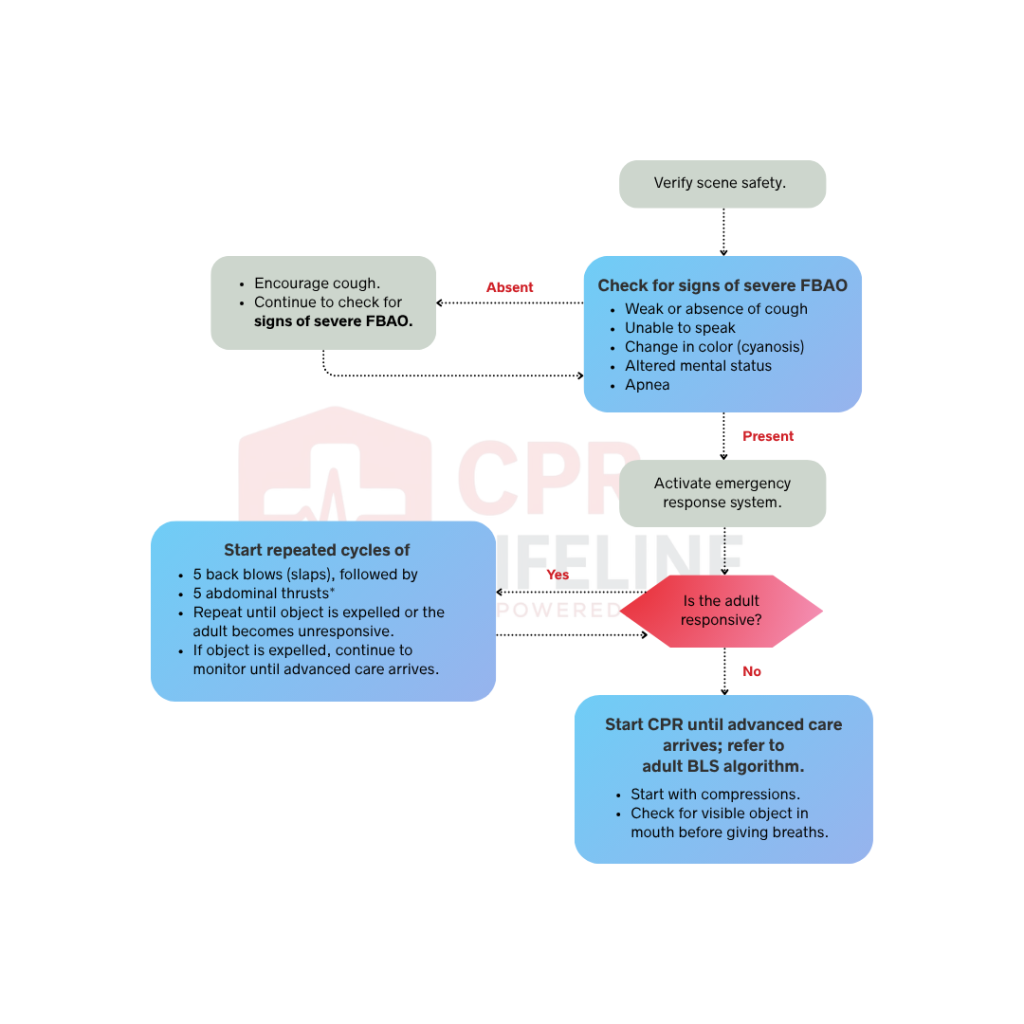
The Adult Choking Algorithm follows a linear sequence driven by two key findings, which is the severity of the obstruction and whether the patient remains conscious. Each step builds directly on the previous one. Below is the full step-by-step breakdown, starting from the moment you identify a choking adult.
Before approaching, confirm the scene is safe and assess the patient immediately. Ask the person directly, “Are you choking?” A person with a severe obstruction will not be able to answer verbally. Look for the universal sign of choking, which is one or both hands clutching the throat. Other signs include an inability to speak, weak coughing, no audible breathing, and cyanosis of the lips or fingertips. Once the scene is confirmed safe and choking is identified, move immediately to Step 2 to assess the severity of the obstruction.
The severity of the obstruction determines your entire next course of action. There are two possible findings at this stage.
A person with a mild obstruction can still cough forcefully, speak, or make sounds. The airway is only partly blocked, but air is getting through. In this case, do not physically intervene and encourage the person to keep coughing. A forceful cough generates more airway pressure than any external maneuver and is the most effective way to clear a partial obstruction. Stay with the patient and monitor continuously. If the cough weakens, the person can no longer speak, or breathing becomes visibly labored, the obstruction has progressed to severe. Move immediately to Step 3 if this happens.
A person with a severe obstruction cannot cough effectively, speak, or breathe. They may be silent, making high-pitched sounds, or showing visible signs of distress such as cyanosis or clutching their throat. Do not wait and move immediately to Step 3 without delay.
Position yourself to the side and slightly behind the patient. Support the patient’s chest with one hand and lean them forward so that the foreign body can exit the mouth rather than travel deeper into the airway. Use the heel of your other hand to deliver five firm back blows between the shoulder blades. Each blow should be a distinct, forceful strike rather than a gentle pat. After each blow, check the mouth to see if you can see the object and reach it easily. If there is something stuck, go ahead and remove it, but do not perform a blind finger sweep.
After delivering all five back blows, check whether the obstruction has cleared. If the object has been expelled and the person can speak, cough, or breathe normally, move to Step 5 to monitor the patient. If the obstruction remains, move immediately to Step 4.
Stand behind the patient and wrap your arms around their waist. Make a fist with one hand and place the thumb side against the patient’s abdomen, just above the navel and well below the breastbone. Grab your fist with your other hand and deliver five distinct inward and upward thrusts. Each thrust should be a separate, forceful movement directed toward the diaphragm. Do not deliver slow or gentle pressure. The goal is to generate a rapid increase in intrathoracic pressure that forces the foreign body up and out of the airway.
After delivering all five abdominal thrusts, check whether the obstruction has cleared. If the object has been expelled, move to Step 5. If the obstruction remains, return immediately to Step 3 and continue alternating cycles of five back blows and five abdominal thrusts. Do not stop until the object is expelled or the patient becomes unresponsive.
Continue alternating between five back blows and five abdominal thrusts without stopping. Check the mouth after each set of back blows. Remove the object immediately if it becomes visible, but you must never perform a blind finger sweep. If the object is expelled and the patient can speak, cough, or breathe normally, stop the cycle and monitor the patient. Even if they appear fully recovered, you must encourage them to seek medical evaluation because abdominal thrusts can cause internal injuries that are not immediately visible. If the patient becomes unresponsive despite continued cycles, lower them to the ground carefully and move immediately to Step 6.
Lower the patient carefully to the ground and call 911 if not already done. Place them on their back on a firm, flat surface and begin chest compressions immediately. Follow the Adult BLS Algorithm from this point forward. Start with compressions at a rate of 100 to 120 per minute and to a depth of at least 2 inches. Each time you open the airway to deliver rescue breaths, you must look inside the mouth for the foreign object and remove it only if it is visible and within reach. Continue CPR until the object is removed, the patient regains a pulse and begins breathing normally, or advanced care arrives and takes over.
While the standard back blow and abdominal thrust sequence applies to most conscious adults, two specific patient groups require a modified approach due to anatomical or physical limitations.
Abdominal thrusts are not safe to perform on a patient in the late stages of pregnancy. The pregnant uterus occupies the abdominal space and makes effective thrusting impossible without risk of injury to the patient and fetus. Replace abdominal thrusts with chest thrusts by standing behind the patient and placing your fist against the center of the sternum rather than the abdomen. Deliver five distinct inward thrusts and continue alternating between five back blows and five chest thrusts until the object is expelled or the patient becomes unresponsive. If the patient loses consciousness, transition to the Adult BLS Algorithm immediately.
Abdominal thrusts may not be effective when the rescuer cannot encircle the patient’s abdomen due to the patient’s size. In this case, replace abdominal thrusts with chest thrusts using the same technique as for pregnant patients. Place your fist on the center of the sternum and deliver five firm inward thrusts. Continue alternating five back blows and five chest thrusts until the object is expelled or the patient becomes unresponsive.
The 2025 AHA Guidelines introduced two significant changes to adult choking management that every BLS-trained provider needs to know.
The first change is the sequence of intervention. Previous guidelines recommended starting with abdominal thrusts alone for conscious adults with a severe obstruction. The 2025 guidelines now require back blows to be delivered first, before abdominal thrusts. The updated sequence is five back blows followed by five abdominal thrusts, repeated in alternating cycles. This change is supported by observational evidence showing that back blows are associated with higher clearance rates and fewer injuries than abdominal thrusts alone.
The second change is the introduction of the Adult FBAO Algorithm as a standalone protocol. Previously, choking management guidance was embedded within the broader Adult BLS Algorithm. The 2025 guidelines extracted it into its own dedicated algorithm, giving FBAO a structured decision sequence separate from cardiac arrest management. This makes the protocol easier to learn, easier to teach, and easier to apply under pressure.
The Adult Choking Algorithm requires you to assess obstruction severity, select the correct intervention, and transition to CPR without hesitation if the patient loses consciousness. These are time-critical decisions that reading alone cannot prepare you for. The 2025 AHA guideline changes also mean that providers trained under previous guidelines need to update their technique. This is especially true for the new back blow first sequence. Update your skills before your next clinical encounter.
BLS certification through the American Heart Association covers the full Adult Choking Algorithm alongside cardiac arrest management, rescue breathing, and AED use. Certification is valid for two years. If you are preparing for initial certification or an upcoming recertification, CPR Lifeline offers AHA-authorized BLS courses that incorporate the 2025 updated FBAO protocol with hands-on simulation and immediate instructor feedback.
By submitting this form you agree to receive text messages at the provided number from CPR Lifeline LLC for appointment reminders. Message frequency varies, and standard message and data rates may apply. You have the right to OPT-OUT of receiving messages at any time. To OPT-OUT, reply “STOP” to any text message you receive from us. Reply HELP for assistance.
The 2025 AHA guidelines recommend alternating five back blows followed by five abdominal thrusts for any conscious adult with a severe airway obstruction. Deliver back blows first with the heel of your hand between the shoulder blades, then deliver five inward and upward abdominal thrusts. Repeat this cycle without stopping until the object is expelled or the patient becomes unresponsive. This sequence replaces the previous abdominal-thrust-first approach used in earlier guidelines.
A mild obstruction allows the patient to cough forcefully, speak, or make audible sounds. Air is still moving through the airway. Encourage coughing and monitor closely without intervening physically. A severe obstruction produces weak or absent coughing, inability to speak or breathe, and signs such as cyanosis or the universal choking sign. A severe obstruction requires immediate intervention with back blows and abdominal thrusts.
Stop the intervention cycle and transition to CPR when the patient becomes unresponsive. Lower the patient carefully to the ground, place them on a firm flat surface, and begin chest compressions immediately following the Adult BLS Algorithm.
A blind finger sweep is performed without directly visualizing the object in the mouth. It carries a significant risk of pushing the foreign body deeper into the airway, worsening the obstruction. Only remove an object from the mouth if you can clearly see it, and it is within easy reach. This applies both during active choking interventions and during CPR after the patient becomes unresponsive.
Replace abdominal thrusts with chest thrusts for any patient in the late stages of pregnancy. Stand behind the patient, place your fist on the center of the sternum, and deliver five distinct inward chest thrusts. Continue alternating five back blows and five chest thrusts until the object is expelled or the patient becomes unresponsive. The same chest thrust modification applies when the rescuer cannot encircle the patient's abdomen due to the patient's size.
Yes. A choking victim should seek medical evaluation after the object is cleared, even if they appear to have fully recovered. Abdominal thrusts generate significant force and can cause internal injuries that are not immediately visible, including damage to abdominal organs or the lower ribs. A medical provider should assess the patient to rule out any injury caused by the intervention itself.
Home | About Us | Classes | Locations | Blogs | FAQ’s | Group Training | Referral | Contact Us
Copyright © 2025 cprlifeline. All Rights Reserved. Powered by Splendour Group
#1. Select your Course, Location and Time
#2. Complete the AHA Online Training
#3. Perform the hands on skills check
#4. CONGRATS! You are certified!