
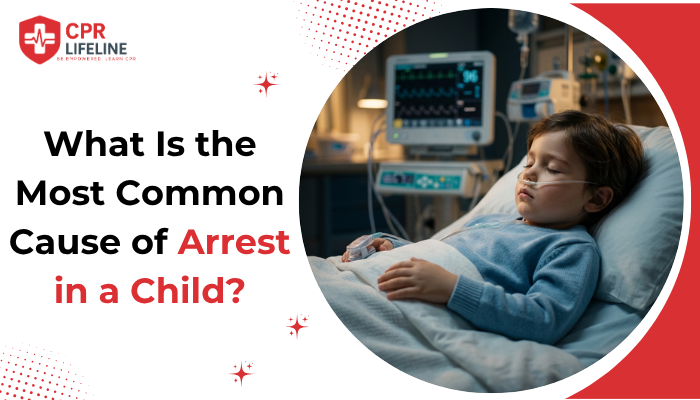


Respiratory failure leading to oxygen deprivation is the most common cause of cardiac arrest in a child. Unlike adults, whose cardiac arrests are most often triggered by heart disease or a blocked coronary artery, pediatric cardiac arrest almost always begins with a breathing problem. By the time a child’s heart stops, the body has typically been struggling with inadequate oxygen for minutes, not seconds.
When a child’s breathing becomes severely compromised, oxygen levels in the blood fall rapidly. The heart, starved of oxygen, eventually loses its ability to maintain an effective rhythm and stops pumping blood. Restoring breathing is the most critical intervention in pediatric cardiac arrest, which is why rescue breaths are a core component of child CPR in a way that differs from adult resuscitation.
This blog covers why children experience cardiac arrest differently than adults, the leading medical causes, the warning signs to recognize early, what to do during a pediatric cardiac emergency, and how prevention and CPR training reduce the risk of a fatal outcome.
Common Cause of Arrest in a Child
Several medical conditions can trigger cardiac arrest in children, but they share a common pathway: most begin with a breathing problem that progresses to oxygen deprivation before the heart stops. Understanding which conditions drive that progression is the most important step toward early recognition and intervention. In the sections below, we break down the leading causes of pediatric cardiac arrest and why each one poses a serious threat.
Respiratory Failure
Conditions that impair a child’s ability to breathe effectively are the leading contributors to pediatric cardiac arrest. Severe asthma attacks can cause the airways to constrict so tightly that adequate oxygen exchange becomes impossible. Pneumonia, bronchiolitis, respiratory syncytial virus (RSV), and influenza can all progress to respiratory failure in young children whose airways are narrower and whose respiratory reserves are smaller than those of adults.
Choking and Airway Obstruction
Children under five are at the highest risk of choking due to developing motor skills and the habit of putting objects in their mouths. Food, small toys, coins, and other foreign objects can partially or completely block the airway, cutting off oxygen within minutes. A complete airway obstruction that is not relieved immediately will progress to respiratory arrest and cardiac arrest rapidly in children.
Drowning
Drowning deprives the brain and heart of oxygen through water inhalation and airway obstruction. Even shallow water poses a significant drowning risk for young children. Cold water drowning can slow the body’s metabolism and extend the window for successful resuscitation, but all drowning incidents require immediate emergency response regardless of water temperature.
Severe Infection (Sepsis)
Sepsis occurs when a severe infection triggers a systemic inflammatory response that disrupts circulation throughout the body. Septic shock reduces blood flow to the heart and vital organs, which can progress to cardiac arrest if not treated aggressively. Children with high fever, rapid breathing, altered responsiveness, or signs of circulatory failure require immediate emergency evaluation.
Congenital Heart Disease
Structural heart abnormalities present from birth can create electrical instability, obstruct blood flow, or impair the heart’s pumping function. Some congenital defects are diagnosed shortly after birth, while others remain undetected until a cardiac event occurs. Children with known congenital heart disease require careful monitoring and individualized emergency action plans.
Trauma
Traumatic injuries are a leading cause of pediatric cardiac arrest outside of the hospital setting. Motor vehicle accidents, falls from height, blunt chest trauma, and severe head injuries can all cause cardiac arrest through blood loss, oxygen deprivation, or direct damage to the heart or brain. Trauma-related cardiac arrest in children has a lower survival rate than arrest caused by respiratory failure, making injury prevention a critical public health priority.
Why Do Children Experience Cardiac Arrest Differently Than Adults?
Cardiac arrest in adults is most commonly caused by coronary artery disease, where plaque buildup in the arteries leads to a blocked vessel, damaged heart muscle, and a life-threatening arrhythmia such as ventricular fibrillation. The heart itself is the origin of the problem. In children, the heart is usually structurally normal. Pediatric cardiac arrest almost always originates outside the heart, triggered by a respiratory, infectious, or traumatic event that depletes oxygen levels until the heart can no longer sustain its rhythm. This distinction changes the entire approach to pediatric resuscitation, including the emphasis on rescue breaths alongside chest compressions.
The American Heart Association and Pediatric Advanced Life Support guidelines reflect this difference directly. Adult CPR protocols prioritize chest compressions above all else because the underlying cause is typically cardiac. Pediatric CPR protocols treat ventilation as equally critical because restoring oxygen is the primary intervention needed to reverse the chain of deterioration that led to arrest. A child in cardiac arrest due to respiratory failure has oxygen-depleted blood circulating through the body, and compressions alone cannot correct that without rescue breaths delivering fresh oxygen into the lungs. Providers who understand this distinction are better equipped to deliver the type of resuscitation that gives a child the best possible chance of survival.
What Are the Warning Signs Before a Child Goes Into Cardiac Arrest?
Pediatric cardiac arrest rarely happens without warning. In most cases, a child displays recognizable signs of respiratory distress or circulatory failure in the minutes before the heart stops. The challenge is that these signs can be subtle in the early stages and are sometimes mistaken for minor illness or fatigue. Identifying them early and acting before the situation deteriorates is what creates the intervention window that saves lives.
Early Warning Signs
Early signs indicate that a child is struggling but has not yet reached a critical point. These include:
- Faster than normal breathing or visible effort to breathe
- Noisy breathing such as wheezing, stridor, or grunting
- Bluish or pale color around the lips or fingernails
- Unusual lethargy or difficulty staying awake
- Poor responsiveness to voice or touch
- Weak or rapid pulse
- Pale, mottled, or ashen skin tone
- Nasal flaring or the skin pulling inward at the neck or between the ribs during breathing
Late Warning Signs
Late signs indicate the child’s condition has deteriorated significantly and cardiac arrest is imminent without immediate intervention. These include:
- Loss of consciousness or complete unresponsiveness
- Absent or severely abnormal breathing
- No detectable pulse
- Limpness with no muscle tone
- Agonal gasping, which is infrequent and irregular and is not effective breathing
Any combination of early warning signs in a child warrants an immediate call to emergency services. Do not wait for late signs to appear before acting. The window between early respiratory distress and cardiac arrest can be as short as a few minutes, and every second of delay reduces the chance of a full recovery.
How Is Pediatric Cardiac Arrest Diagnosed During an Emergency?
Diagnosing cardiac arrest in a child during an emergency does not require medical equipment or clinical training. It requires a fast, structured assessment that any bystander or first responder can perform in under ten seconds. The assessment follows a straightforward sequence that evaluates responsiveness, breathing, and circulation in that order. Acting on the findings immediately is more important than conducting a perfect assessment.
The emergency assessment follows three steps:
Check Responsiveness
Tap the child’s shoulders firmly and call their name loudly. For infants, tap the bottom of the foot. A child in cardiac arrest will not respond to voice or touch. Any response, including a groan, eye movement, or limb withdrawal, indicates the child is not in full cardiac arrest and changes the next steps.
Check Breathing
Look for chest rise, listen for breath sounds, and feel for air movement for no more than ten seconds. Absent breathing or agonal gasping confirms that the child requires immediate CPR. Do not spend more than ten seconds on this step. A child who is not breathing normally needs compressions and rescue breaths without further delay.
Check Circulation
Healthcare providers check for a pulse at the carotid artery in children or the brachial artery in infants for no more than ten seconds. Bystanders without medical training should skip the pulse check and begin CPR immediately if the child is unresponsive and not breathing normally. Delaying CPR to search for a pulse costs critical time and is not recommended for untrained responders.
Once CPR has begun, an AED should be attached as quickly as possible. Pediatric pads deliver a lower energy shock calibrated for a child’s body and should be used whenever available. If only adult pads are present, they can be used on a child in the absence of pediatric pads, with one pad placed on the center of the chest and the other on the center of the upper back to prevent overlap.
What Should You Do If a Child Goes Into Cardiac Arrest?
Every second without CPR during pediatric cardiac arrest increases the risk of permanent brain damage and reduces the chance of survival. The response sequence for a child in cardiac arrest is straightforward, and knowing it in advance is what allows a bystander to act immediately rather than hesitate. You should follow these steps of CPR in order:
- Step 1. Check for responsiveness: Tap the child’s shoulders firmly and call their name loudly. For infants, tap the bottom of the foot. Do not shake the child.
- Step 2. Call emergency services: Dial 911 immediately. If a second person is present, send them to call while you begin CPR. If you are alone with a child, perform two minutes of CPR before stepping away to call.
- Step 3. Open the airway: Tilt the head back gently and lift the chin to open the airway. Avoid over-tilting in infants, as their airways are more flexible and can become kinked.
- Step 4. Check for breathing: Look, listen, and feel for normal breathing for no more than ten seconds. Begin CPR immediately if breathing is absent or abnormal.
- Step 5. Begin chest compressions: Place one or two hands on the lower half of the sternum for a child, or use two fingers for an infant. Compress at least one-third of the chest depth at a rate of 100 to 120 compressions per minute.
- Step 6. Deliver rescue breaths: After every 30 compressions, deliver two rescue breaths. Each breath should be small enough to produce visible chest rise without over-inflating the lungs.
- Step 7. Attach an AED as soon as one is available: Power on the device, apply pediatric pads if available, and follow the audio prompts. Resume compressions immediately after any shock is delivered.
- Step 8. Continue until help arrives: Do not stop CPR unless the child begins breathing normally or professional responders take over. Fatigue sets in quickly during pediatric CPR, so rotate with another rescuer every two minutes if one is available.
How Is Pediatric Cardiac Arrest Treated in the Hospital?
Hospital treatment for pediatric cardiac arrest begins the moment emergency responders hand the child over to the receiving team. The immediate priority is restoring and maintaining oxygenation, circulation, and a stable cardiac rhythm through a coordinated sequence of advanced interventions. Treatment decisions are guided by the underlying cause of the arrest, the child’s age and size, and how long the child was without effective circulation before resuscitation began.
Advanced hospital treatment covers six core intervention areas:
Ventilation and Oxygen Therapy
Establishing a secure airway is the first priority. Advanced airway management includes endotracheal intubation or supraglottic airway placement to deliver controlled ventilation directly to the lungs. Supplemental oxygen is provided at levels calibrated to restore normal blood oxygen saturation without causing oxygen toxicity.
Emergency Medications
Epinephrine is the primary medication used during pediatric cardiac arrest resuscitation. It stimulates the heart and constricts blood vessels to improve circulation during CPR. Additional medications, including amiodarone, may be used to treat persistent arrhythmias that do not respond to defibrillation alone.
Defibrillation
Defibrillation is used when the child’s cardiac rhythm is shockable, specifically ventricular fibrillation or pulseless ventricular tachycardia. Pediatric defibrillation uses weight-based energy dosing to deliver the correct shock intensity for the child’s size. Shocks are delivered in sequence with ongoing CPR until a normal rhythm is restored.
ECMO
Extracorporeal membrane oxygenation, known as ECMO, is used in select cases where standard resuscitation has not restored circulation. ECMO bypasses the heart and lungs entirely, pumping and oxygenating blood externally while the underlying cause of arrest is treated. It is available in specialized pediatric centers and is reserved for cases where conventional resuscitation has failed, but the cause is potentially reversible.
Intensive Care Monitoring
Following return of spontaneous circulation, the child is transferred to a pediatric intensive care unit for continuous monitoring of cardiac rhythm, blood pressure, oxygen levels, and neurological function. Temperature management may be used to reduce brain injury in selected patients. The treatment focus shifts from resuscitation to stabilization and identifying the root cause of the arrest.
Can Cardiac Arrest in Children Be Prevented?
Yes, many cases of pediatric cardiac arrest are preventable. Because most cardiac arrests in children originate from respiratory failure, choking, drowning, infection, or trauma rather than underlying heart disease, the majority of contributing factors can be addressed through supervision, education, and proactive medical care. Prevention does not eliminate all risk, but it meaningfully reduces the likelihood of the emergencies that most commonly lead to pediatric cardiac arrest.
These are the most important prevention strategies for caregivers, parents, and educators:
- Water supervision: Never leave a child unattended near water, including bathtubs, kiddie pools, buckets, and open bodies of water. Drowning can occur in inches of water and within seconds of a child being left alone.
- Choking prevention: Cut food into small pieces for young children, avoid giving children under three hard, round, or sticky foods, and keep small objects out of reach. Learn the age-appropriate choking relief technique for infants and children before an emergency occurs.
- Asthma management: Ensure children with asthma have a current action plan, carry prescribed rescue medication, and receive regular follow-up care. Uncontrolled asthma is one of the most common triggers of respiratory failure in children.
- Vaccinations: Keep children current on recommended immunizations. Vaccines against influenza, pneumococcal disease, and other respiratory infections directly reduce the risk of severe illness that can progress to respiratory failure.
- Safe sleep practices: Place infants on their backs on a firm, flat surface free of loose bedding, pillows, and soft objects. Safe sleep practices reduce the risk of sudden unexpected infant death and sleep-related breathing emergencies.
- Sports physicals: Ensure children who participate in organized sports receive a pre-participation physical examination that screens for undetected congenital heart conditions. Sudden cardiac arrest during athletic activity in children is rare but is most commonly linked to undiagnosed structural heart abnormalities.
- CPR education: Caregivers, parents, teachers, and childcare providers who are trained in pediatric CPR are equipped to respond immediately if a child’s condition deteriorates into cardiac arrest. Getting certified in pediatric CPR and first aid is one of the most direct steps any caregiver can take to improve a child’s chance of survival in an emergency.
Understanding the Leading Cause of Pediatric Cardiac Arrest Can Save Lives
Respiratory failure is the most common cause of cardiac arrest in children, and recognizing that fact changes how caregivers, educators, and bystanders respond to pediatric emergencies. Early warning signs of breathing distress, airway obstruction, or circulatory failure are visible before cardiac arrest occurs, and acting on them immediately is what creates the intervention window that determines whether a child survives. CPR with rescue breaths, rapid AED use, and an immediate call to emergency services are the three actions that matter most when a child’s heart stops.
Prevention and preparation are what make those actions possible before an emergency demands them. Parents, teachers, and childcare providers who are trained in pediatric CPR arrive at an emergency with the skills and confidence to act without hesitation. CPR Lifeline offers AHA-certified CPR and PALS courses across Tennessee and Georgia designed for caregivers and healthcare professionals who work with children. Browse available CPR certification courses and take the step that puts life-saving skills in your hands before they are needed.
Faqs

Chris Peters
Chris Peters is a certified American Heart Association instructor and firefighter since 1996 with over 30 years of emergency response experience. After answering thousands of 911 calls, he founded CPR Lifeline to provide AHA-certified training that transforms bystanders into confident lifesavers who act decisively when seconds count