
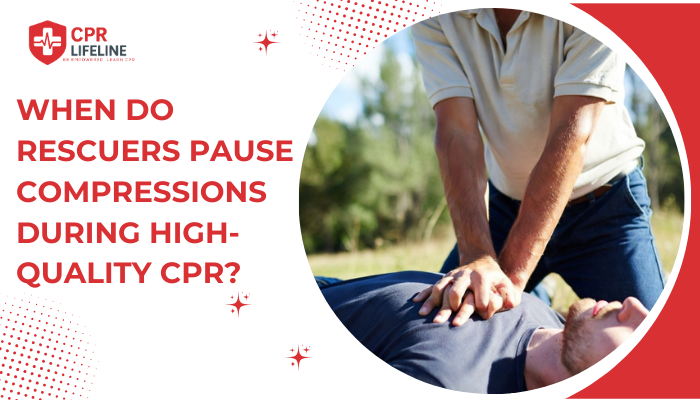




Pause in compressions during high-quality CPR is necessary sometimes, but it must be done with precision and purpose. While uninterrupted compressions are vital for keeping oxygenated blood flowing to the brain and vital organs, certain critical actions require a brief stop. However, an unnecessary pause in compression too frequently can disrupt this crucial blood flow and lower the patient’s chance of survival.
Rescuers typically pause compression during high-quality CPR only for specific situations like using an automated external defibrillator (AED) to analyze the heart rhythm, deliver a shock, switch between roles due to fatigue, or quickly assess for signs of life. Each of these interruptions should last no more than 10 seconds. Longer pauses can significantly reduce coronary perfusion pressure and reduce the effectiveness of the entire resuscitation effort.
In this article, we discuss in depth when rescuers typically pause compressions during high-quality CPR & why. You will also learn the exact moments pauses are permitted, the maximum allowable duration, and proven strategies to minimize interruptions.
When Do Pauses in Compressions Occur During CPR?
While continuous chest compressions are critical, brief pauses are sometimes necessary for essential interventions that improve patient outcomes. Understanding when a pause is needed during CPR helps rescuers to perform CPR safely and effectively, ensuring that the required steps are taken without needlessly sacrificing perfusion. These pauses are limited and deliberate.
1. Pausing to Deliver Rescue Breaths (Ventilations)
During high-quality CPR on an adult without an advanced airway, rescuers must pause compression to provide rescue breath. According to AHA guidelines, the rescuer should pause compression after every 30 minutes to give two rescue breaths using the chin-lift maneuver, each lasting one second. This process should continue without interruption until emergency personnel arrive to take over the circulation of oxygenated blood to the brain and heart. If the victim is an infant or child, the compression-to-ventilation ratio should be adjusted to 15:2 to support their higher oxygen needs.
If an advanced airway such as an endotracheal tube is in place, chest compressions should be continuous at a rate of 100–120 per minute with no pauses for rescue breaths. Ventilations are then delivered separately at a rate of about 1 breath every 6 seconds (10 breaths per minute) for adults, each over 1 second with visible chest rise, while avoiding hyperventilation.
2. Pausing for Rhythm Analysis and Assessment
Rescuers must pause compressions to allow the Automated External Defibrillator (AED) or medical personnel to analyze the heart rhythm. Compressions should be stopped completely during this analysis to prevent motion artifact from interfering with the device’s ability to correctly identify shockable rhythms like ventricular fibrillation or pulseless ventricular tachycardia. This pause should be as brief as possible, ideally no longer than 5 to 10 seconds, and compressions should resume immediately if no shock is advised or right after a shock is delivered.
If the AED receives a distorted reading due to chest movement, it may repeat the analysis, which causes unnecessary delays and increases total pause time. According to CPR research, extended rhythm-analysis pauses are linked to lower survival rates, so keeping this step short and precise is essential for effective resuscitation.
3. Pausing for Defibrillation Shock Delivery
Compressions are paused briefly when delivering a defibrillation shock. This momentary pause is necessary to protect rescuers from accidental shock exposure and to ensure the electrical energy reaches the heart effectively without interference from chest movement. Even a small amount of motion can disrupt the shock’s precision, so a few seconds of stillness are required for the AED to deliver the most efficient and safe shock.
This pause is part of the rhythm check and shock delivery sequence, but must be kept as short as possible. Current guidelines mention that rescuers should immediately resume chest compressions after the shock is delivered, without stopping to check for a pulse. The time already spent analyzing the rhythm and administering the shock is sufficient, and any added delay reduces blood flow and lowers survival chances. Continuous CPR immediately after a shock greatly improves the heart’s ability to regain an effective rhythm and supports better patient outcomes.
4. Pausing for Pulse Checks
Rescuers may need to pause compressions briefly to check for a pulse, but modern CPR guidelines strongly warn against prolonged or repeated checks. Pulse assessments should last no more than 10 seconds and are only recommended after a shock is delivered or after about two minutes of continuous compressions. This limited timing ensures that rescuers confirm the heart’s status without allowing a harmful drop in circulation.
These checks must be quick, purposeful, and strictly aligned with established guidelines to prevent a decline in blood flow to the brain and heart. Checking too often or extending the pause beyond the recommended time significantly increases the risk of poor outcomes. Keeping these assessments brief protects the victim by maintaining the highest possible level of circulation during CPR.
5. Switching Responders
Switching rescuers every two minutes, or sooner, is recommended to maintain adequate compression depth and rate throughout the resuscitation. Rescuer Fatigue after approximately two minutes of continuous CPR significantly reduces compression depth and rate, making CPR less effective and lowering the chances of a successful resuscitation. A fresh rescuer can maintain consistent force and rhythm, which is critical for sustaining adequate blood flow during cardiac arrest.
This brief transition helps keep compressions within the recommended high-quality standards of 2 to 2.4 inches in depth and 100 to 120 compressions per minute. To reduce unnecessary pauses, the switch should be coordinated with the scheduled two-minute rhythm check so both actions occur in one short interruption. This approach minimizes total off-chest time while ensuring compressions stay strong, effective, and aligned with CPR guidelines.
How Long Should Chest Compressions Be Paused?
Understanding the precise duration of pauses is just as vital as knowing when to pause. The duration of pauses during high-quality CPR is the key determinant in maintaining blood flow and improving the patient’s survival chances. Even necessary interruptions must be as brief as possible and aligned with current guidelines.
AHA Guidelines on Compression Interruptions
The American Heart Association (AHA) strongly recommends keeping all pauses in chest compressions under 10 seconds whenever possible. This “10-second rule” is the absolute maximum allowed for any single interruption.
According to the official AHA CPR Guidelines, minimizing pauses in chest compressions is critical for maintaining blood flow and improving survival outcomes. These guidelines are designed to maximize coronary and cerebral perfusion during resuscitation. Studies have shown that even short interruptions lead to a rapid drop in blood pressure, and it takes multiple compressions to build that pressure back to a life-sustaining level.
Common Timing Scenarios
The maximum pause of 10 seconds is not a goal but rather an absolute limit. Understanding the recommended duration for each specific pause helps teams perform more efficiently and maintain higher compression fractions throughout the resuscitation effort.
| Scenario Requiring Pause | Recommended Max Duration | Rationale for Minimizing Time |
| Rescue Breaths (30:2 cycle) | 5-6 seconds | Minimize time lost between cycles while still ensuring effective ventilation. |
| Rescuer Switch (Hands-off time) | Under 5 seconds | Ensure the quality swap is rapid, often synchronized with the rhythm check. |
| Rhythm Check / Shock Delivery | 10 seconds (Absolute Max) | This is the most critical pause; time must be used to analyze and charge the AED simultaneously. |
Risks of Prolonged or Unnecessary Pauses in High-Quality CPR
Unnecessary or extended pauses in chest compressions significantly reduce the effectiveness of CPR. Maintaining continuous compressions is critical for delivering oxygen to vital organs and increasing the patient’s chances of survival.
Reduced Blood Flow
When chest compressions stop, blood flow to vital organs drops to nearly zero within seconds. The pressure built up from compressions falls immediately, and it takes several pushes to bring it back to effective levels. During these pauses, the brain, heart, and other organs get little to no oxygen. It is especially dangerous for the brain, which starts dying after just 4 to 6 minutes without oxygen. Keeping pauses under 10 seconds helps maintain steady blood circulation and prevents permanent damage to vital organs.
Lower Coronary Perfusion Pressure
Coronary perfusion pressure is what drives blood flow to the heart muscle during CPR. This pressure drops rapidly when compressions stop. A study on coronary perfusion pressure during prolonged cardiac arrest shows that it must reach at least 15mmHg for successful resuscitation. Extended pauses let this pressure fall below the critical level needed for the heart to recover. Without adequate blood flow to the heart, even a defibrillation shock is less likely to work.
Decreased Defibrillation Effectiveness
Defibrillation success depends on good compressions delivered right before the shock. When compressions pause too long before shock, the heart gets less oxygen and becomes less responsive to the electrical therapy. The heart needs oxygen to respond to the shock, and long pauses deprive it of this critical support, reducing the chance of successful defibrillation.
Compromised CPR Quality
Frequent or long pauses disrupt the rhythm of high-quality CPR, making it harder to maintain proper compression rate and depth. When compressions restart after a pause, rescuers often need several cycles to return to optimal performance. It reduces the chest compression fraction, the percentage of time spent doing compressions. An abstract presented at the 2024 AHA Resuscitation Science Symposium shows that a compression fraction above 80% leads to better survival, and every unnecessary pause lowers this metric.
Delayed Oxygen Delivery
During cardiac arrest, chest compressions are the only way to deliver oxygen-rich blood to vital organs. When compressions stop, oxygen delivery stops completely. The brain is at risk and is in need of a lot of oxygen, as it can’t store much energy. Even short pauses mean the brain goes without oxygen, and this can make recovery harder. Minimizing interruptions keeps a consistent oxygen supply to tissues, reducing injury risk and improving the patient’s chances of recovery.
Increased Risk of Poor Patient Outcomes
Prolonged or unnecessary pauses directly lead to worse patient outcomes, including lower survival rates and increased brain damage among survivors. Studies consistently show that chest compression fraction is one of the strongest predictors of survival. Patients receiving CPR with minimal interruptions have significantly higher survival rates and better neurological function. That’s why in a cardiac arrest, every second of uninterrupted compressions truly counts.
How to Avoid Unnecessary Pauses During High-Quality CPR
Preventing unnecessary interruptions during CPR requires preparation, coordination, and disciplined execution. By following proven strategies and staying organized, rescuers can keep interruptions brief and ensure compressions remain effective. Every action taken to reduce pause time directly improves the patient’s chance of survival.
Prepare the Scene and Gear First
Rescuers must quickly assess scene safety, ensure the patient is flat on a firm surface, and have AED pads/airway tools ready beforehand to prevent setup delays during CPR. This preparation reduces total pause time per AHA guidelines.
Use Team-Based CPR With Smooth Switches
Assign roles clearly, i.e., compressor, ventilator, and AED/monitor for parallel task execution. Employ closed-loop communication like “shock advised, clear?” followed by “resume compressions now” to ensure seamless flow. Make sure to practice simulations to ensure seamless transitions.
Keep Compressions Going During AED Use
One rescuer should continue chest compressions while another applies the Automated External Defibrillators (AED) pads. Compressions should only pause when the AED instructs you to analyze or deliver a shock. Proper AED setup helps minimize interruptions, so ensure your device is ready and well-maintained by reviewing your Automated External Defibrillators.
Limit Checks and Give Breaths Quickly
Rescuers must restrict pulse/breathing checks to the required 2-minute intervals (<10s each). In 30:2 single-rescuer CPR, breaths must be delivered efficiently using the head-tilt/chin-lift technique, and compressions must resume immediately to avoid unnecessary delays.
Maintain Position and Avoid Unnecessary Movement
Keeping hands on the chest between cycles helps the rescuer stay in position and reduces the time lost in repositioning. Additionally, minimizing patient movement except when absolutely required for safety or access ensures a continuous 100-120/min rate without unnecessary, unplanned pauses.
Elevating Your CPR Skills by Training to Minimize Compression Pauses
Knowing when to pause and when to continue compressions is vital for high-quality CPR. Minimizing interruptions preserves blood flow and improves survival chances during cardiac emergencies. Regular practice builds confidence and readiness, ensuring that when faced with a real emergency, you can respond quickly and effectively without hesitation or confusion.
The skills required for effective CPR must be regularly refreshed and practiced to maintain proficiency. At CPR Lifeline, we offer convenient AHA Blended Learning HeartCode courses that combine online modules with a quick 30-minute in-person hands-on skills check using a Voice Assisted Manikin (VAM). This efficient format ensures you’re fully certified and ready to save lives. Enroll today to stay current and prepared.
Faqs
The maximum pause time remains 10 seconds for all ages. However, compression-to-breath ratios differ. Adults use 30:2 with a single rescuer, while children and infants often use 15:2 when two rescuers are present.
Continuous compressions without pausing are possible when an advanced airway, like an endotracheal tube, is in place. In this case, ventilations are delivered separately and asynchronously, allowing compressions to continue uninterrupted at 100 to 120 per minute.
No, you should not stop compressions to check breathing. Only pause for rhythm analysis, defibrillation, or scheduled rescue breaths. Continuous compressions are the priority unless the patient shows clear signs of recovery or regains consciousness.
Any trained bystander can start CPR immediately. In team situations, roles are divided clearly. One person performs compressions and checks rhythm every 2 minutes, while others handle ventilations and operate the AED for efficient resuscitation.
Yes, a quick pulse check is necessary, but only stop briefly when the AED is checking the heart or during your 2-minute checks. Never stop compressions spontaneously to check for a pulse, as this disrupts critical blood flow.

Chris Peters
Chris Peters is a certified American Heart Association instructor and firefighter since 1996 with over 30 years of emergency response experience. After answering thousands of 911 calls, he founded CPR Lifeline to provide AHA-certified training that transforms bystanders into confident lifesavers who act decisively when seconds count