

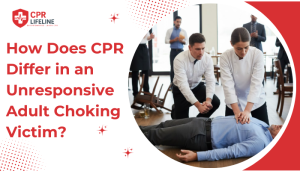
Choking is a serious emergency that can happen to anyone at any time. It occurs when a foreign object blocks the airway, preventing oxygen from reaching the lungs. If the obstruction is not removed quickly, the person may become unresponsive, placing their life at immediate risk. Prompt recognition and immediate action are critical to preventing severe brain injury or death.
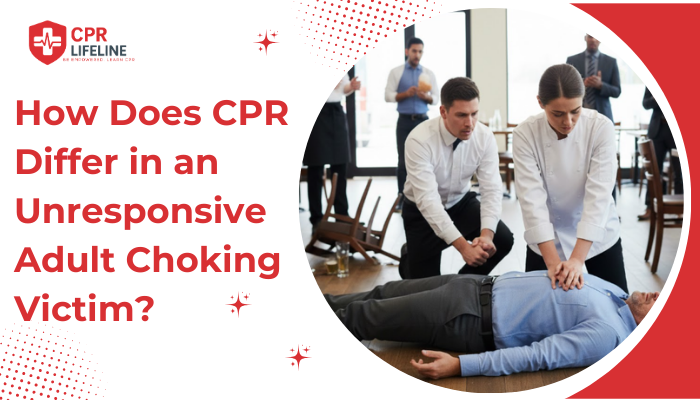
When someone becomes unresponsive due to choking, bystanders must begin CPR right away. However, CPR for a choking victim is slightly different from standard CPR. In addition to chest compressions and rescue breaths, rescuers must check the mouth for a visible obstruction after each set of compressions before attempting breaths. The primary goal is to help clear the airway while maintaining circulation so oxygen can continue reaching the brain and other vital organs.
In this blog, we’ll explain the key differences between standard adult CPR and CPR for an unresponsive choking victim, how to properly perform CPR in a choking emergency, how to assess airway obstruction, when to use the Heimlich maneuver, and common mistakes to avoid during choking emergencies.
What Happens When an Adult Choking Victim Becomes Unresponsive?
When an adult choking victim becomes unresponsive, it means the airway obstruction has prevented enough oxygen from reaching the brain. Without oxygen, brain cells begin to die within 4–6 minutes. The person can no longer cough, speak, or signal for help, and their body may go limp as consciousness is lost.
At this stage:
- Back blows and Abdominal thrusts are no longer appropriate
- The situation becomes serious life-threatening medical emergency
- CPR must begin immediately
CPR is initiated right away to maintain circulation to the brain and vital organs while chest compressions create pressure that may help dislodge the airway obstruction. Immediate action significantly increases the chances of survival and reduces the risk of permanent brain damage.
How Does CPR for Choking Differ from Standard CPR?
CPR for a choking victim differs because the airway is blocked, not just the heart. Rescue breaths alone won’t reach the lungs until the obstruction is removed, so chest compressions are prioritized to maintain blood flow, and the mouth should be checked regularly for any visible object before attempting breaths.
Below are some of the key differences in how standard adult CPR is different from unresponsive choking CPR
| Aspect | Standard Adult CPR | Unresponsive Choking CPR |
|---|---|---|
| Airway Assessment | Open airway once after each set of 30 compressions | Check mouth for visible objects after each compression cycle |
| Compression Priority | Equal emphasis with rescue breaths | Compressions prioritized over rescue breath as it help circulate blood and may dislodge object |
| Breathing Technique | 2 breaths per 30 compressions (expect chest rise) | Breaths are given after checking the mouth for obstruction. If the chest doesn’t rise, reposition and try another breath. Then continue compressions |
| Object Removal | Not applicable | Remove visible objects carefully between cycles |
| Success Indicators | Return of pulse, normal breathing, signs of life | airway clearance (object expelled), Return of consciousness, effective breathing |
1. Airway Assessment
In Standard CPR, the airway is assumed open and only requires proper head positioning (head-tilt/chin-lift) after each set of 30 compressions to allow rescue breaths. Whereas in unresponsive choking CPR, a quick visual check of the mouth for visible objects after every 30 compressions is required, before attempting rescue breaths. This repeated assessment helps determine if the airway has cleared enough for effective ventilation and allows safe removal of any easily visible foreign body.
2. Compression Priority
During Standard CPR, chest compressions and rescue breaths are given equal emphasis in the 30:2 cycle to maintain circulation and oxygenation. However, in unresponsive choking CPR, compressions are prioritized over rescue breaths as the primary focus is to create pressure to dislodge the obstruction while keeping blood flow to the brain and vital organs.
3. Breathing Technique
In Standard CPR, 2 rescue breaths are delivered after every 30 compressions regardless of the airway status. In unresponsive choking CPR, you attempt 2 rescue breaths only if the airway appears clear after the checking for visible objects. If the airway still remains blocked, skip the breaths and continue with compressions immediately without delaying the cycle to avoid forcing the obstruction deeper.
4. Object Removal
Object removal is not the priority in standard CPR as the focus is cardiac resuscitation and restoring normal heart rhythm. In unresponsive choking CPR, object removal becomes the primary focus throughout the process, with rescuers checking visible blockages after every 30 compressions and breath attempts until cleared or EMS arrives, per AHA protocols.
5. Success Indicators
In Standard CPR, success is indicated by return of a pulse, resumption of normal breathing, or other signs of life (purposeful movement, response to voice). In unresponsive choking CPR, success is shown by the victim regaining consciousness, complete airway clearance, (often with the object expelled), and effective spontaneous breathing returning. These signs confirm the obstruction has been resolved and oxygenation is restored.
How to Perform CPR on an Unresponsive Adult Choking Victim?
When a choking victim becomes unresponsive, CPR must be performed immediately to maintain circulation and attempt to clear the airway. The steps should focus on chest compressions, checking for visible obstructions, and delivering rescue breaths when possible.
Below are the key steps bystanders should follow when performing CPR on an unresponsive adult choking victim during an emergency:
1. Assess Scene Safety and Call for Help
Ensure scene safety before approaching an unresponsive choking victim by quickly checking for hazards such as traffic, fire, electrical wires, or slippery surfaces. It is crucial to protect yourself first, if you become a victim, you cannot help anyone else. Only move the person if the area poses an immediate danger.
Once the scene is safe, call 911 immediately, or instruct someone nearby to do so, and have an AED brought to the scene if available. This ensures professional help is on the way while you begin life-saving interventions.
2. Position the Victim
After ensuring the scene is safe and help is on the way, carefully position the unresponsive choking victim on their back on a firm, flat surface. Support the head and neck as you lower them to prevent injury. Proper positioning is essential for effective chest compressions and to allow airway management during CPR. Make sure the victim’s body is straight, with arms at their sides, so you can perform compressions efficiently and safely.
3. Begin Chest Compressions
With the victim on a firm surface and help on the way, you should begin CPR immediately. Deliver 30 high-quality chest compressions by placing the heel of one hand on the center of the chest over the lower half of the breastbone, with the other hand on top. Keep your elbows locked and shoulders directly above your hands. Compress the chest at least 2 inches but no more than 2.4 inches at a rate of 100–120 compressions per minute, allowing full chest recoil between compressions.
High-quality compressions serve a dual purpose in unresponsive choking victims. They maintain critical blood flow to the brain and vital organs while simultaneously building internal pressure that may help dislodge the airway obstruction. Even though the airway remains blocked initially, proper chest compressions continue to circulate what oxygen remains in the bloodstream, providing the victim with time for additional interventions to succeed. This makes consistent, uninterrupted compressions the single most important intervention in choking-related cardiac arrest.
4. Open the Airway and Check for Visible Obstructions
After completing 30 compressions, open the victim’s airway using the head-tilt/chin-lift technique, then quickly look inside the mouth for any visible foreign object. If you can clearly see an obstruction, such as food or another object, carefully remove it with your fingers using a sweeping motion. Only remove objects you can see, never perform blind finger sweeps, as this can push the obstruction deeper or cause throat injury.
If no object is visible, proceed immediately to attempt rescue breaths. This brief airway check after each compression cycle is critical in choking victims, as the pressure from chest compressions may have dislodged the obstruction enough to make it visible and removable, potentially restoring the airway before EMS arrives.
5. Attempt Rescue Breaths
If the airway appears clear or no obstruction is visible, attempt 2 rescue breaths by pinching the victim’s nose shut, making a complete seal over their mouth with yours, and giving each breath over 1 second while watching for the chest to rise. If the chest rises with your breaths, the airway is at least partially open, continue with the next cycle of 30 compressions followed by 2 breaths.
However, if your breaths do not cause the chest to rise, the airway remains blocked. In this case, reposition the head to ensure proper airway alignment and attempt one more breath. If the chest still does not rise after repositioning, do not waste time on additional breath attempts, immediately return to chest compressions. Remember that compressions alone can still circulate oxygen and may help clear the obstruction, whereas repeated unsuccessful breath attempts only delay life-saving compressions.
6. Continue CPR Cycles Until Help Arrives or the Victim Recovers
Continue performing CPR cycles of 30 chest compressions followed by airway checks and 2 rescue breath attempts until one of the following occurs: emergency medical services (EMS) arrive and take over care, the victim begins breathing normally and shows signs of consciousness, or you become too exhausted to continue safely and another trained rescuer can take over.
During each cycle, maintain high-quality compressions with minimal interruptions and check the mouth for visible obstructions before attempting breaths. If the object becomes visible at any point, remove it carefully and continue CPR. Do not stop CPR prematurely, even if the victim does not immediately respond, as successful airway clearance and recovery can occur after several minutes of consistent effort. Your continued actions provide the victim with the best possible chance of survival until advanced medical help arrives.
How to Assess Whether a Choking Victim is Conscious or Unconscious?
Determining whether a choking victim is conscious or unconscious directly impacts which life-saving technique you should use. Conscious choking victims require the Heimlich maneuver (abdominal thrusts), while unconscious victims require immediate CPR. Making the wrong choice can waste precious seconds or even cause harm.
Heimlich Maneuver: For Conscious Choking Victims
The Heimlich maneuver, also known as abdominal thrusts, is the primary intervention for conscious adult choking victims with a complete airway obstruction. This technique works by creating sudden upward pressure beneath the diaphragm, forcing air from the lungs upward through the trachea with enough force to expel the obstruction.
When to Use the Heimlich Maneuver?
Use repeated cycles of 5 back blows followed by 5 abdominal thrusts when you observe the following signs in a conscious victim with severe choking.
- The universal choking sign – The person clutches their throat with one or both hands, signaling they cannot breathe.
- Inability to speak – When you ask “Are you choking?” the person cannot verbally respond but may nod their head yes.
- Silent or weak coughing – The person attempts to cough but produces no sound or only weak, ineffective coughs with no air movement.
- Inability to breathe – No air is moving in or out, though the person may be making exaggerated breathing efforts.
- High-pitched sounds or no sound – You may hear a high-pitched wheeze (stridor) or complete silence despite visible breathing attempts.
- Obvious distress and panic – The person shows extreme anxiety, wide eyes, and frantic gestures indicating they’re in severe respiratory distress.
- Cyanosis begins to develop – The face, lips, or fingernails may start turning bluish due to oxygen deprivation.
Critically, all of these signs occur while the person is still conscious, alert, and able to stand or sit upright. This conscious state is what makes the Heimlich maneuver both possible and effective.
Adult CPR: For Unconscious Choking Victims
Adult CPR becomes the appropriate intervention the moment a choking victim loses consciousness. This represents a critical transition point that many rescuers miss or delay, often with serious consequences.
When to Transition from Heimlich Maneuver to Adult CPR
You must immediately switch from abdominal thrusts to adult CPR when the choking victim:
- Becomes unresponsive – The person stops responding to your voice or touch and cannot be awakened.
- Collapses or goes limp – The person’s body goes slack and they begin to fall or slump over.
- Loses consciousness – The eyes close, the body becomes unresponsive, and the person cannot maintain an upright position.
- Stops breathing or gasps – Normal breathing stops, replaced by either no breathing at all or occasional gasping (agonal respirations).
This transition often happens suddenly, a conscious choking victim can lose consciousness within 1-2 minutes if the obstruction is not cleared, as oxygen deprivation rapidly affects brain function
Common Mistakes to Avoid During CPR for Unresponsive Adult Choking Victims
When a choking adult victim loses consciousness and requires CPR, even well-intentioned rescuers can make critical errors that reduce survival chances. Understanding these common mistakes can help you respond more effectively when every second counts.
Here are some of the common mistakes you should avoid during performing CPR for unresponsive adult choking victims:
1. Performing Back Blows and Abdominal Thrusts on an Unconscious Victim
One of the most dangerous mistakes is continuing back blows and abdominal thrusts after a choking victim loses consciousness. Once unconscious, the victim should be immediately lowered to the ground, and CPR should be performed instead of back blows or the Heimlich maneuver.
Back Blows and abdominal thrusts are only effective on conscious, standing victims. On an unconscious person lying flat, they become ineffective and potentially harmful, causing internal injuries without providing the circulation needed to keep the brain alive. More critically, every second spent on ineffective thrusts is time lost from chest compressions.
2. Performing a Blind Finger Sweep
Reaching into the victim’s mouth without seeing an obstruction, called a blind finger sweep is an outdated and dangerous technique. It can push the object deeper into the airway, cause throat damage, or trigger dangerous spasms of the vocal cords.
Current guidelines are clear i.e you should only remove an object if you can clearly see it. After each cycle of 30 compressions, you should open the airway and look inside the mouth. If any foreign objects are visible, then only you should try to remove it. If not, it is important to proceed immediately to rescue breaths.
3. Inadequate or Incorrect Chest Compressions
Poor compression quality, too shallow, too slow, wrong placement, or frequent interruptions dramatically reduces CPR effectiveness. Even trained rescuers often compress too softly, underestimating the force required.
High-quality compressions are the single most important factor in CPR success. They must be at least 2 inches deep, delivered at 100-120 per minute, centered on the lower half of the breastbone, with complete chest recoil between compressions and minimal interruptions.
4. Delaying or Failing to Call 911
Some rescuers become so focused on interventions that they forget to call for help, or they hesitate thinking they should resolve the situation first. This delay can be catastrophic, as advanced medical care is essential even if you successfully clear the obstruction.
5. Giving Up Too Soon
Stopping CPR prematurely due to exhaustion, discouragement, or perceived hopelessness can cost someone their life. Successful resuscitation is possible even after extended periods when high-quality compressions are maintained.
Be Prepared to Respond to Choking Emergencies
Choking emergencies can turn fatal within seconds, making it essential to understand how to recognize airway obstruction, perform the Heimlich maneuver for conscious victims, and carry out CPR for unresponsive individuals. Knowing when and how to act can mean the difference between life and death, whether you are a healthcare professional, caregiver, teacher, or everyday bystander.
Reading about CPR is not enough. You need proper training and certification to perform CPR safely and correctly. CPR Lifeline offers flexible and comprehensive courses, including CPR & First Aid, BLS, ACLS, and PALS. These courses are suitable for beginners and healthcare professionals. Join our certified CPR course to build real skills and confidence to act in emergencies. Start your training with CPR Lifeline today. Your action now could save a life tomorrow.
Faqs
Yes, CPR can sometimes cause injuries such as rib fractures or bruising. However, these injuries are far less dangerous than untreated oxygen deprivation. Saving the person’s life is always the priority.
Yes, an AED should be used if the victim is unresponsive and not breathing normally. Even if choking caused the collapse, the heart rhythm may become abnormal, and an AED can help restore it.
Brain damage can begin within 4 to 6 minutes without oxygen. This is why immediate CPR and airway management are critical in choking emergencies.
Yes, CPR should be performed if a pregnant victim becomes unresponsive. Chest compressions remain the same, but abdominal thrusts are modified when the victim is conscious.
If the object cannot be removed, continue CPR cycles until emergency services arrive or the victim shows signs of recovery. Chest compressions can help move the obstruction.

Chris Peters
Chris Peters is a certified American Heart Association instructor and firefighter since 1996 with over 30 years of emergency response experience. After answering thousands of 911 calls, he founded CPR Lifeline to provide AHA-certified training that transforms bystanders into confident lifesavers who act decisively when seconds count