Copyright © 2025 cprlifeline. All Rights Reserved.

In a cardiac emergency, having a clear, evidence-based roadmap can mean the difference between life and death. The ACLS Algorithm provides exactly that, a systematic approach to managing the most critical cardiovascular emergencies healthcare professionals face.
The American Heart Association released updated ACLS algorithms in the latest AHA Guidelines for CPR and ECC in October 2025, incorporating evidence-based recommendations that focus on high-quality CPR techniques, advanced airway management, defibrillation strategies, team dynamics, more precise medication administration, and post-cardiac arrest care. These algorithms represent more than just flowcharts: they’re built on decades of research, clinical trials, and real-world evidence that have proven to improve patient survival rates and neurological outcomes.
ACLS algorithms are systematic evidence-based guidelines developed by the American Heart Association to guide healthcare providers through risky cardiovascular emergencies like cardiac arrest, stroke, and arrhythmias. These structured algorithms help healthcare providers emphasize high-quality CPR, rapid rhythm assessment, defibrillation, advanced airway, and medications to improve patient outcomes.
The 2025 American Heart Association (AHA) Guidelines for CPR and ECC introduce key clarifications to distinguish “breaths” (spontaneous) from “ventilations” (assisted) for training consistency and integrate real-time feedback devices for optimizing CPR quality during active resuscitation.

ACLS is used during cardiac arrest, symptomatic arrhythmias, acute coronary syndromes, stroke, and post-resuscitation care. ACLS protocols guide fast assessments and evidence-based interventions during time-critical events.
Primary ACLS Use Cases:
VF, pulseless VT, asystole, PEA
Bradycardia with hypotension, tachycardia with shock signs
STEMI, NSTEMI
Rapid neurological evaluation, reperfusion time-targets
Targeted temperature management, oxygen titration, perfusion stabilization
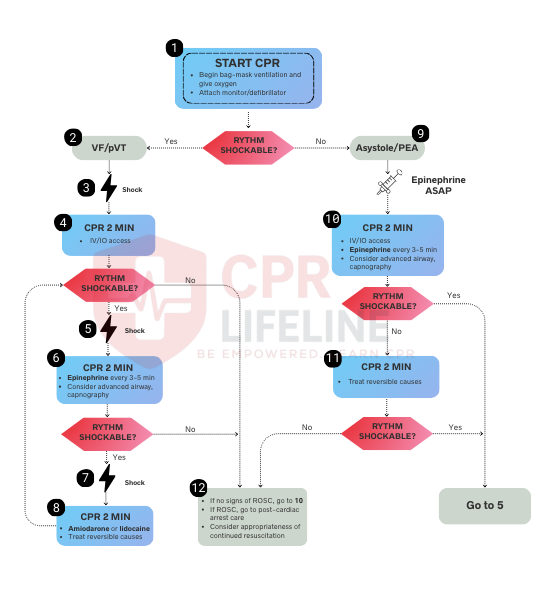
The Adult Cardiac Arrest Algorithm provides a standardized approach for managing patients in cardiac arrest, emphasizing high-quality CPR and rapid defibrillation. This algorithm is applicable to all adult patients experiencing pulseless cardiac arrest, including both shockable and non-shockable rhythms. In cases of ventricular fibrillation (VF) or pulseless ventricular tachycardia (pVT), immediate defibrillation is critical to survival.
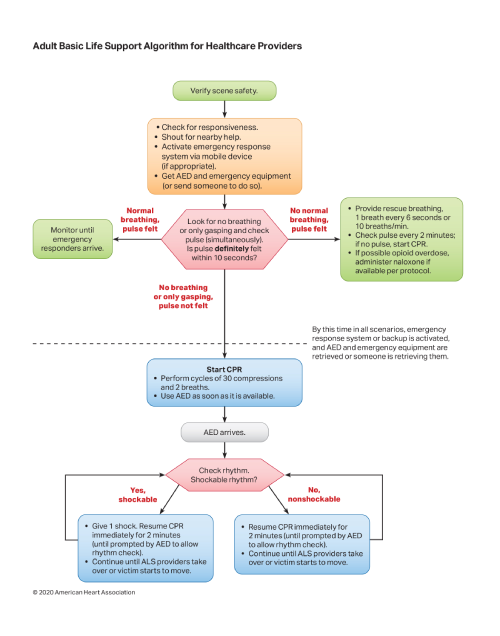
The Cardiac Arrest Circular Algorithm visualizes the continuous, cyclical process of resuscitation, integrating CPR, rhythm analysis, and interventions. This model emphasizes that care during cardiac arrest is not linear but revolves around the constant priorities of chest compressions, airway management, and identifying/treating reversible causes. The cycle continues until the ROSC is achieved.
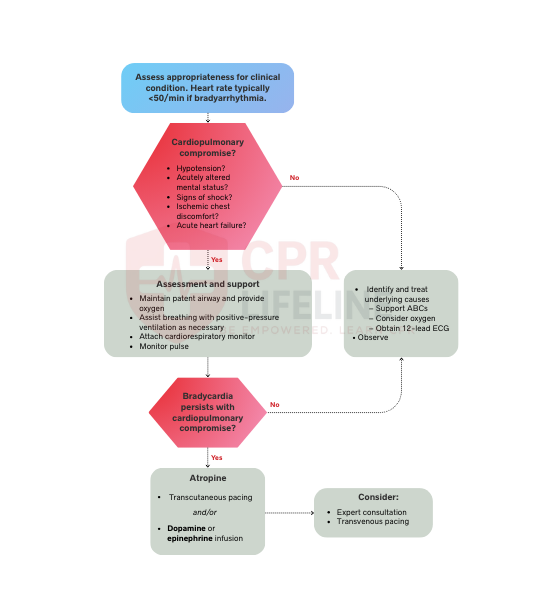
The Adult Bradycardia Algorithm guides healthcare providers to manage symptomatic bradycardia (heart rate below 50 bpm), applicable to both stable and unstable cases. In cases of 2nd heart block type II or 3rd heart block, which are critical forms of bradycardia, emergency intervention such as pacemaker placement is often required.
The adult tachycardia algorithm allows healthcare providers to manage both stable and unstable tachycardia effectively. This algorithm is used in patients with rapid heart rates (over 150 bpm) with a pulse, distinguishing narrow-complex from wide-complex rhythms and stable from unstable cases.
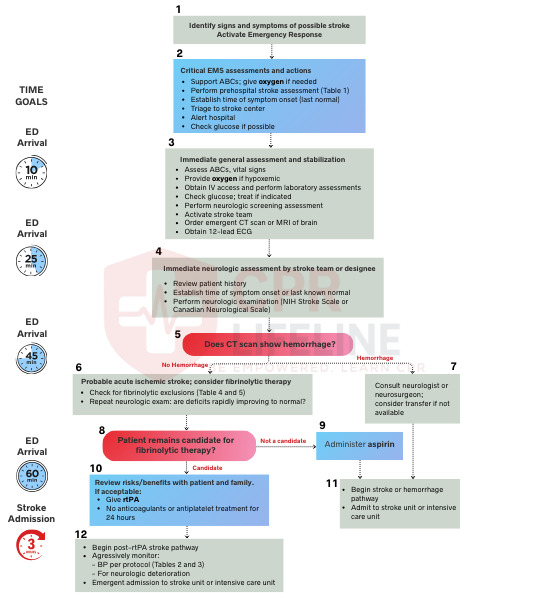
The Suspected Stroke Algorithm guides healthcare providers in rapid recognition, assessment, and acute management of suspected stroke patients. It identifies candidates for time-sensitive interventions like fibrinolytic therapy or thrombectomy. For ischemic strokes within the treatment window, emergent reperfusion therapy minimizes brain injury.
The Post-Cardiac Arrest Care Algorithm outlines the comprehensive, systematic approach to stabilizing and treating patients after the return of spontaneous circulation (ROSC). This care is critical for optimizing neurological recovery and identifying the underlying cause of arrest. In cases where a cardiac etiology is suspected, emergency coronary angiography and targeted temperature management are often required.
The Cardiac Arrest in Pregnancy Algorithm offers a modified approach for managing cardiac arrest in pregnant patients, addressing unique physiological changes and reversible causes. This algorithm emphasizes the importance of simultaneous interventions for both the mother and the fetus. In cases of maternal cardiac arrest, immediate left uterine displacement and preparation for perimortem cesarean delivery are often required.
The AHA ACLS Guidelines released in 2025, refine protocols based on the latest resuscitation science to improve survival rates and team performance during cardiac emergencies. These updates emphasize high-quality CPR, precise interventions, and human factors in high-stress scenarios. Here are the most impactful changes:
Adult cardiac arrest algorithms have been modified to minimize interruptions in chest compressions and early defibrillation for shockable rhythms. Also, the epinephrine administration timing, increased use of capnography to assess CPR quality and return of spontaneous circulation (ROSC), and improved care following the arrest are also included.
Recent updates enhance the management of advanced airway usage, ventilation rates, and strategies to prevent hyperventilation. Bradycardia and tachycardia algorithms refine pharmacologic escalation, pacing initiation, and cardioversion timing for stable versus unstable rhythms.
The important update on the 2025 Guidelines is their emphasis on human performance during resuscitation. The improvements include a stronger focus on closed-loop communication, team leader roles, and crew resource management to reduce errors. This refinement enables the team to provide smoother, safer, and more efficient care during cardiac arrests.
Medication timing for epinephrine, amiodarone, and others is clarified with evidence-based pathways in the recent update. Courses now integrate updated megacodes, feedback tools, and simulation for real-world readiness.
The systematic approach to ACLS provides a structured framework for managing cardiac emergencies, prioritizing rapid assessment, high-quality CPR, and reversible cause identification per AHA 2025 guidelines.
During any cardiac arrest, systematically evaluating for reversible causes can dramatically impact survival. The H’s and T’s provide a memorable framework for this critical assessment:


ACLS certification requires active BLS certification and fundamental ECG and pharmacology knowledge. The certification validates your ability to apply algorithms in real emergencies.
The ACLS algorithm turns decades of evidence into clear actions that improve survival during cardiac emergencies. The 2025 AHA updates refines every step of care, from the first compression to advanced post-arrest management. Mastering these protocols equips you to respond quickly, confidently, and effectively when seconds count.
Support Available
Passed rate
Certified Students
The ACLS Algorithm is a set of evidence-based, step-by-step guidelines developed by the American Heart Association to help healthcare providers manage serious cardiac emergencies including cardiac arrest, stroke, and dangerous arrhythmias. These visual flowcharts ensure quick, effective, and standardized emergency care across all medical settings.
ABC refers to Airway, Breathing, and Circulation: the foundational assessment sequence used in emergency care. Healthcare providers use this systematic approach to prioritize interventions: first ensuring the airway is open, then confirming adequate breathing/ventilation, and finally assessing circulation and perfusion.
The primary ACLS medications include epinephrine (for all cardiac arrest rhythms), amiodarone or lidocaine (for refractory VF/pVT), atropine (for symptomatic bradycardia), and adenosine (for narrow-complex tachycardias).
ACLS training is essential for physicians, nurses, paramedics, respiratory therapists, and other healthcare professionals who respond to cardiac emergencies. It’s required for emergency department staff, intensive care unit personnel, cardiac care unit workers, and prehospital emergency medical services providers.
The 2025 guidelines refined epinephrine timing for non-shockable rhythms, expanded guidance on supraglottic airway devices, enhanced termination of resuscitation criteria, and emphasized real-time CPR feedback devices. Team dynamics and post-resuscitation care protocols also received significant updates to improve patient outcomes.
Home | About Us | Classes | Locations | Blogs | ACLs – Algorithm | FAQ’s | Group Training | Contact Us
Copyright © 2025 cprlifeline. All Rights Reserved.
#1. Select your Course, Location and Time
#2. Complete the AHA Online Training
#3. Perform the hands on skills check
#4. CONGRATS! You are certified!